Skip to main content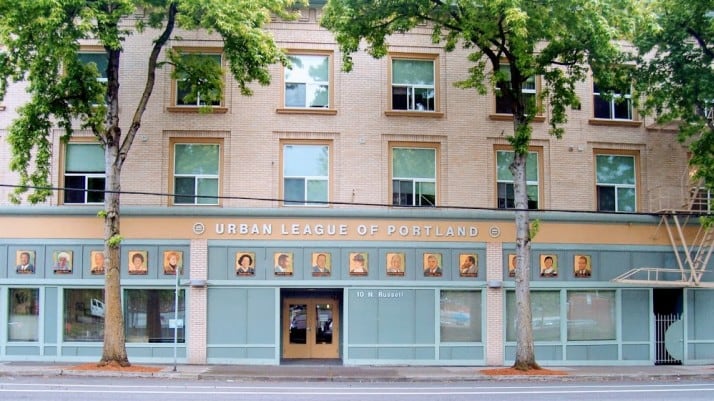
During its annual Martin Luther King, Jr. Day brunch on Jan. 19, the Urban League of Portland announced that last year it had vacated its longtime headquarters in the Eliot neighborhood because the building had become uninhabitable.
“This is the first time we are publicly acknowledging that the Urban League of Portland is no longer able to operate out of Urban Plaza—and it’s heartbreaking to say out loud,” Mike Schmidt, Urban League’s general counsel, told attendees. “After four decades of uninterrupted services, that continuity came to an end in 2025 when the building became uninhabitable due to severe disrepair.”
The Urban League, a nonprofit that provides housing and services primarily to Black people in North and Northeast Portland, left the office space on the first floor of the building at 10 N Russell Street in early 2025. Around that same time, it began whittling down the number of services it was offering out of the Urban Plaza due to concerns about the building’s condition and security concerns, including break-ins.
What Schmidt did not address at the annual brunch was the underlying tension: that the building itself is owned by another historically Black-run nonprofit, Portland Community Reinvestment Initiatives, and that for years the Urban League has sought to regain ownership of the building.
The Urban League purchased Urban Plaza, the longtime home of its office and services for decades prior, in 1985. But the Urban League entered financial distress in the early 2000s, and PCRI in 2006 agreed to buy the building from Urban League to save it from lender re-possession. PCRI allowed Urban League to stay in the building, and once Urban League regained its financial footing, the nonprofit began paying rent to PCRI for the office spaces. Meanwhile, PCRI managed the 24 affordable apartments in the building’s top floors and rented to low-income tenants.
In 2024, due to the building falling into disrepair, PCRI moved out all of the apartment tenants. Schmidt tells WW that the building at that point had become uninhabitable to Urban League’s employees, too; it suffered flooding, pest infestations, squatters moving into the vacant apartments, theft and occasional break-ins.
The two nonprofits disagree about what sale discussions took place in recent years, and the details of those discussions.
PCRI’s general counsel, Ernest Warren, says PCRI offered to sell the building to Urban League in 2024 for between $2 and $3 million and that Urban League counter-offered with “about half a million.” He says the PCRI board swiftly shot it down. “You shouldn’t disrespect the hand that fed you,” he says.
Schmidt says Warren’s account is inaccurate. He says that, in fact, PCRI in early 2023 offered to sell the building for $3.6 million, which Urban League shot down.
“We were prepared then and now to pay $2 million,” Schmidt says, “roughly equal to what the asset is appraised at.”
Schmidt, who became the Urban League’s general counsel after a single term as Multnomah County district attorney, provided a drafted sale agreement between the two nonprofits dated March 2021 that shows the Urban League offered $2.1 million for the building nearly five years ago. (Those talks also fell through.) He also provided a 2023 appraisal, commissioned by the Urban League, that valued the building at just over $2 million. Another appraisal commissioned by PCRI in September 2022 valued the building at $2.4 million.
Underpinning all of this is a fundamental disagreement over what had been agreed upon two decades earlier between the two nonprofits when PCRI came to the Urban League’s aid.
It was always Urban League’s understanding, Schmidt tells WW, that PCRI would transfer the building back when Urban League achieved financial stability. “The parties had a good-faith, informal understanding—often described as a handshake agreement—that Urban Plaza would ultimately return to Urban League once the organization regained stable financial footing," Schmidt says.
Warren says that’s a “mischaracterization,” though he concedes that it was always the hope of PCRI’s former executive director, Maxine Fitzpatrick, that the Urban League would eventually regain ownership.
“I know under corporate law that Maxine does not have the power to make that call. That call has to be made by the board of directors, ” Warren says. “It has to be proposed in a written resolution, studied and voted on.”
In summer of 2025, the two nonprofits agreed to enter mediation. The two entities both say it was the other one that unexplainably backed out of mediation just weeks before it was set to begin. After that, talks stalled.
Warren says he doesn’t understand how the two nonprofits’ relationship “regressed into something that was so acrimonious,” and says that, at least from his point of view, “the door is always open” for a sale.
Now, Urban League appears to be taking their frustration about the building semi-public.
“We want to be back in our historic home,” Schmidt said at the brunch, “but there are currently no funded plans in place to renovate and reopen the building.”
Schmidt tells WW that if Urban League were to regain ownership of the building, “the goal would be to reopen again as soon as we could in order to resume serving the public in that location,” including rehabbing the affordable apartments.