Skip to main content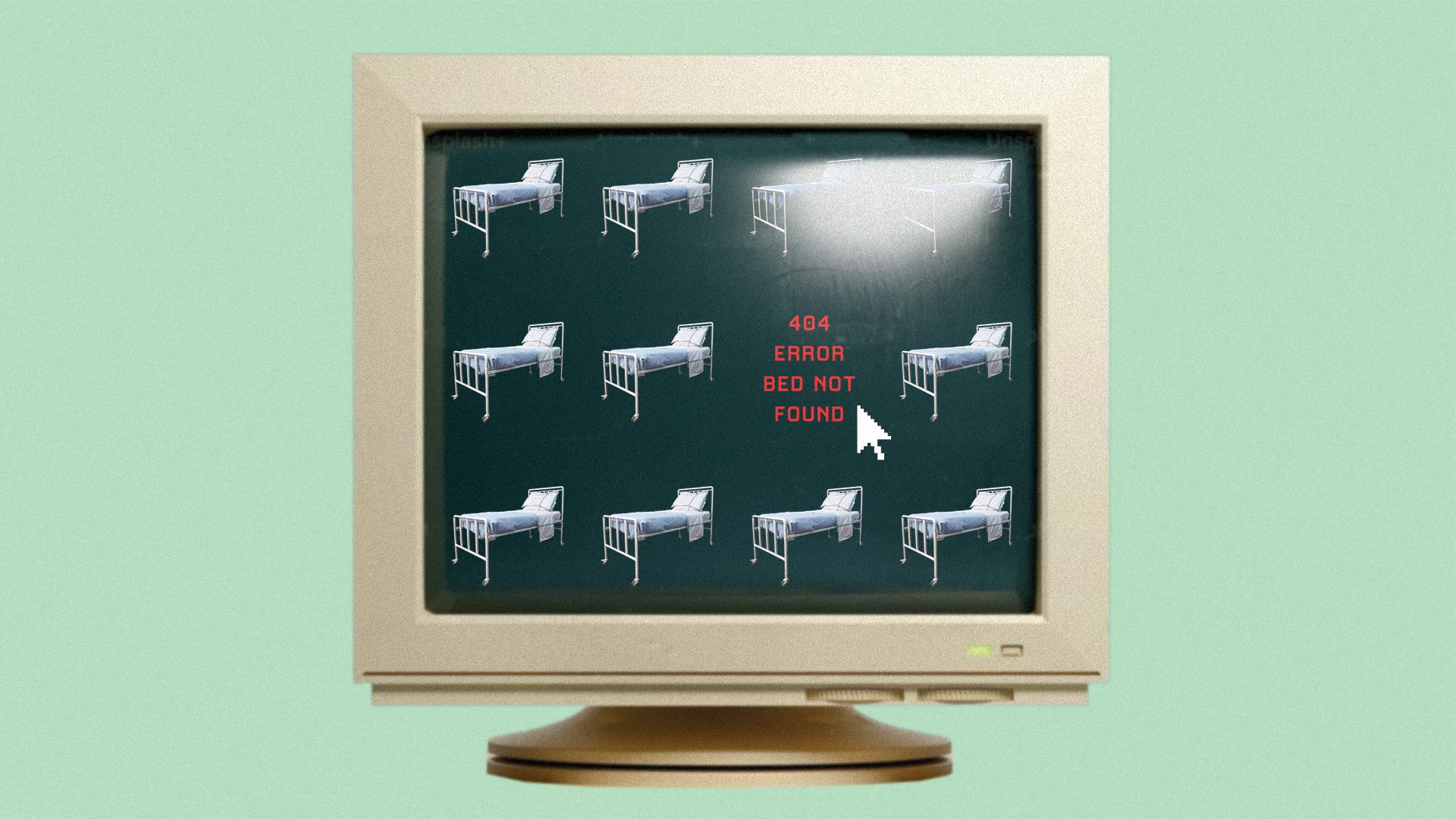
From an office at Oregon Health & Science University named Mission Control, a team has sought to fashion a nervous system linking hundreds of mental health and addiction treatment providers across the state.
Few doubt the concept is worthy: A registry tracking real-time bed capacity data in behavioral health facilities around Oregon should make it easier to get acutely ill patients the care they need—and identify choke points in the system.
And yet, millions of public dollars in, the Oregon Behavioral Health Coordination Center has, judging by its own numbers, coordinated very little actual behavioral health care at all.
The project got its first funding in 2022, launched in 2023, and opened its call center inside Mission Control in July 2024. In the 16 months between then and December 2025, it reported about 30 “activations”—instances in which someone, like a psychiatrist, used the coordination center to try to match a patient with a bed.
In a state with thousands of residential treatment beds, this pencils out to just over two such activations per month.
To be fair, the underwhelming monthly average masks a sharp uptick that began this past fall, when the OBCC said it started expanding outreach efforts. Meanwhile, its leaders say, their primary focus in these initial years has been on building out their real-time bed census database—not coordinating placements.
Judging the activation data on its own terms at this point, they say, would be like tracking traffic on a road that is not yet complete. And, with the state putting more of its weight behind them in recent weeks, OBCC leaders have high hopes of completing an initial phase of their project—integrating with every residential behavioral health provider in the state—within a year.
Still, from another perspective, the figures look even worse: Only a subset of the 30 activations actually resulted in a patient getting placed into care. And a report to lawmakers in December found the OBCC was hampered by basic flaws and had so far generated new administrative burdens but “little utility” for the state behavioral health system—uninspiring words for a project that had cost taxpayers on the order of $7 million thus far.
Put most harshly, that comes out to something like $200,000 per activation.
OHSU rejects this framing, arguing it’s a stupid way to characterize the benefit of a system that has already managed to unify census data for half of the state’s behavioral health beds, and is charging hard to build out its coverage further. “I don’t know how many more ways we can explain that the OBCC tool is not finished and activations are not the purpose at this point,” university spokeswoman Sara Hottman says.
Still, some remain unimpressed. Asked about the OBCC activation data, Heather Jefferis, executive director of Oregon Council for Behavioral Health, tells WW, “That doesn’t seem like great performance to me.”
The Mission Control model emerged in the world of physical health care. In the pandemic era, the OHSU program integrated with hospitals statewide to create a real-time registry of inpatient beds—the idea being to better track and move patients around a bursting system.
According to Dr. Matthias Merkel, a leader at Mission Control, lawmakers asked OHSU to do something similar for behavioral health care. “It’s a substantially more complex space than the hospital space,” Merkel tells WW. “And we knew that.”
Hospitals range in size and scope, but they operate on the basis of similar technologies and categories of care. In comparison, behavioral health providers tend to be smaller, lower tech and eclectic. Seemingly identical bed types are described in different terms. Continuums of care are less straightforward. In short, this was an unruly system that defies the data scientist’s imperative to put things in boxes.
Jefferis, of the council for behavioral health, welcomes a functioning census. “When people need this service, it’s important for all of the system partners to be able to know where to refer to in their community,” she says. But, she adds, the technology necessary to submit real-time data is currently inaccessible to many providers.
Meanwhile, the database has lacked basic information, like gender tags on beds, that are essential to actually placing the patient.
OBCC staffers tell WW they did not include this information in their database because providers expressed concerns about patient privacy, but they have made changes to allow such information to be tied to beds in the future. Jefferis says she doesn’t know who gave the OBCC the idea that they should not include gender and other details. “I’m sure somebody must have told them,” she says, “but I have no idea where that came from.”
Different treatment programs, she explains, take different patients based on their clinical needs. Some are specific to gender, or older adults, or those who are medically fragile. “Having some kind of ability to ensure that you’re referring the proper patient to the proper setting is really important,” Jefferis says.
She adds, “I think there’s a lot of room for much more communication.”
Mission Control wasn’t the first such census effort. As the OBCC team did its work, hundreds of behavioral health providers were already submitting capacity information to a separate system, which was produced with far less money.
Lines for Life, a Portland nonprofit, gets thousands of calls a year and functions for many as what amounts to the front door to addiction treatment. Since 2020, it’s been developing a side project with the Oregon Health Authority called the Behavioral Health Provider Directory, which costs between $100,000 and $150,000 annually, says Lines for Life CEO Dwight Holton.
The directory includes a web-based search tool through which anyone can look up treatment options—filtering by county, need, gender, insurer type, and other variables. The search results are shaped by back-end capacity data, which is viewable by health care providers and care managers.
In a report last year, the Lines for Life directory said it drew weekly census data from 217 residential mental health and substance abuse treatment providers. For context, OHSU says it has gotten more than 250 providers in its own real-time database.
State Sen. Lisa Reynolds (D-Portland) heralded the Lines for Life service as an “amazing resource” at an April 2025 hearing of the Senate’s behavioral health committee. Still, as presenters told her and other lawmakers then, they had a long way to go.
One big challenge was getting all the providers in the state to report their capacity information in the first place. The mental health side was more game, but providers of substance use disorder treatment “don’t actually need advertising because people are knocking down your door,” Holton told the committee, speculating why it was so hard to get them on board. Plus, he said, providers already had lots of reporting duties, and did not seem enthused by the idea of another.
In that committee hearing, Holton sketched out “the dream.” One day there would be an electronic integrated system that even the smaller providers—residential and nonresidential both—could plug into. Until then, he said, many providers are “not going to have the capacity” to be on an electronically integrated database.
It remains unclear when that dream might be realized. The idea is wonderful, but “we’re a long way off,” Holton tells WW. For now, he says, he would like to see the Lines for Life database integrate with OHSU’s.
The two registries have some redundant aspects, but Holton told lawmakers at the hearing that they were largely complementary. Mission Control is more focused on high-acuity residential treatment and has no plans to track the nonresidential side. Whereas Lines for Life seems oriented in large part toward the public seeking care, the OBCC has no public-facing dashboard and seems designed for medical providers—like a psychiatrist at an overcrowded hospital looking to refer out a patient in a mental health crisis.
Meanwhile, whereas Lines for Life draws on weekly reports, the OHSU project seeks daily, and ideally, real-time information that could one day allow rigorous scientific analysis of the system. This is tricky. “The goal is to automate it for everyone,” Merkel says, but currently, OBCC says about half of the providers that send it data do so manually. And, again, many providers don’t send data at all right now.
For now, instead of integrating the databases, the state appears to be drawing clearer lines between them. In a Jan. 14 memo, the Oregon Health Authority ordered all residential mental health and drug treatment operators to start sending their bed capacity information to the OBCC within weeks. While nonresidential treatment providers would continue to submit bed census information to Lines for Life, residential providers would not.
“Starting May 1, 2026, Lines for Life will focus exclusively on outpatient mental health and substance use disorder providers, while OBCC will manage inpatient/residential and withdrawal management capacity in real time,” the OHA says in a statement. The agency said no one was available for an interview.