Skip to main content
Emily Horton has been churning through therapists lately—and not by choice, or because her weekly sessions were uncommonly challenging.
Instead, the disruption is happening because her public health insurance plan is no longer willing to pay the mental health providers she wants to see.
It was not always this way. In the booming telehealth landscape of pandemic 2020, therapists seemed suddenly to abound, and soon she and hers were meeting regularly.
It was about a year ago that her troubles began.
Horton, 33, says she’s been diagnosed with anxiety, obsessive compulsive disorder and depression. She takes her mental health care seriously, seeing it as a precondition for showing up for her friends, family, and the kids she nannies.
But one day last year, in the Southeast Portland office of her therapist, with tea and paintings all around—she’d long ago begun attending the sessions in person—her therapist revealed disturbing news: She would soon lose the ability to bill CareOregon, the Medicaid administrator that manages Horton’s Oregon Health Plan benefits. And since Horton doubted she could pay out of pocket, this meant the two could no longer keep meeting for an hour a week.
Horton felt destabilized losing a therapist who had formed such a deep well of foundational knowledge about her, but she liked the new provider with whom her therapist soon linked her. In time, Horton opened up, but she never fully shook off her wariness. With good reason, it would turn out. In a session this past July, her new therapist dropped the news: As of mid-September, she wouldn’t be able to bill the Oregon Health Plan either.
“She told me she will do whatever she can to help me find a therapist—or figure out what I want to do next,” Horton recalls. “And then we talked about how I felt about it, which was awful.”
After a lightning pandemic-era expansion, a creaking retraction has been under way in certain realms of Oregon’s behavioral health care ecosystem, forcing disruptive experiences like Horton’s—and raising knotted questions about what therapy is for, how it should be administered, and to whom, especially when the government, rather than the patient, is buying.
The proximate reason Horton lost access to her first therapist has been well documented. CareOregon, the largest contractor administering the Oregon Health Plan, abruptly announced last summer it would cut off all payments to providers that weren’t in its network.
The proximate reason Horton lost access to her second therapist has not been as well documented. CareOregon sent letters to dozens of in-network providers this year terminating their contracts. (Notably, Horton says CareOregon also cut off a third therapist she had seen when her first one was on maternity leave.)
Some say this is all happening far too fast, and seems likely to undermine vulnerable patients’ mental health. Others, however, see the moves as part of a needed corrective to contain a treatment area that some providers have taken too far.
Between 2020 and 2025, according to the Oregon All Payer All Claims database, the number of standard hourlong outpatient psychotherapy sessions billed to the Oregon Medicaid system leapt more than threefold, from 608,626 to 2.2 million.
Factoring in growing OHP membership, that’s a 160% increase per capita in talk therapy claims in five years. Go back a decade, and the per capita increase is roughly 460%.
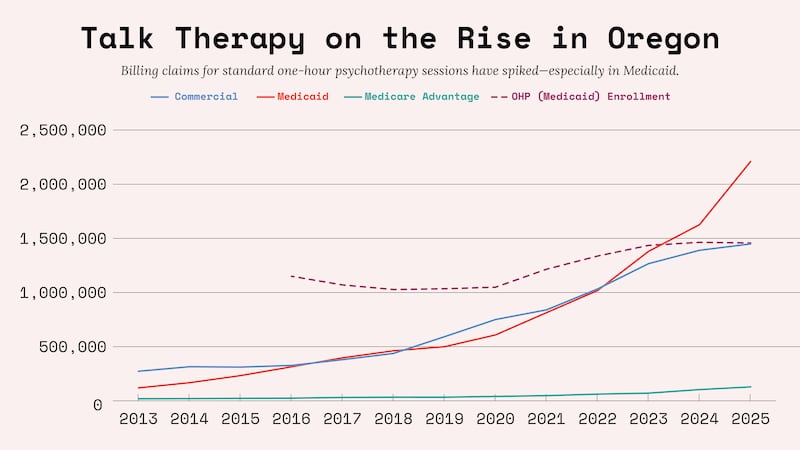
One major issue is a concept called “utilization”—how often and for how long patients attend therapy. The question is, how much therapy is too much?
Some see good occasions to offer it quite a bit. “Working with people on Medicaid and working with the LGBTQ community, we’re experiencing a lot of clients that have tons of stuff going on, who are experiencing oppression, who are experiencing chronic stress,” says Emelie Douglas, the CEO of Sprout Therapy PDX, one of the larger practices to have received a contract termination notice from CareOregon lately. (She says the practice has a certificate of approval—basically a quality endorsement from the Oregon Health Authority—as well as a separate designation indicating it is particularly well equipped to serve the queer population.) Douglas says Sprout Therapy PDX follows medical necessity guidelines, but adds, “Utilization for those communities is going to be higher than [for] your average client.”
CareOregon, for its part, maintains it is engaged simply in routine network management. But new priorities are clearly at play here. Beyond its new insistence on reimbursing only in-network providers, the insurer wants to “work with the providers that are managing utilization in a way that we think is clinically efficient,” Jeremiah Rigsby, CareOregon’s chief legal & public affairs officer, tells WW. “Coming out of the pandemic, we were trying to get as much access out there as possible. Now we’re really trying to get and work with providers that are in line with our standards of quality.”
Told of this, Horton retorts that she was perfectly happy with the quality of her therapists, and says they had reassured her, time and again, that there was no one right way to use their services. “It’s always been like, ‘If you, the client, feel you need therapy, then you should access therapy,’” she says.
Providing mental health care for people who cannot afford to purchase it themselves has traditionally been the work of the Community Mental Health Program. The most well-known CMHP providers are “big box” operators like Cascadia Heath or Central City Concern, which manage an array of services, often through large government contracts, to treat the state’s most acutely (and, often, conspicuously) drug-addicted and mentally ill.
In recent years, private practices have increasingly elbowed into some of this work. Though many private providers note the severe challenges their clients face, these businesses tend to offer talk therapy and its therapeutic ilk to a less acutely ill clientele.
A series of policy decisions over the past decade made it far easier for a wider range of therapists, including those early in their careers, to get paid by the Oregon Health Plan. The stated idea was to increase access—an imperative seen as particularly pressing during the pandemic and its aftermath. The largest plan administrator, CareOregon, “threw open its panel and basically said, ‘Any willing provider, we’ll pay,’” recalls Chris Bouneff, executive director of the mental health patient advocacy group NAMI Oregon.
Also during the pandemic, Oregon lawmakers enhanced behavioral health provider rates by a muscular 30%, making it suddenly far more appealing to work with and get paid through Medicaid.
“That 30% increase was a lifesaver,” says Julie Ibrahim, CEO of the community mental health organization New Narrative and a board member of the Tri-County Behavioral Health Providers Association.
But the cash infusion and the lower barriers to entry reshaped the behavioral health care system in unexpected ways.
The outcome has been documented in many a postmortem government analysis: Utilization went way up for mental health care, particularly in outpatient settings like psychotherapy. So did spending. According to the Oregon Health Authority, the proportion of Oregon Medicaid spending on behavioral health between 2018 and 2026 jumped from 12% to 20%—the equivalent of hundreds of millions of additional dollars flowing into services spanning from residential drug treatment to weekly talk therapy sessions.
From a certain perspective, the state achieved its goals of trying to get people into behavioral health care, says Rigsby of CareOregon. “We wanted to keep behavioral health clinics alive, wanted to grow the workforce, we wanted people to have access.” But it put massive pressure on the budgets of Medicaid administrators—and the state that feeds them. Many underestimated how much demand would expand to take advantage of the new provider options, Rigsby says. And “the size of the demand just does not match the resources we have as a state.”
Bouneff, the mental health advocate, says it’s a “pervasive thought” among Medicaid administrators in Oregon that some providers and patients—the “worried well”—are overutilizing, billing weekly hourlong sessions with no clear goal, when in fact a key goal of behavioral health treatment is that it should end.
Like others in the behavioral health world, he’s wary of this critique. Mental health disorders did in fact spike during the pandemic, he says; commercial insurers also spent more in this domain. And there is something perverse about the fact that, in a state that chronically underfunded behavioral health care for years, therapists are suddenly “being blamed for overspending in Medicaid.”
He doubts physical health care would get the same scrutiny. Still, he says, as in physical care, episodes of behavioral health care should generally end—with the understanding that you can always come back.
Executive director Heather Jefferis of the Oregon Council on Behavioral Health agrees. “The job of therapy is to help you stop going to therapy,” she says.
The state is undergoing a reset, reinstituting barriers to billing the Oregon Health Plan, reflecting a consensus among health system leaders that in some cases outpatient psychotherapy has been overused, pulling resources from parts of the system equipped to serve the most acute patients.
It’s great that outpatient mental health got built up, says CareOregon chief medical officer Amit Shah, but this will not always help the most acutely ill, and more intensive services for substance use disorders and severe mental illness remain “woefully underutilized.”

But some warn against an overcorrection, and think with better planning recent therapy disruptions could have gone much smoother. Many therapists tell WW they are appalled that CareOregon forced members to transition providers so quickly last year, and they are also appalled at the relatively short time frames in which, once again, therapists are having to boot their OHP clients. Some argue that alternative paths remain available. It is completely possible, for example, to let an existing member keep seeing their therapist while blocking that therapist from taking on new members—a course CareOregon has not taken in the case of Emily Horton.
CareOregon has other outpatient talk therapists available in its network and says it is happy to help facilitate a connection. But at this stage, Horton says she’s repulsed by the idea of finding a replacement. With local government mulling whether to pour hundreds of millions of dollars into Moda Center, she rejects as absurd the notion that spending on regular therapy for low-income clients is a questionable use of taxpayer funds.
Asked in an initial interview if she could pay for her therapy out of pocket and dial down the frequency to say, once a month, Horton said she could do this “in the same way that I could skip lunch, or that I could walk to work instead of drive a car”—the point being this was not a reasonable option.
Sitting on her porch in Northeast Portland the other day, Horton revisited this question. She says the search for a replacement therapist has not gone well. “I have found almost no therapists who take OHP and also are well suited for my own diagnosis and what I need out of therapy,” she says.
Maybe she’ll just pay out of pocket to keep seeing her current therapist. But, Horton says, she’d have to see her far less frequently.
Correction: The initial version of this story misstated the percentage increase in per capita Oregon Health Plan psychotherapy claims. WW regrets the error.