Skip to main content
In late summer 2025, Oregon health officials told a federal judge they were on the brink of something big.
People charged with crimes but found too mentally ill to stand trial were languishing in jail, and the problem was worsening. The Oregon Health Authority was under court order to get those jailed people into treatment faster, and was laying out its plan.
The consensus view was that the core reason for the treatment delays was inadequate health care system capacity. The highest-acuity psychiatric institution, Oregon State Hospital, was full, and officials urgently needed to get more alternative licensed residential treatment beds online.
“The most direct way for OHA to ensure compliance” with the court order, said OHA behavioral health director Ebony Clark in one filing, “is to build enough capacity in the community to place patients who are ready to discharge from OSH or to divert them from entering OSH in the first instance.”
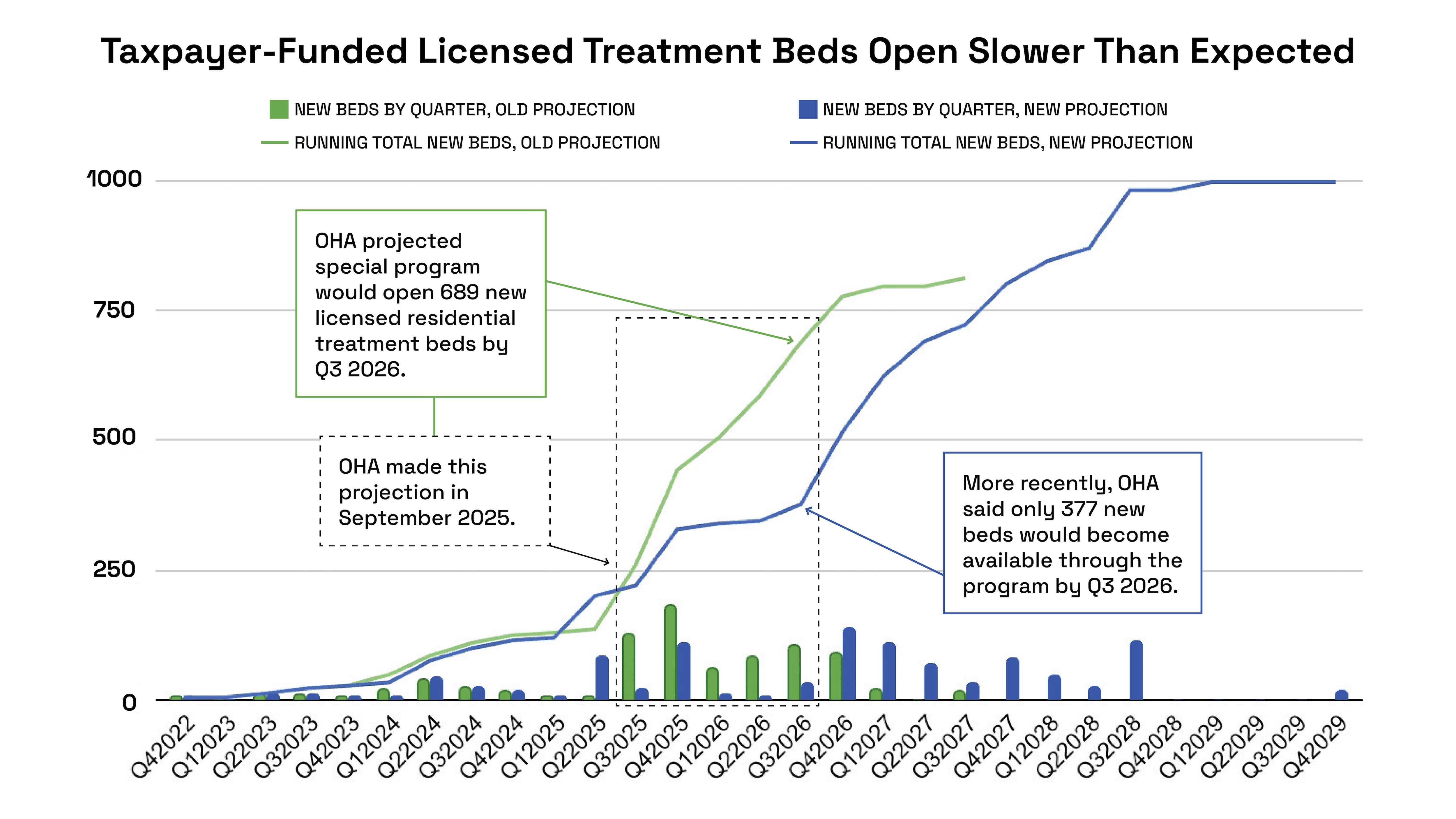
In fact, the agency told the judge, it was well on its way to accomplishing this. Over the past five years, the Oregon Legislature had given it hundreds of millions of dollars to get new licensed residential treatment facilities running, and the agency said it had been working diligently to translate that cash into real-world beds. As evidence that these efforts were starting to really bear fruit, the agency showed the court a graph showing newly opened licensed residential treatment beds over time that its Behavioral Health Investments team had funded.
After years of steady but slow growth, the line began to ascend rapidly in mid-2025—just where it stopped representing the past and began to represent the future.
It was a pleasing representation. Reality, however, proved to be a bit more dour.
In a fresh court filing the state submitted last month, new OHA projections appear in a graph that at first glance looks like the old one. But the time horizon runs longer, stretching to 2029 instead of 2027, even as the total number of expected new licensed beds does not greatly increase.
In other words, OHA now projects similar results that will take longer to achieve.
And, as for the year that just passed, just over half of specially funded beds that were supposed to have entered the system by now had been activated at all. Where, just a year ago, the state said its Behavioral Health Investments program would bring 689 new residential treatment beds online by October 2026, now it was saying the real number was 377.
Like the old graph, the new one shows a line moving steeply upward in the near future. Perhaps this time around, it will end up proving accurate. But for now, the malleable projections raise questions about the OHA’s effectiveness in getting residential treatment facility projects to the finish line, and underscore how the goalposts for measuring success have changed.
“There’s this very big gap between what we keep being told is going to happen and what actually happens in the real world,” says Tom Stenson, deputy legal director at the nonprofit Disability Rights Oregon. “We put out a shiny report that says Oregon is in the process of building this gigantic amount of behavioral health resources that never quite arrive.”
OHA doesn’t deny the delays, though it distances itself from accountability for faulty projections, saying the timeline estimates come from the private organizations with which it contracts to build and run the facilities.
OHA spokeswoman Amber Shoebridge cites many reasons delays might occur—“OHA can’t eliminate issues like construction costs and labor shortages that impact many kinds of capital building projects and shift estimated project completion timelines”—but says the state has in fact dramatically built out residential treatment capacity in recent years. Including beds newly licensed outside OHA’s special Behavioral Health Investments program, she says the state has licensed more than 1,000 new treatment beds since 2023, a figure officials expect to eclipse 1,700 by the end of 2028.
“OHA is committed to continuing this unprecedented bed expansion,” Shoebridge says.
Despite the delays, OHA and its boss, Gov. Tina Kotek, insist the situation has clearly improved. In their telling, they have brought order and direction to an unruly behavioral health system in just a few short years.
Kotek, in an interview, says where residential treatment occurred “willy-nilly” before, her administration has brought strategy and more centralized funding streams to the build-out. She says she has sought to instill at the OHA a “culture of urgency,” but acknowledges that delays, whether the result of slow deployment of funds to local issues, remain a frustration.
“From my perspective, as a funder, the health authority needs to move the money fast, provide the technical assistance, and say, ‘Why aren’t those doors open yet?’” she says. “We should be better at that, and that is a work in progress.”
Still, the agency lacks a permanent leader after director Sejal Hathi, whom Kotek had appointed, resigned amid criticism this past summer, and the chair of the state’s Senate Committee on Early Childhood and Behavioral Health, Sen. Lisa Reynolds (D-Northwest Portland), describes the agency as “going through turmoil right now.”
Reynolds tells WW she was expecting a report on the residential treatment build-out during hearings in December. “I’m embarrassed to say I don’t think I realize they’ve fallen short of their projections,” she says. “I mean, I’m not going to lie: Accountability is hard to do, right? And holding big agencies accountable is challenging. We hold committee hearings, but I think there has to be more consequences.”