Skip to main content

If you or your associates are sniffly, beware: The flu has arrived earlier than normal this year across the American West.
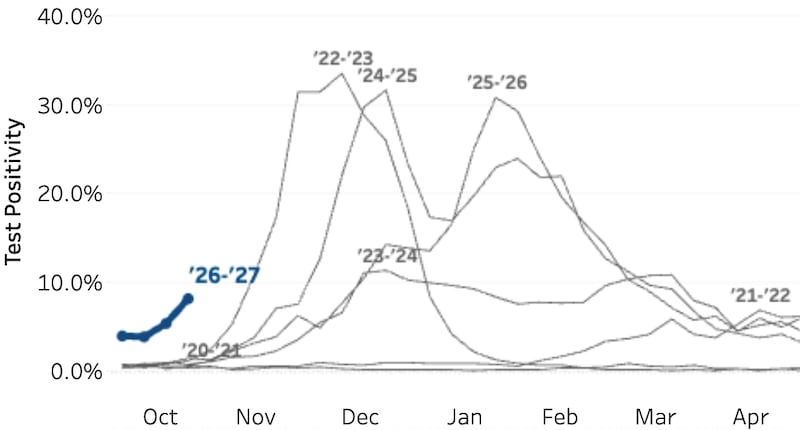
Federal data tracks the trend, and Oregon Health Authority figures show positivity rates for influenza in the state have begun a swift upward trajectory, weeks earlier than is normal.
“This is an unusually early flu season,” says Dr. Melissa Sutton, OHA’s medical director for respiratory viral pathogens. Still, she adds, this does not necessarily mean it will be uncommonly severe. She says the feds have forecast a moderately severe flu season, and there are so far no signs of unusual intensity in this flu, which Sutton says appears well matched to the prevailing vaccine.
And thus she dispenses the typical advice: getting a flu shot is the best way to reduce the risk of a severe infection.
Sound though it may be, this mantra of public health has been falling lately on less and less receptive ears. As the Oregon Journalism Project reported, just 30% of Oregonians got a flu shot in the 2025-2026 flu season. Last week, the Oregon Health Authority released data showing that, between that season and the 2019-2020 one, the rate of health care workers who get a flu shot dropped from 85% to 52%. (The agency says the lowest rate of all last year was among workers at nursing facilities, of whom just 25% got the shot.)
“While we encourage everyone in Oregon to get the flu vaccine, it’s especially important for people in the healthcare field to be vaccinated,” said Dat Tran, who runs the OHA’s healthcare associated infections program, in a written statement. “The people being cared for in health care settings often have health conditions that make them particularly susceptible to severe health outcomes, and even death.”
Oregon faces other challenges. It has one of the nation’s lowest rates of hospital beds per capita, constraining health systems’ ability to care for people amid surges in respiratory illness. In a recent press event to raise awareness of the coming respiratory virus season, Oregon Health & Science University President Shereef Elnahal recommended vaccination, and, when sick, staying home from work or school.
“Those simple things can honestly make this respiratory season a lot easier for everybody,” he said, “most notably patients and families, but also for our care teams” that treat the sickest patients.
Dr. Carl Eriksson, who works in OHSU’s pediatric intensive care unit, said groups that tend to face higher risks are people with chronic health conditions and kids.
“Winter is a tough time for children’s hospitals,” he said.
He added that forecasts—which look at the Southern hemisphere, among other places, to track how viruses are mutating and spreading—suggest the flu will peak in Oregon in December, and that RSV, another contagious respiratory virus, will peak in late January.
Covid-19 infectious swelled in Oregon this summer, but the latest data shows these have likely been declining in the state in recent weeks.