Skip to main content
On a crisp Sunday morning in outer Northeast Portland, a group of parents and volunteers sorted willow tree cuttings into three size groups, preparing to weave an arch through a small portion of a new outdoor courtyard at Vestal Elementary School.
Using a planting tool that looked a lot like a pogo stick, volunteers took to forming about 20 holes to bury the ends of the tree cuttings (willows require about 16 inches to root). Others cut string and gently pulled the long stems into arches, fastening them to the height of a regular elementary schooler. With time, individual thin stalks can fuse together into bigger trees, the leading restoration ecologist told volunteers.
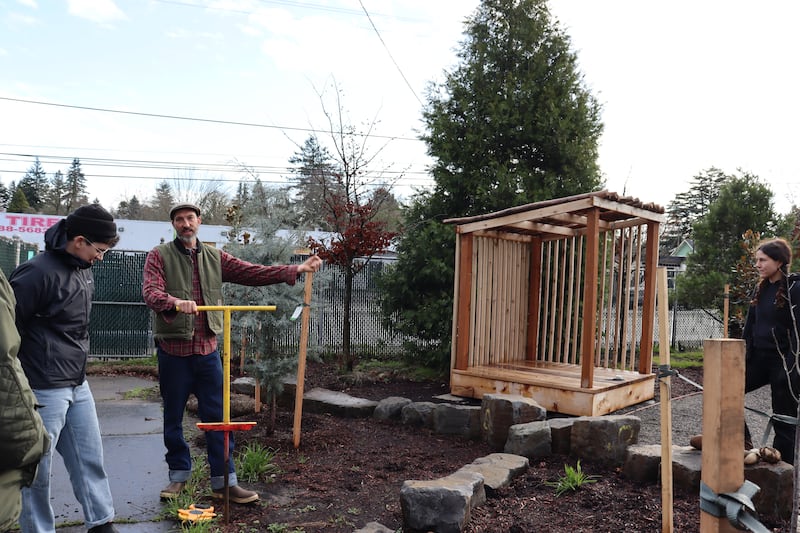
The willow arch is one of the final accents Vestal parents are installing at the elementary school in conjunction with Depave, a Portland-based nonprofit whose mission is to re-green urban spaces, particularly for disenfranchised communities. Less than a year ago, the courtyard—which now features permeable flooring, a wooden stage for kids to perform, and an outdoor learning table—looked very different. Apart from a few trees, it was marked by inch and a half thick blacktop across the terrain.
Vestal, a Title I school in outer Northeast Portland, does not typically have the resources to pursue ambitious improvement projects like the outdoor courtyard. Jake Sepulveda, the Vestal Parent Teacher Association president and parent to a second grader at the school, says securing funding and time from families is not an easy task.
“We have a lot of families who have a single parent home, or a double working parent home,” he says. “Their daily schedules are like, ‘I’m done at six, I’ve got to go home and make dinner. I can’t show up for volunteer stuff.’”
But when a group of Portland State University students embarked on a project to envision ways to reduce urban heat islands on 82nd Avenue, Depave staff members tell WW Vestal was one of the locations the students identified for heat mitigation. Indeed, schools across Portland often trap heat on their campuses, many of which are paved with blacktop. That has consequences that range from toxic water runoff to lower air quality, Depave staff say.
“Vestal specifically is located right on 82nd Avenue, which is a part of the city that has lots of parking lots and very low access to parks and green spaces,” says Katherine Rose, Depave’s communications and engagement manager.
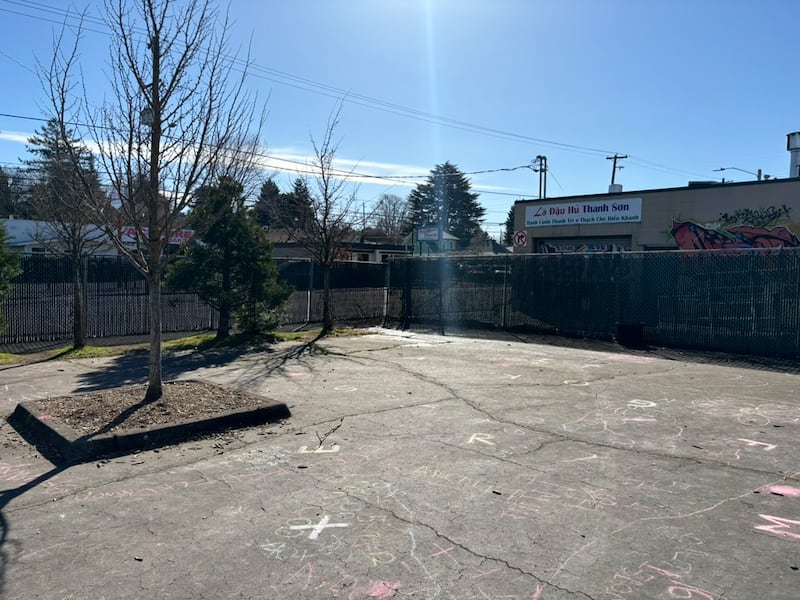
Depave built off of the notion from PSU and reached out to the Vestal PTA, Sepulveda says. Through contracting with Learning Landscapes Design, a local landscape architecture firm, Depave was able to ask Vestal community members what they wanted in the space and develop designs accordingly. Then, they navigated Portland Public Schools’ own hefty permitting process. (Depave also shoulders the costs for projects they pursue, relieving the PTA of hefty fundraising efforts. Vestal’s funding came from grants from the Portland Clean Energy Fund.)
The same parts of the city with lower incomes are often “frontline communities” to the effects of climate change, Rose says. But tackling the problem is often a project too big for the community it affects.
Zoé Walker Aparicio, the nonprofit’s community projects and stewardship manager, says that when cost barriers are removed, there’s often great interest in projects like the one at Vestal. At a June event where volunteers removed the blacktop, she says more than 40 community members turned up in the pouring rain to contribute.
Sepulveda says watching students at Vestal discover the new space for them has brought a lot of joy. “They’re all pretty blown away by how drastic the change is,” he says. “I see a lot of kids use the boulders as their little balance walk arounds. They walk around asking, ‘What’s that for? What’s that for?”
He adds: “We wanted kids to be able to come in and have freeform play, self guided learning in the space. I think we really achieved it.”