Skip to main content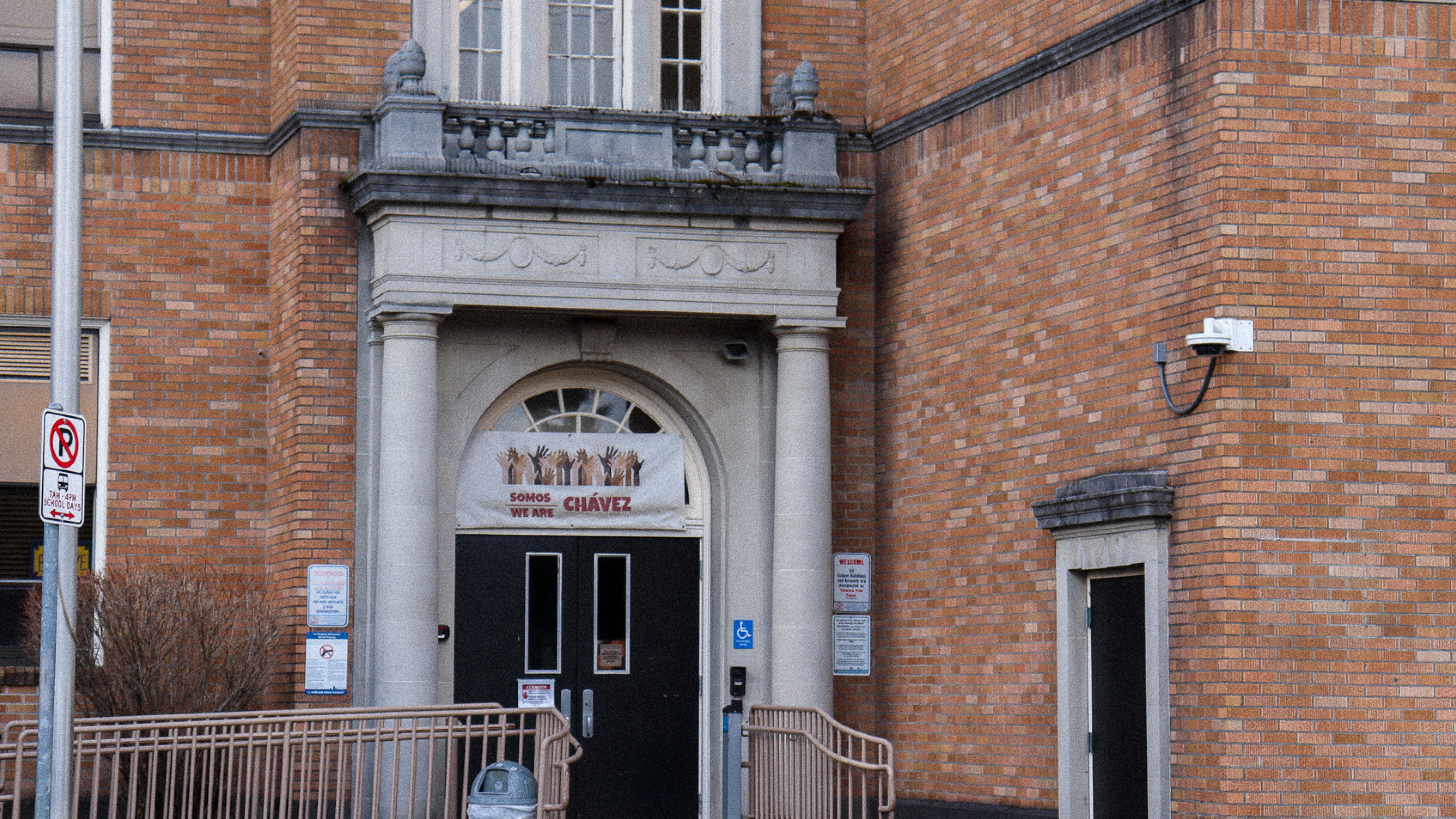
Arielle Tozier de la Poterie, a parent of a student at César Chávez School in North Portland, spends her day job working in international disaster risk reduction. So she’s familiar with the risk of schools collapsing on children during an earthquake.
For Tozier de la Poterie, the seismic risk of many buildings in Portland Public Schools’ portfolio was concerning; she went so far as to email the district asking about any seismic improvements that had been made to César Chávez ahead of her son starting there. She recalls them telling her some roof improvements had been made.
“It was worded in a way to make me feel better about it,” she says now. “And then, honestly, I think I was just like, ‘This is too much, what am I supposed to do about this? I can’t do anything about it. Am I going to not send my child to school?’ So I put it out of my head.”
Now, Tozier de la Poterie is thinking about it again. So are a number of other parents who are troubled that César Chávez and other elementary schools with higher proportions of low-income students aren’t on the list of nine chosen to receive full or partial retrofits.
“I didn’t even start going into this thinking that Chávez was going to get any of this money,” she says. “What irked me was the process or the lack thereof.”
Tozier de la Poterie says she voted for the $1.83 billion school bond last May because she believed children should be safe where they learn. She was reassured by the School Board’s last-minute, $100 million allocation of bond money to seismic retrofits at some of the district’s riskiest schools.
But now, many parents are wondering how district officials arrived at the nine chosen schools. A small group of them started circulating a letter Feb. 12 questioning the process. The list of schools includes just one Title I school, Kelly Elementary, which is receiving a partial retrofit, raising further concerns that PPS is not spreading the funding it received evenly around the diverse array of communities its students come from.
There’s also another, more subtle reason why getting a school on the retrofit list is appealing. Early into the seismic conversation, PPS officials hinted there’d be some sort of linkage between seismic retrofit decisions and school consolidations. At a January facilities subcommittee meeting of the Portland School Board, PPS senior chief of operations Jon Franco confirmed that the nine schools receiving upgrades weren’t candidates for school closure, a process multiple district officials have anticipated will start in spring.
School Board member Rashelle Chase-Miller, whose zone encompasses many North Portland schools, says choosing not to invest in Black and brown communities is consequential, and matters when so many schools have similar seismic risk scores.
“So many of our schools are at an unacceptably high risk level, so if all those highest-risk schools are predominantly schools that serve more white kids and fewer kids of color, or are in higher-income communities…in the event of an earthquake, it’s the schools that poor kids and Black and brown kids go to that will crumble,” she says.
Chase Miller adds: “Beyond that, when you bring in closures and consolidations into the conversation, this is the road we’ve been down before and, historically, the district has listened to the more affluent schools, the predominantly white schools, when it comes to making those decisions. So it’s the kids from low-income communities or from Black and brown schools that are forced to move out of their community.”
That the $100 million siphoned from the May bond would not cover all needed seismic improvements across PPS has been a known fact from the start of a renewed push for earthquake safety this past spring. (The latest public cost estimates by Holmes Consulting Group, which PPS commissioned for such work, found it would cost about $902.9 million to retrofit all schools in the district.)
The district landed on nine buildings through a prioritization formula it crafted in November, which ranked buildings based 90% on seismic risk score, 5% on enrollment and 5% on maintenance conditions. Beverly Cleary K–8 and Rose City Park Elementary are the two schools receiving full upgrades, while Ainsworth, Beach, Capitol Hill, Kelly and Richmond elementary schools—and Vernon and Winterhaven K–8s—are slated to receive targeted upgrades to specific, dangerous parts of their buildings.
That formula, which does not explicitly consider equity, emerged after significant outcry from seismic safety advocates about a more holistic draft formula presented to the School Board in October. Back then, the district was considering a formula that weighed seismic risk at 35%, also giving 15% consideration to equity and 20% to right-sizing. That formula was upsetting to many parents involved in the advocacy group Safe Structures PPS because of how close many buildings’ risk scores were clustered together.
Afton Wilcox, a parent of a second grader at PPS, says the November formula the district ultimately landed on came with no community engagement. “From the outside, [90% to seismic risk] would make a lot of sense,” she says. “But if you look at the things they’ve taken away, then you start to wonder, well, why are those things not in there anymore?”
PPS spokeswoman Valerie Feder says the district has made seismic improvements to 20 of 36 Title I schools since the 2012 bond. She says the district has done this prioritization work “at the pace necessary” to prepare for construction in 2026, 2027 and 2028.
“Our responsibility is to balance continued input with decisive action to improve safety in our schools. The proposed list reflects multiple rounds of refinement shaped by ongoing community input and feedback,” Feder says. “We will continue listening and making thoughtful adjustments where appropriate as we move forward to address urgent seismic safety needs across the district.”
To some parents watching seismic implementation occur, there’s also criticism that the district developed its list by listening to the loudest voices in the room. For example, Beverly Cleary K–8, where much of the idea for Safe Structures PPS was born in spring, is considered among the most dangerous schools and secured a full retrofit.
Per Olstad, one of the leaders of Safe Structures and a parent at Beverly Cleary, tells WW that he “wouldn’t even attempt to rebut” such accusations, acknowledging there is some truth to them. He says the community at Beverly Cleary is better resourced than many schools across PPS and that it had an ability to organize and advocate.
But he says Safe Structures is still adamant that PPS provide a better answer as to what the district considered under the blanket term of equity.
And Olstad adds that mobilizing parents to the cause has been difficult work: “There is a bit of a chicken-and-egg problem in that the reason Beverly Cleary and Rose City Park were so loud and vocal is because those are the two riskiest schools,” he says. “I don’t think we would have had as much engagement from the parent communities at either school if they were not so clear that they were the riskiest two buildings in the portfolio.”
Wilcox, for her part, says the district should be taking the initiative to engage parents, not the other way around.
“The reason for a public engagement process is, you have to give a voice to the people that are not showing up to meetings so they can understand what a change like this is going to do to their lives,” she says. “It’s saying, if and when this disaster happens, what does that really look like for people’s lives? Who’s asked to change schools? Who’s asked to change neighborhoods?”
The Feb. 12 open letter also outlined why many families can’t come to the table for seismic conversations, from work obligations to concerns about federal immigration enforcement. Chase-Miller adds that in many North Portland schools, there are endless day-to-day struggles. “It’s hard to focus on the theoretical when the immediate needs and challenges are so profound,” she says.
Even some School Board members wonder if they’ll get a meaningful say in choosing the schools that get seismic upgrades. (At a January meeting, all nine schools were in a design phase, indicating the district has done at least some work on them.)
Wilcox and Tozier de la Poterie are among the parents asking for a do-over that involves more transparency and better engagement. They argue, in part, that high-risk schools should be contenders for consolidation instead of improvements. Starting over is a proposal that would certainly cause anxiety for some parents, including Olstad, who argues that if PPS waits to tackle seismic after its consolidation process, it will have lost precious time and money for the retrofitting effort.
Tozier de la Poterie says disaster management is more nuanced than structural damage alone. There is the risk to the building, she says, but it is also common practice to consider the vulnerability of individual communities—including the resources they would independently have to overcome disaster. The way PPS has navigated the seismic process “makes me feel a complete lack of confidence,” she says.
“It’s PPS’s responsibility to live up to their own resolutions and their own commitments around transparency, equity, and community engagement,” Tozier de la Poterie adds. “It seems like they have resolutions coming out of their ears, and at the end, they just disregard them. Why do they even have them then?”