Skip to main content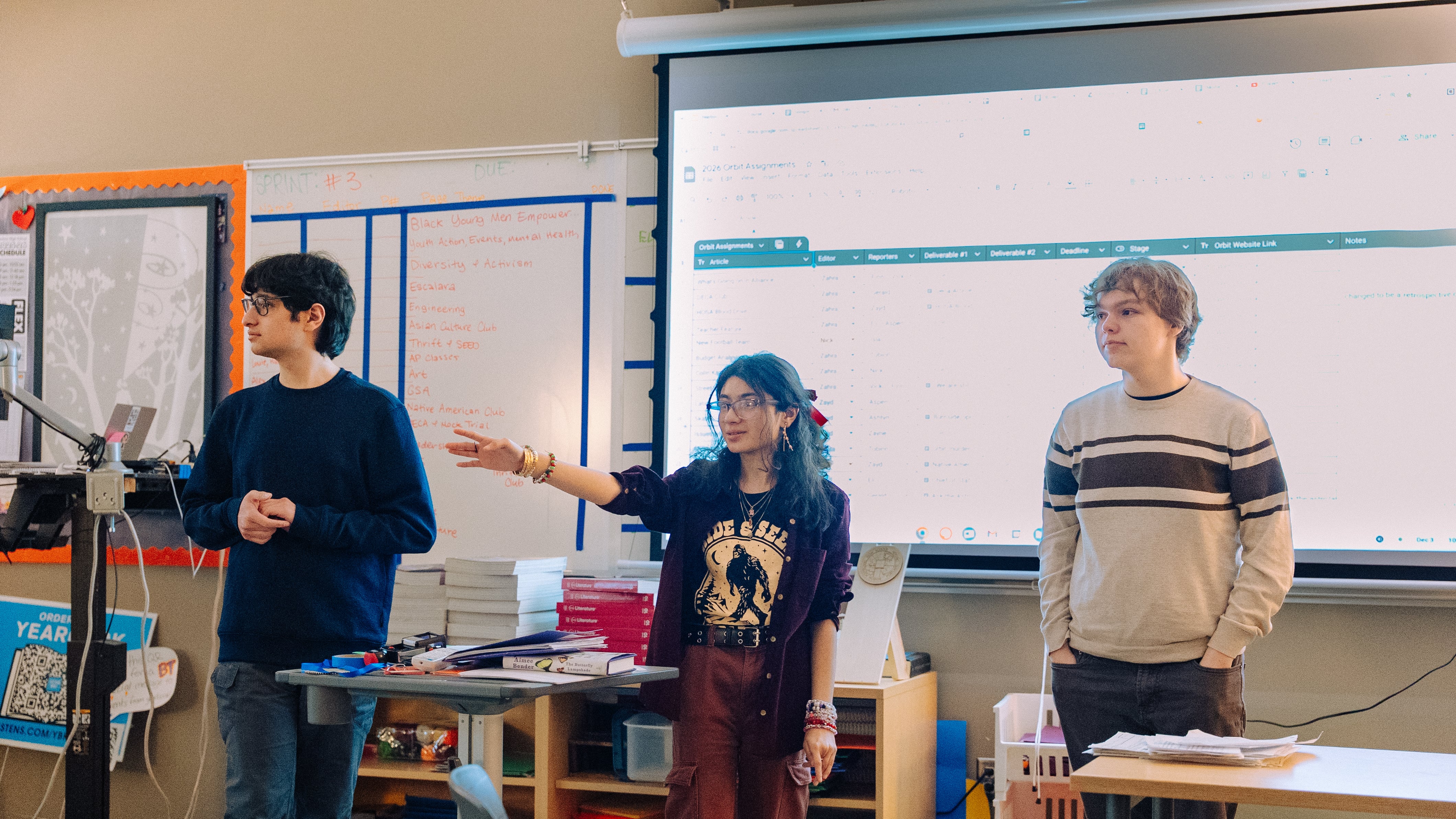
As Benson Polytechnic High School students settle into their new, modernized building, its students say many activities and efforts are coming “Back from the Dead.”
That’s the theme of the March print issue of Benson’s freshly revived student newspaper, whose masthead now proclaims The Benson Orbit. It’s the first print student paper that’s graced Benson’s hallways in about 16 years, after the school’s 90-year-old student newspaper, known as Tech Prep, shuttered in May 2010. (At that time, most of The Orbit’s staffers were newborns or, at oldest, toddlers.)
The long drought of an independent student paper at Benson ended in 2024–25, when two journalism advisors decided to start up a journalism club. “At the beginning, there weren’t that many students who were part of it, like five or six,” says student editor Zahra Faruqui. But interest has nearly quadrupled the staff’s size in one year, giving advisors the opportunity to grow journalism into a class in the 2025–26 academic year.
“I really like writing and reporting on what’s happening around the school, and I was really interested in bringing that into the journalism program,” says Zayd Faruqui, another student editor. He says the student publication has published stories on topics that range from event stories to club features, teacher profiles, or stories on the big issues students face. It has an opinion section and the print edition comes with a crossword. Its editors say the intention is to have something for every student.
A couple of big headlines at Benson include the multimillion dollar budget deficits PPS faces in both the current year and the upcoming academic year. Budget cuts were the reason the original student newspaper at Benson shut down. The student editors say they are preparing stories about what might be cut at Benson specifically, and about student reactions to those cuts.
Nick Oates, another student editor at the paper, says a benefit of The Orbit is that the staff and its readers are classmates. That means the paper’s editors have their own takes on topics like Portland Public Schools’ “off and away” all-day cellphone policy. (Spoiler alert: They think it’s too strict. It’s much easier to voice record on a phone than to jam a chromebook in a source’s face, one says.) So they’ve written multiple stories about the student reaction.
But Oates says The Orbit’s journalism tries to balance being critical with spotlighting the positive things about Benson.
“Having student voices have their own platform in our community lets them stand on their own,” Oates says. “If the administration does something we disagree with, we can write an opinion story about it. But we can also celebrate our community and have student perspectives on those celebrations. It’s really important to have student journalism run by and for students.”
Related: Benson is also home to America’s oldest student radio station.
Like journalists nationwide, The Orbit’s editors are also weighing tough questions. Zahra Faruqui says chief among them include how to handle coverage of student protests and activism. “There are lots of different things I had to think about when we were releasing our recent article about the [Immigration and Customs Enforcement] protest,” she says. “Specifically regarding student safety, or if the things that students said were things they wanted to have out on the internet forever.”
There are grand plans to further expand The Benson Orbit’s staff with another journalism course added in the upcoming academic year. And more immediately, student editors are shooting for another print issue to come out during Benson’s Tech Show, where students at Benson show off technical skills they’ve mastered in their studies.
Journalism advisor Greg Huntington says it’s been inspirational to see how students have scaled up The Benson Orbit. He says that the publication has filled a void in the high school and has created a space for students to express themselves and share their ideas.
“Writing is the gold standard of thinking. It’s hard, it’s about engaging an audience. It does all the things that we want young people to do,” Huntington says. “These kids have just stepped up to this challenge in the bravest way possible.”