Skip to main content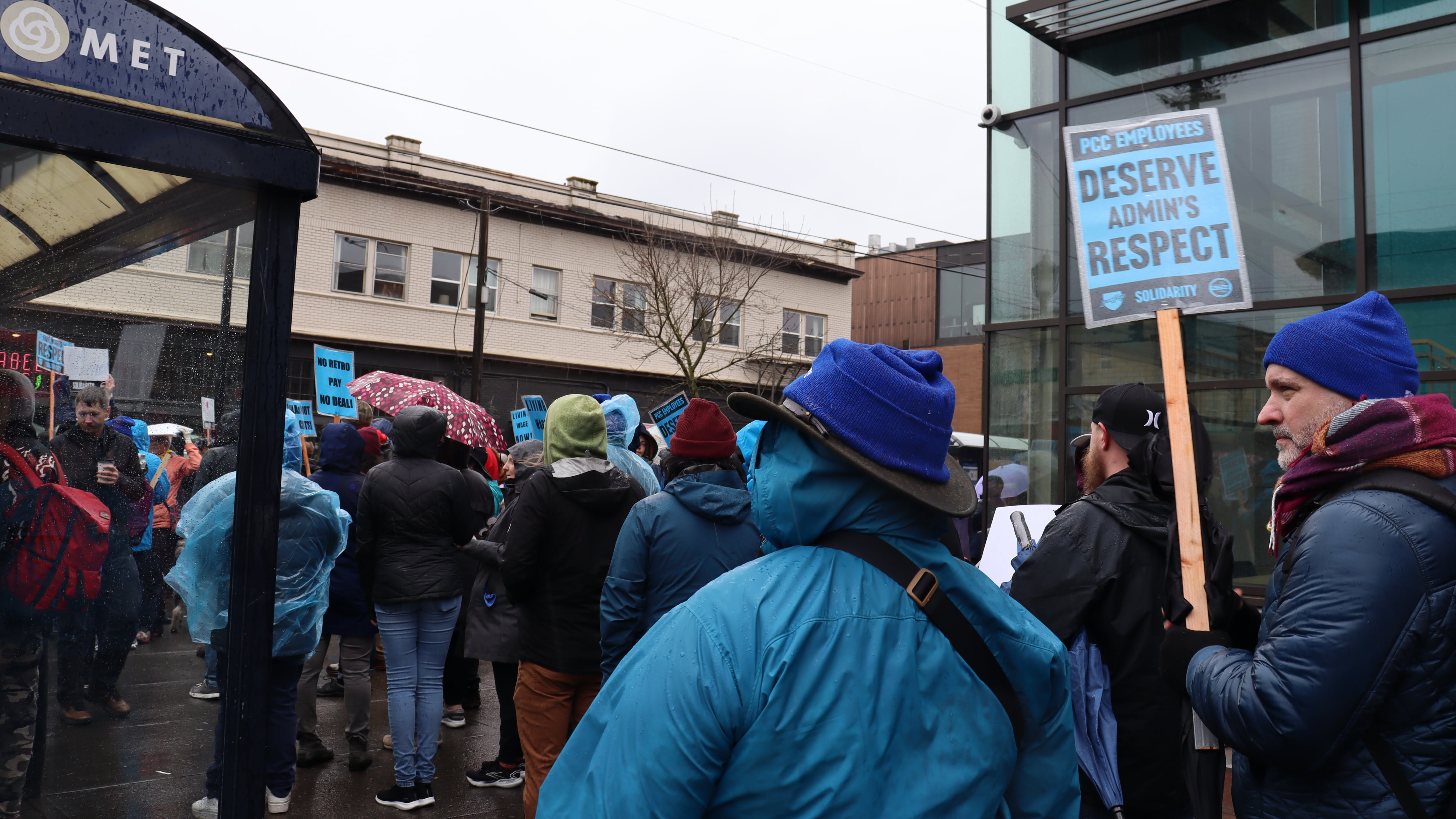
Portland Community College is in talks about potential changes to its spring term following another round of unsuccessful negotiations with two of its largest unions on Monday night.
Members of the college’s Federation of Faculty and Academic Professionals and Federation of Classified Employees took went on strike March 11, following months of stalled talks with PCC around salary and benefits. (Together, the unions represent about 2,300 workers and a bulk of student-facing positions at the college.)
The strike has so far interrupted the end of PCC’s winter term, including finals week and final grade submissions. The college has so far dragged out some winter term deadlines. In an email to students from March 20, PCC wrote that students “will receive grades” for classes this term, though they “will be delayed” for most classes.
PCC officials had previously said that spring term, scheduled to begin March 30, could proceed as normal if all parties came to agreements by Monday. But Monday’s negotiations fell flat, and both unions are poised to soon enter into the third week of strikes. That also means potentially shifting timelines for spring term.
PCC spokesman James Hill says that the college “should announce a decision within a few days about the start of spring term as offers are being mulled.” Much of the timeline for spring, he says, rests on mediation sessions scheduled for Wednesday and Thursday of this week.
“There are levers PCC can use to preserve the integrity of the term if we delay a week, but nothing [is] official right now,” Hill says, in response to WW’s questions about if a delayed spring term would lead to a shortened term. “In the meantime, our Student Affairs and Academic Affairs teams are meeting daily to plan for multiple scenarios as the situation develops. PCC’s priority is to protect students’ academic progress and support them as fully as possible.”
Talks in recent weeks have largely stalled over cost of living adjustments, but union leaders say there’s also a new hold-up over PCC’s refusal to provide back pay to striking workers. Leaders in both unions say that employees expect to return to a large amount of work to make up and should be compensated as such.
Particularly, PCCFCE has been close to reaching a deal for about a week. But the union issued a statement Tuesday saying that while it was willing to accept management’s economic package, the issue of restorative pay once again left negotiations unresolved.
Tensions continue to flare between the unions and the administration. Notably, membership of both unions voted overwhelmingly to declare no confidence in PCC President Dr. Adrien Bennings, with PCCFCE voting 94% no confidence and PCCFFAP voting 98%. Students appear in line with union members; the student government of the college has also overwhelmingly voted to declare no confidence in Bennings’ leadership.
“The message is clear. Dr. Bennings should no longer be the president of Portland Community College. Without shared governance, we have no mechanism to remove you,” David Shultis, PCCFFAP’s organizing officer, told board members and Bennings at a meeting Thursday. “But it is undeniable that you have lost the trust of students, faculty, and staff.”
The third week of strikes also means PCC workers will be one of the early test cases for implementation of one of the most controversial pieces of legislation in the 2025 session, Senate Bill 916. The bill allows striking workers to access unemployment insurance after two weeks (an unpaid strike week and a regular waiting week), and benefits are capped after 10 weeks.
It made Oregon the first state in the nation that requires public employers—cities, counties and school districts—to pay unemployment benefits when their workers strike.
Many public employers testified against the bill in the 2025 session, warning that they did not have the financial means to sustain such a model, and that pay would incentivize workers to hold out for a better deal. PCC, for its part, would expect to pay about $1.45 million a week in benefits if most union members claimed them.
At a Thursday event organized by unions known as The People’s Board Meeting for PCC, state Reps. Rob Nosse (D-Portland) and Mark Gamba (D-Milwaukie), who both supported the bill, told WW they did not worry that workers would prolong the strike in light of the bill.
“I supported the bill because if you’re making 20 bucks an hour in Oregon, you’re barely hanging down by your fingernails, and if you’re out of work for five weeks, you’re likely to be homeless,” Gamba said. “All we did was make it so that doesn’t happen. I don’t think anybody’s going to artificially extend their strike, just so that they can collect money without having to work.”