Skip to main content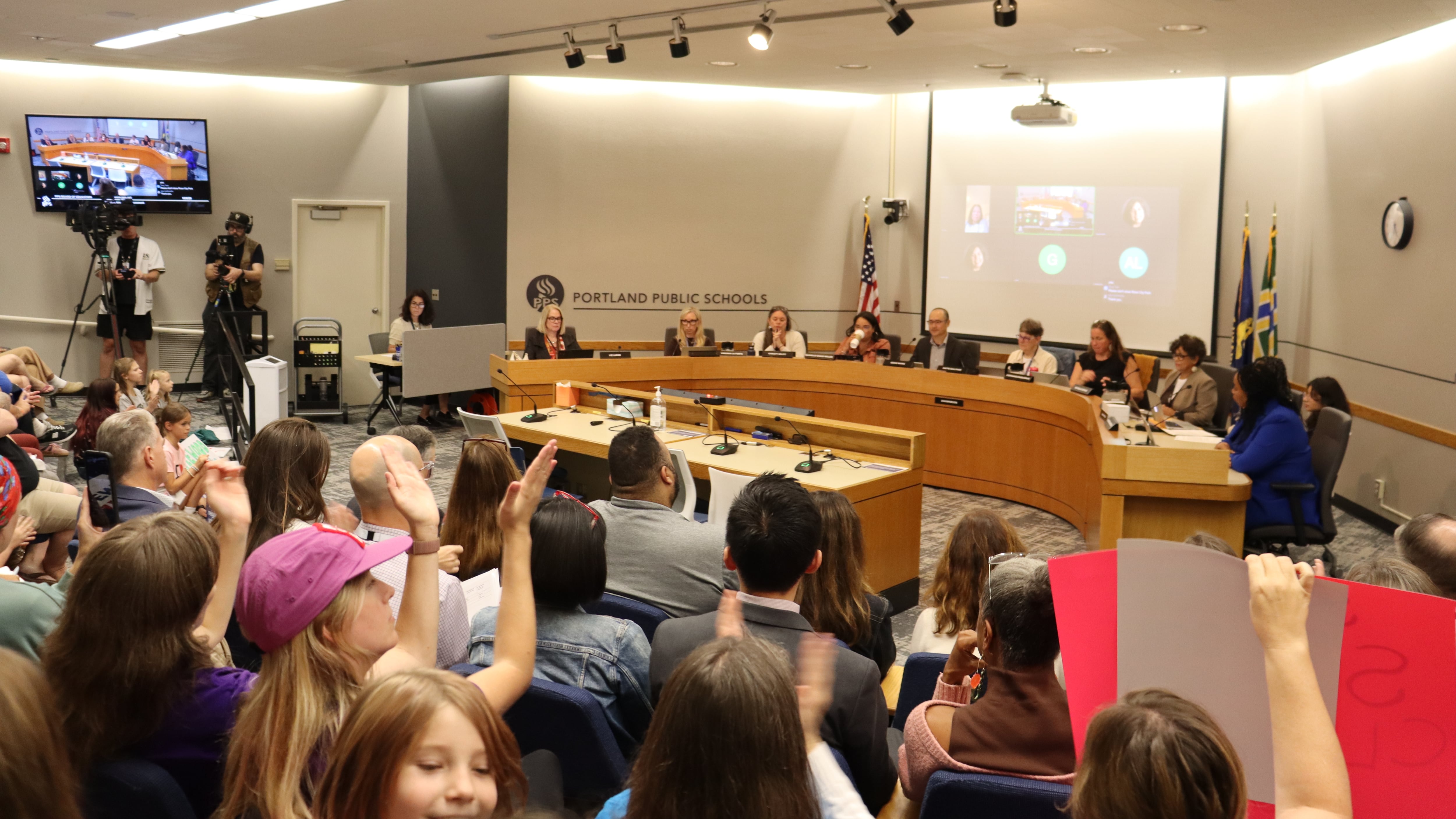
Just one day after Portland Public Schools publicly released two school closure scenarios, Portland School Board members took to the dais at an Oct. 6 meeting to share their initial reactions to the proposals. (The two scenarios, termed A and B, would shutter 14 and 11 schools, respectively.)
A furious crowd booed and jeered as district leaders presented their proposals. And it was clear that board members needed more information as they asked about everything from the future of focus option schools to whether the district would issue a fiscal impact statement.
In the early noise, it also appeared that some were more skeptical of the two proposals than others.
Board member Michelle DePass said Portland was once full of young, big families, and that’s no longer the case. “For that reason, I think we need to do something,” she said.
Meanwhile, board member Christy Splitt said she felt the scale of the closures was too vast for the moment. “It affects 24% to 27% of our students, and that’s a really big number to me,” Splitt said.
It was that concern that led Splitt that night to ask the School Board to verbally commit that it would not add any schools to the closure list at the eleventh hour. That request spurred some debate, but ultimately the board agreed that if the list were modified at all, it would be to remove a building.
It’s becoming clear that—despite public outcry—the board has little wiggle room to tweak the district’s proposals. “One change, one modification, one add has a cascading effect,” PPS Superintendent Dr. Kimberlee Armstrong told board members.