Skip to main content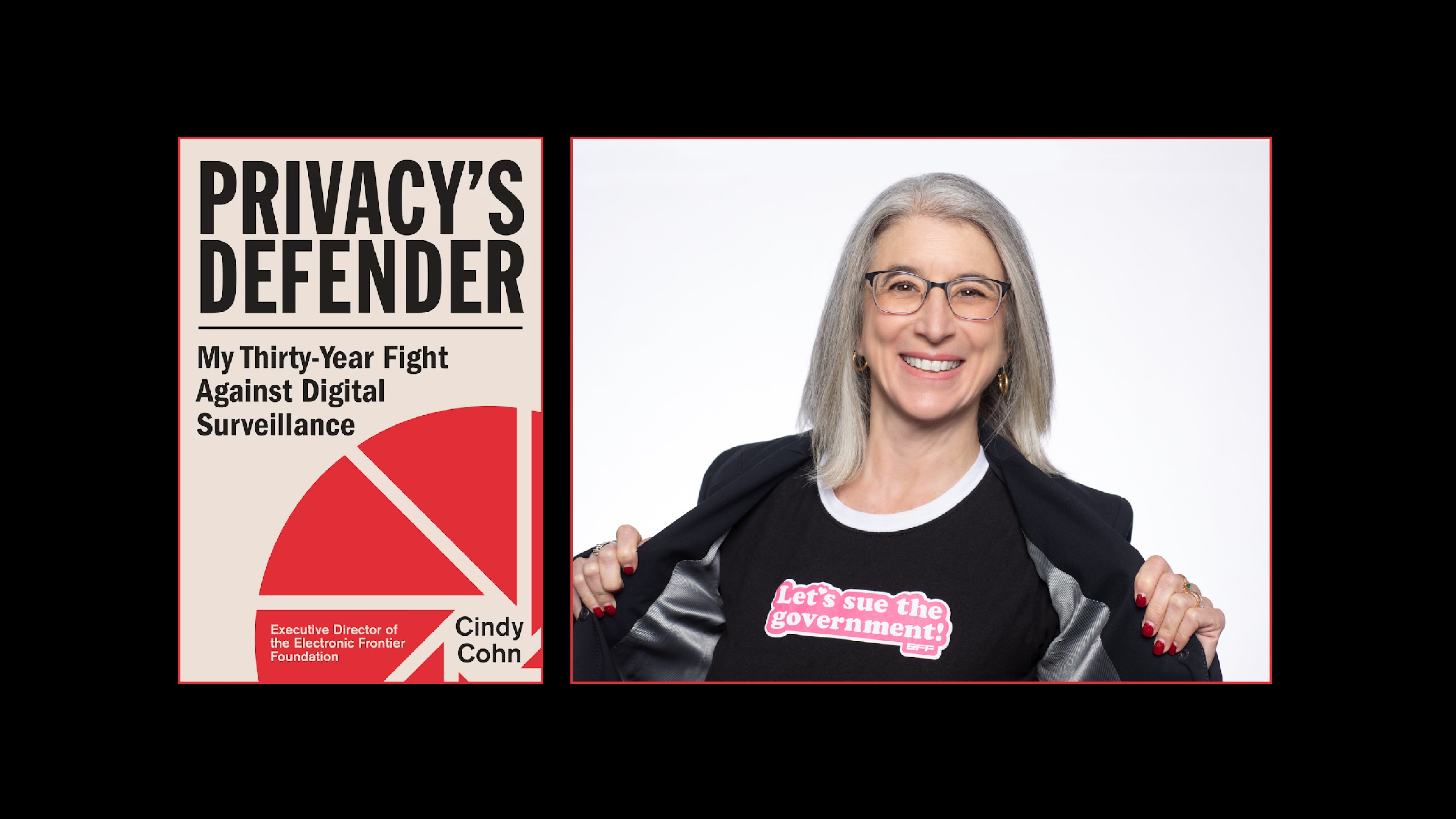
Cindy Cohn isn’t done suing the government.
Cohn, the author of Privacy’s Defender (MIT Press, 248 pages, $29.95), which came out March 10, is retiring later this year after a 30-year career with the Electronic Frontier Foundation, the San Francisco-based digital rights group founded in 1990. For the first half of her time with EFF, Cohn served as legal director and general counsel, fighting for internet users’ rights to digital encryption and against telecom companies’ tapping and mining of users’ data.
As Cohn writes, she got involved in EFF not because she was interested in tech, but because she became friendly with some of the organization’s founders while working as a young lawyer in San Francisco. They included John Barlow, one of EFF’s founders, who was also a published poet and a lyricist for the Grateful Dead, a band Cohn loved.
During a video call with WW, Cohn said she wants to return to the “fightier” part of her advocacy work; she hasn’t decided quite where she’ll end up, though privacy, the rule of law and the separation of powers remain major concerns. She also talked to WW about EFF’s wins and losses and how citizens are fighting against surveillance tech like Flock’s AI license plate reading cameras (which were discontinued in Eugene and Springfield in December after public outcry). This interview has been edited for space and clarity.
WW: When it comes to issues that EFF has advocated on, what are the things that most concern you or that you see as continuing to be big fights in the future?
Cindy Cohn: The way that surveillance has overtaken our lives is just the issue of the moment right now. We really do have to build real privacy back into our systems—both privacy vis-à-vis the government and privacy vis-à-vis companies. A lot of the fights that I talk about in the book are situations in which the government doesn’t come to you to get information about you. They go to your service provider—whether that’s your telecommunications provider or your ISP or some other service provider—to get information about you. So we have to stop that in order to really give people the kind of privacy that they deserve.
And are there glimmers of hope?
The hyperlocal fights are some of the ones where we’re seeing the most hope. There’s a lot of communities that are standing up against the Flock license plate reader cameras, especially as it becomes increasingly clear that efforts to make sure that information is only used by your local law enforcement for real crime are failing. The information is being made available to ICE, or is made available to prosecutors in Texas who are looking for people who are seeking reproductive help. I’m hopeful. I’ve seen communities really show up in some of these fights. Here in California and in Texas, communities have said no. I think there’s been some big fights in Oregon as well. That’s, to me, the sound of people waking up and really wanting to make their voices heard and wanting to have control over who’s spying on them all the time.
In the ’90s, when the EFF was first forming and you were getting involved, it really felt like there was a lot of optimism about what the internet could be, what technology could be. Now even people who were super-early tech adopters don’t feel that way. There’s a sense that a handful of corporations have taken over everything. What has been your perception?
Sometimes I feel a little like Cassandra [the character in Greek mythology who could see the future, but whose prophecies were never believed]. We have been in the business of trying to build an internet that serves people, and we haven’t won. We’ve won some things; we have encryption. People are organizing like crazy right now using end-to-end encrypted tools like Signal, and that’s because we won an early fight. Protecting the internet as a place of free speech where the government doesn’t get to stop you from saying things—even if it doesn’t like what you’re saying—those things matter. And in some ways, they’ve kind of fallen into the wallpaper of how we all live.
But in other ways, we lost. We have not won [the fight against] the surveillance business model of tracking everything and selling it to data brokers—and, you know, the government is now the No. 1 purchaser from these data brokers. This is at the center of the fight between Anthropic and the Department of Defense: how much of this public consumer data is going to be fed into the Department of Defense systems. On that level, the money and the big tech companies kind of won. And the lack of competition and the consolidation in the industry has made it so that a few big companies control way too much about our rights and what we do online. There are efforts to try to go back to the way the internet used to be—decentralized systems where you don’t have to just hope the CEO is ethical. Those things are alive and well, but they’re not the centerpiece. We didn’t win all the fights yet, and we have to keep fighting.
In the intro of your book, you said when we talk about privacy for its own sake, those conversations get really confusing, but when you talk about what privacy is for, that is much more clarifying.
I stole that from one of the leading privacy professors, Dan Solove at George Washington University School of Law, but I think it is the right way to frame it. I also think of privacy as a check on power. It’s a way that whoever you are, you have some protection against people who have more power than you. If you’re a teenager and it’s your parents, or if you’re somebody in an abusive relationship and it’s somebody who lives in your home who has more power than you, you need privacy. It goes all the way up to people needing privacy against their government.
You mentioned AI earlier. As you watch the development of AI, what are your thoughts and the privacy concerns that you have?
The government, after 9/11 especially, got really good at collecting a lot of data about a lot of people, but still wasn’t very good at actually marshaling it and using it. But AI systems—neural networks especially—and automated decision-making things, they can really turn that huge mass of data into something that can be much more powerful. That’s why the Trump administration wants access to a lot of the data that the government collects in different data silos, and they want it all together, because then they can analyze it and really marshal it. I think AI adds power to surveillance to really make it much more dangerous than it might otherwise be. So I think of AI systems as supercharging a lot of what’s wrong in the way that we do government and law enforcement right now, and also around consumers.
I spent a lot of the book and a lot of my time [in EFF] dealing with government surveillance. Increasingly, we’re seeing these systems decide how much you pay for things. They’re deciding whether you could qualify for a mortgage. They’re deciding whether you get interviewed for a job. They may not all sound like privacy issues, but they’re ways in which our data is being marshaled in ways against us.
SEE IT: Cindy Cohn in conversation with Allison Morris at Powell’s City of Books, 1005 W Burnside St., 800-878-7323, powells.com. 7 pm Friday, March 13. Free.