Skip to main content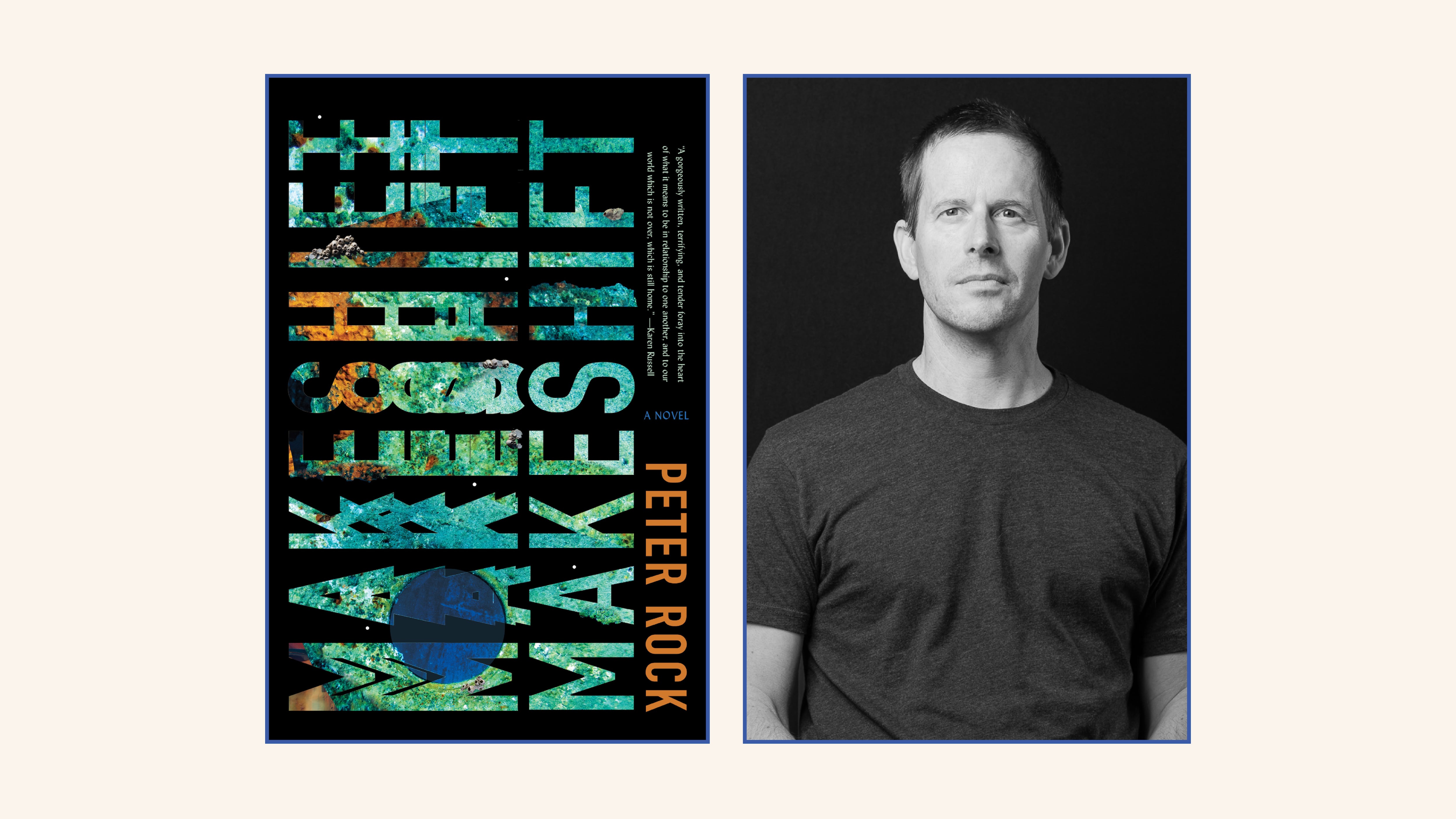
The narrator of Peter Rock’s new novel, Makeshift (Soft Skull Press, 203 pages, $27), believes she and her two sisters are the last humans on earth. Ari, Heiko and CeCe live on a remote island somewhere in the Pacific Northwest. They are completely free of contact with the outside world—until curiosity gets the better of them.
When they finally venture out, the society they encounter is leaning toward dystopia, though it’s only incrementally more brutal than our world. Ari holds her belief tightly. The three sisters are human, while everyone else is only appearing as such: “a gray-haired man with spectacles” or “appearing as a” child.
Rock, once a Guggenheim Fellow, has taught creative writing at Reed College since 2001. Of his dozen books, he is best known for the 2010 novel My Abandonment, which was based on the real-life story of a military veteran and his daughter who lived in Forest Park; it was adapted into the 2018 film Leave No Trace.
He’s carved a niche for himself writing about fringe characters and exiled groups who might just have figured out something the rest of us are too busy to notice. They often have real-world ties as well, like his 2013 novel, The Shelter Cycle, which drew on a group of doomsday preppers in Montana.
However, over Zoom recently, Rock explained that the larger ideas about the wisdom of outsiders usually come after the fact. “When I write a book, I’m kind of not aware of what it is that I’m talking about, exactly,” he said. “I’m just in that dream.”
Makeshift was partially inspired by Richard Brautigan’s post-apocalyptic novel In Watermelon Sugar. Rock describes it as being “about an alternative community that has a sinister past, but the narrator is telling a kind of oblivious story about it.” Initially, he played with setting Makeshift in a similarly destroyed world, making the sisters truly the last humans on earth. Then he wondered, “What if it is kind of just like it is right now?” Our conversation has been edited for brevity and clarity.
WW: Though she doesn’t use the word, Ari, the narrator and protagonist, is presumably trans. How did that character take that shape? Was it a challenge to write from that perspective?
Peter Rock: It’s interesting because people react in different ways. Ari identifies as a sister and also a brother. One of the challenges, or one of the pleasures of the story, was just trying to peel back—to just say, well, these are three young people who kind of grew up without parents and without constructs. Are they sisters? No. Are they all biologically female? No. The way they use gender, I think, is different amongst themselves. The question of identity for Ari is very based in relation to the other sisters, wanting to be like them, but it’s not a decision, really.
For context, these three sisters are the last survivors of a group that moved to an island and kind of exited society. It wouldn’t be hard to call it a cult. The wisdom of outsiders is a long-running theme in your work. Did you want to set it up like this, as something that would probably be viewed negatively?
I always think of this community as having really good intentions. It’s this kind of matriarchy; they’re kind of appropriators; they’re kind of borrowing a bunch of ideas from a lot of different places. But then things get hard, you know, and personalities rise up.
When I think of the book now, I think one thing it’s about is parenting—bad parenting, but also a lack of parenting. These three sisters have more of an oblivious and sort of positive take on what their parents were doing. But for a reader, like yourself, you could kind of read between the lines.
CeCe and Heiko, Ari’s two sisters, lived in traditional society at some point, somewhere in Canada, right?
Yeah, somewhere.
But Ari was born on the island, Makeshift, which creates a really unique disposition. It’s something like, what would a person do, how would they be, if they were completely unaware of industrialized society?
Ari is constantly trying to figure out how to describe things—combining other things in ways we recognize. But it’s sort of like, “Oh yeah, that is really strange.” Like, a movie theater is a bizarre space to be in. Even being in a Target is so odd.
There’s the sense of like, “I’m real, but the rest of this is not real.” Like, “I’m human, but that’s inhuman.” It’s very much generated by how they’ve lived on the island…and it’s fundamental to how Ari understands things. It’s also fundamental to how Ari’s sisters control the narrative around what they might encounter, who they might encounter, or what’s going on.
Ari is the only one in the group who can read and write. Eventually, we understand that we’re reading her version of the story. Presumably they’re speaking English, but it is this kind of stilted English that feels almost like translation, or even an attempt to record a language that’s only spoken, and so the English kind of fails to record all of what’s said.
When something is written down, you have evidence, you have documentation of something written in a specific time. The thing about oral history is, it could be corrected, and it can modulate and change through time. The practice of reading and writing is something the parents took away. [It’s] seen as dangerous to a community that wants to control and have a shifting story and—you know, it doesn’t take a huge step, as I talk about it, to recognize the political world that we live in.
There are several direct references to Inuit and Arctic cultures in the book. Specifically, the sisters use wayfinding talismans called inuksuks. Did you have reservations about writing a book about these kinds of appropriators? It takes a while to figure out that that’s what’s going on.
It’s something I was very—I would say aware of, if not nervous about. The book is about a time when things are so broken down. There are just pieces of various beliefs here and there. An inuksuk is an Indigenous icon or wayfinding device, but at this point, they’re everywhere. The ways in which they are related to how they began are fewer. In the world right now, not necessarily in my book, I think there are a lot of people who refer to inuksuks, or use them, who are sailors, who have no idea where they came from. And so it’s been kind of leached out of that history in some way.
Another example is that two of the sisters watch the movie Atanarjuat: The Fast Runner, which was the first feature film ever produced entirely in the Inuktitut language. Ari experiences this profound recognition. After doubting the humanity of everyone she’s encountered in the city, it’s very clear to her that the people on the screen are humans.
Characters don’t find definition, they don’t really become human, except in relationships, and in relation to each other. That is sort of how these sisters operate. But then when they go out in the world….It is very funny that it’s a film—it’s a film that’s a fiction, you know?—but it’s the first time that Ari does see, like, human people interacting in ways that are recognizable: caring about each other, taking care of each other, feeding each other.
It’s hard when your whole way of understanding the world is breaking up and changing. So in the second half of the book, Ari is very much like, “Do you think it’s possible that this person was kind of human?” Because it’s clear that that’s hard to give up.
GO: Makeshift author Peter Rock appears in conversation with Sara Jaffe at Powell’s City of Books, 1005 W Burnside St., 800-878-7323, powells.com. 7 pm Thursday, Sept. 10. Free.