Skip to main content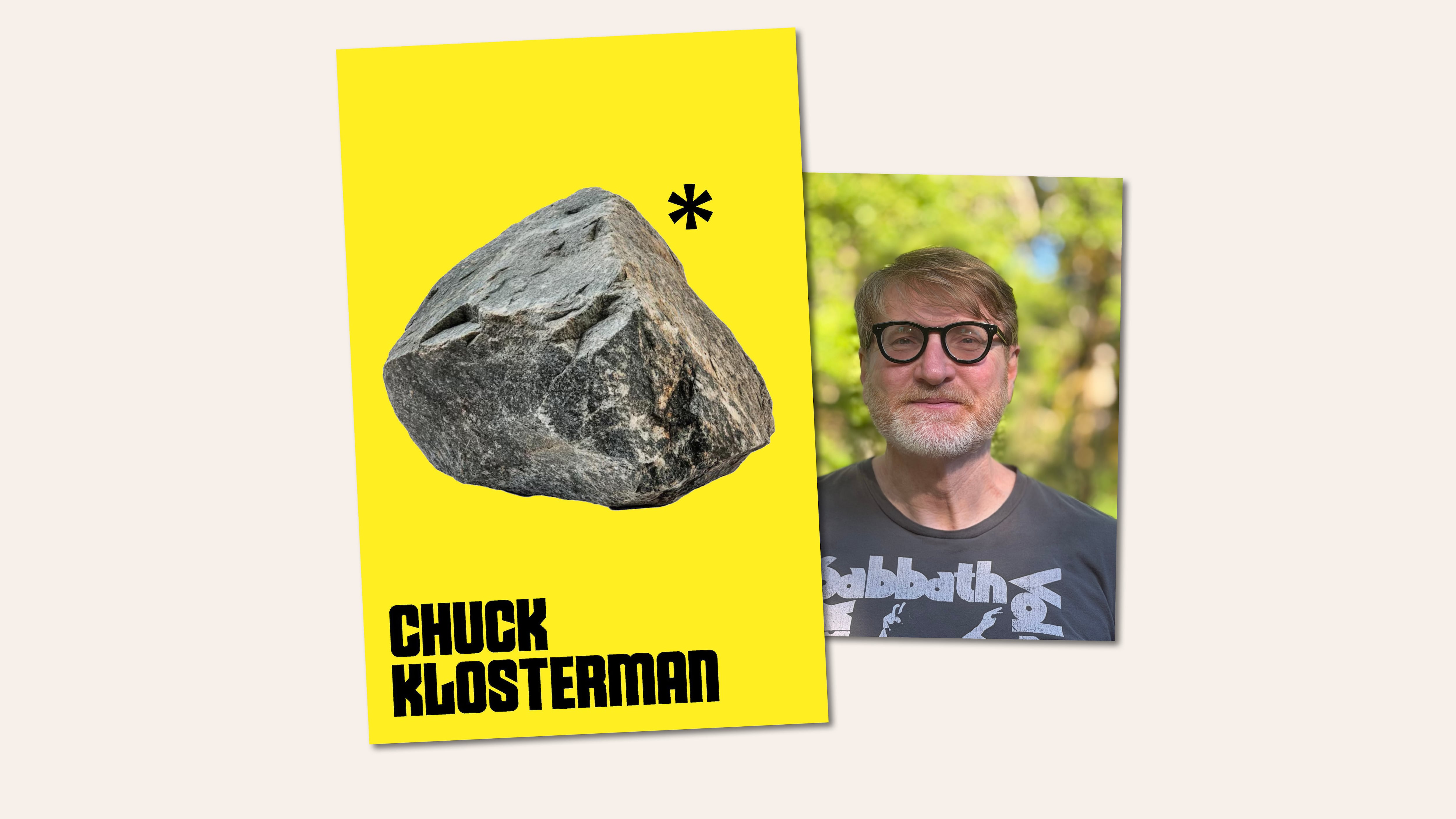
Chuck Klosterman usually tells the truth. Outside of a few novels, the prolific Portland writer is known for his nonfiction chops—profiling and interviewing people like Britney Spears and Taylor Swift and Jimmy Page for the country’s biggest media outlets and writing books about subjects as intimidatingly humongous as the ’90s and, most recently, football.
His new book, Rock* (Da Capo Press, 288 pages, $32.50), reads like a mockumentary. You could call it a speculative cultural history, which is to say, Klosterman made it all up.
It’s essentially The Rolling Stone History of Rock & Roll if, instead of the Beatles, the Velvet Underground was the biggest band the world ever knew. Though it is quite literally some dude going incredibly deep on a series of conspiracy theories and what-ifs, impressively, Klosterman steers almost entirely clear of making you feel like you’re eavesdropping on a round of beers after a dad band practice.
Early on, he lays out the true-ish story of the Velvet Underground’s making: “a rock band invented as an art project” by Andy Warhol. Warhol’s great insight, however, is what’s up for debate, and what Klosterman argues for the next 250 pages. “All things straight society viewed as ‘popular’ were not inherently popular,” Klosterman writes. “There is no identifiable quality or message that makes consumers want anything, outside of a single amorphous property—people will want whatever others claim to want.”
So, what if, in an alternate world, the masses favored difficult, sophisticated art music instead of bubblegum pop? Klosterman traces his thought experiment through about 40 years, starting with the thing that started it all, the Velvet Underground’s 1967 debut. (As the cliché goes, The Velvet Underground & Nico sold only 10,000 copies, but everyone who bought it started a band.) We pulled some of the funnier bits of phony rock lore—and a few beautiful moments—to give a sense of his bizarro reality.
1. The Velvet Underground & Nico was the bestselling album of all time. This is the switch that flips the book upside down, the bit that animates all the other bits. High school girls across America took to “Nico Speak,” adopting the German singer’s low vocal lilt. The magazine that produced this compendium of rock-’n’-roll history was not called Rolling Stone but instead Velveteen.
2. Eclipsed by new cultural mores, rock-’n’-roll progenitor Elvis Presley fell into obscurity. In the Velvet Underground’s world, Elvis was impotent, safe, boring. He was remembered mostly as a Jimmy Dean sausage spokesman. Though he did live longer—long enough to link up with producer Rick Rubin for a later in life album.
3. 1967 was the Summer of Drone. In the timeline we live in, 1967 was the Summer of Love. But in this velour upside-down, “Venus in Furs,” the Velvets’ droning song about sadomasochism that’s propelled by a shrill electric viola, was the Billboard No. 1 hit for nine weeks. The fashion was to stand wordless and apathetic in the crowd. Full-blown Velvetmania subsumed the continent by spring.
4. Two years later, Woodstock was a flop. Marred by grisly violence, it symbolically marked the death of the hippie movement. Instead, the Altamont Speedway Festival later that summer—which, in reality, was marred by grisly violence—was remembered as a triumph, complete with its own limp 25-year reunion. “Does this still feel like your summer of love,” Klosterman has Lou Reed say from the Altamont stage in 1969. “It’s fifty-four degrees, so maybe this is your winter of discontent. Also, I hate it here.”
5. John Lennon gave up on hope. Speaking to Joan Didion for a profile in Life, and responding to (probably true) rumors that Steely Dan’s 1972 track “Only a Fool Would Say That” was about him, John Lennon said this: “If he thinks I’m out of touch, maybe I’m out of touch. It’s not my job to touch things.…I still want peace. Yoko still wants peace. But if nobody else thinks peace is worth pursuing, I don’t see the value in constantly lecturing about why it matters so much to me.” (Reiterating that this is fake; while Didion did name the book collecting her articles published in Life at the time after the Beatles’ White Album, none of them featured an interview with Lennon.)
6. Lou Reed was murdered in 1983. IRL, Reed died of liver disease in 2013. But in Klosterman’s speculative Rock* land, Reed is basically John Lennon, who was, of course, shot by a fan in 1980. Klosterman uses the killer’s same name and adds three years to the timeline to account for the fact that the VU’s debut came out three years after the Beatles’.
7. Led Zeppelin was too heady for the masses. Instead, “big-money rivals” like T. Rex and the New York Dolls ate up the airwaves. Androgyny was easy to understand. But to “appreciate Zeppelin,” Klosterman writes, “one needed to appreciate sophisticated things—the occult, The Hobbit, the theremin.”
8. The Rolling Stones never caught on, either. “When it came to culture,” Klosterman writes, “they just didn’t get it. The Rolling Stones refused to accept that progressive boho teenagers preferred bookishness to lasciviousness.” He also notes that the band’s members were all quite short.
9. MTV was a smashing success, but it soon felt doomed and remade itself as ROCKSPAN in 1984. Instead of broadcasting music videos 24/7 (“it’s not what the kids want”), the new approach was to splice music videos with lectures by and debates among the leading public intellectuals of the day. Camille Paglia and Susan Sontag fought on air. Jacques Derrida lectured about “the flaws of Jacques Lacan and the limitations of poststructuralism.” The kids loved it.
10. Robert A. Caro was a writer for Spin magazine. Because, of course, in this universe, rock ’n’ roll is where the real power brokers reside. Caro interviews Julian Casablancas about a very in-depth conspiracy theory linking the Strokes to 9/11.
SEE IT: Chuck Klosterman reads from Rock* at Powell’s City of Books, 1005 W Burnside St., 800-878-7323, powells.com. 7 pm Tuesday, Sept. 29. Free.