Skip to main content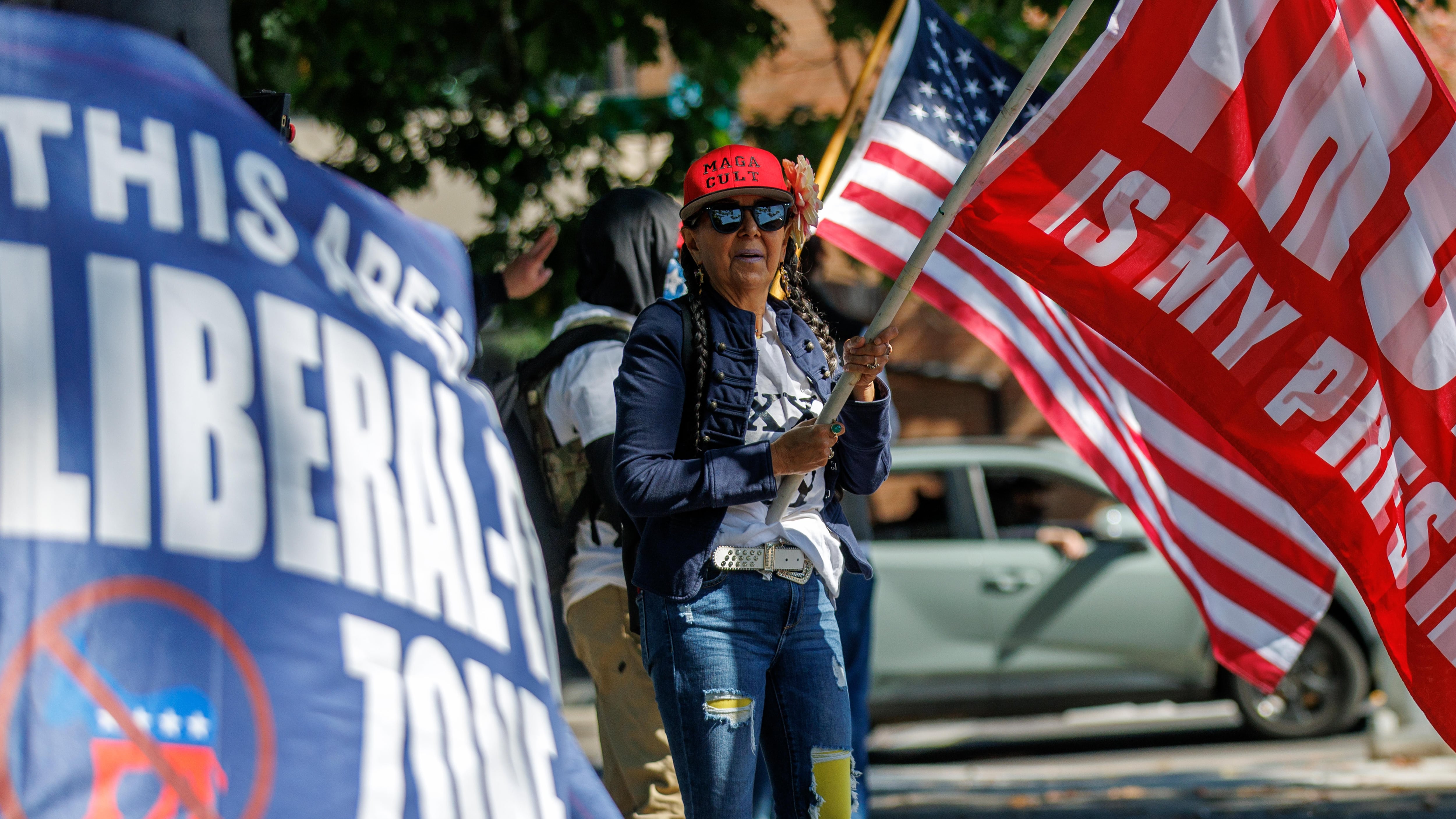
I don’t want to write this column.
I really didn’t think I’d have to. But it seems, even in Portland, women’s sports can’t escape right-wing anti-trans fearmongering.
The most recent escalation of public debate started with a July story on ESPN’s website about WNBA player Sophie Cunningham, in which she doubled down on her stance that transgender women shouldn’t be allowed in women’s sports. Anti-trans protesters have held rallies outside of WNBA games in the months since, including a couple dozen people who gathered outside a Portland Fire game in July.
Then, on Sept. 6, the matter made it into a Portland stadium: A handful of attendees were kicked out of the Portland Thorns’ match against the Washington Spirit for wearing shirts advocating the exclusion of trans women from women’s sports and for “distributing unapproved materials,” according to a statement by the club’s front office provided to the Portland Mercury.
The group then migrated to the Sports Bra, where a staff member asked that they either cover their shirts’ messaging or leave. They opted to leave.
The next weekend, Portland police responded to a verbal confrontation between anti-trans protesters stationed across the street from the Sports Bra and pro-trans activists, The Oregonian reported. Anti-trans protesters and counterprotesters gathered outside the bar again on Sunday. Counterprotesters outnumbered the anti-trans crowd on both occasions.
I don’t want to write about this.
It’s not like the boundaries aren’t clear. The overseers of the spaces mentioned above have left no room for questions; the Rose City Riveters—the Thorns’ supporters group—have vocally advocated for trans individuals, and the Sports Bra has also firmly asserted its support of trans people and, especially, trans women in sports.
Even the Thorns, who have not put out an explicit statement regarding the uptick of anti-trans messaging in women’s sports, acted decisively to remove attendees from the stadium who were promoting harmful rhetoric. And given that they barred an individual who was distributing racist anti-trans flyers at a 2025 Thorns game from future matches, one can conclude they’re at least not endorsing that rhetoric.
Still, the influx of anti-trans discourse in women’s sports spaces over the past couple of years is exhausting.
I know I’m not the only one who has gravitated toward women’s sports as a place to come together and celebrate athletic achievement without the macho posturing that seems embedded in most men’s sports.
As a queer person who grew up in Portland, the Thorns—and women’s soccer more broadly—have been a place where I could see people like me represented both on and off the field, a place where people like me could be celebrated amid the victories or bitter defeats. Watching players like Mana Shim and Tobin Heath and AD Franch helped me feel comfortable in my own queerness, even as I struggled to put language to what gender meant to me.
Later, trans athletes like Quinn in the NWSL and Layshia Clarendon in the WNBA showed there was room for me (as a reporter and fan) in those places, too.
There are no out trans athletes currently playing in either league, but there’s no reason there shouldn’t be (save the mental impact of playing a professional sport while your right to be there is constantly under scrutiny). And trans people should be allowed to exist in public spaces, to play sports at all levels (because, remember, much of the exclusionary trans sports legislation we’re seeing targets youth playing for their school sports teams) without feeling like our right to exist is up for debate.
To be clear: I believe trans women belong in women’s sports. I understand there’s nuance here, and I know I’m not an expert on gender inclusion in sports (even if it’s something I’ve spent a lot of time learning and thinking about). I also think any gender-inclusive policy that isn’t fundamentally based on self-identification will ultimately fall short of accommodating the complexities of gender and sex into a very binary-gendered sports system.
That being said, I’m not naive enough to believe sports happen in a vacuum, in an arena of pure meritocracy, totally separate from the politics and societal biases of the world they exist in.
I think conversations about the interplay of sports and society are important—and they’re part of why I love sports as much as I do.
But what’s happening now feels frivolous and frustrating; instead of using sports as a lens through which to examine society or vice versa, women’s sporting events are becoming fodder for right-wing anti-trans panic.
But that’s not what I want to write about.
What I want to write about is going to Thorns games every other week—and watching other NWSL and WNBA games on TV in between. I want to write about the players who are thriving on the pitch, the people supporting those players, what the club’s front office is doing well, and where it has room to grow.
I want to write about sports and gender, about gender expression and pushing back against patriarchal norms that paint women’s sports as lesser. I want to write about the gender diversity that exists within gender-segregated spaces and how we—people across the gender spectrum, but especially trans people—navigate that and find community regardless.
I don’t want to write about transphobic fearmongering that seeks to exclude trans people from public life. Trans people—especially trans women and trans people in sports—deserve better. Women’s sports deserve better.