Skip to main content
Debt hangs heavy over the heads of hundreds of millions of Americans. To list just two prime sources, U.S. student loan debt is currently sitting at $1.86 trillion while credit card debt is close behind, at $1.26 trillion. Such debt shapes and structures our lives, albeit soundlessly, shapelessly. But it’s there, shadowing nearly every aspect of our existence, cradle to grave.
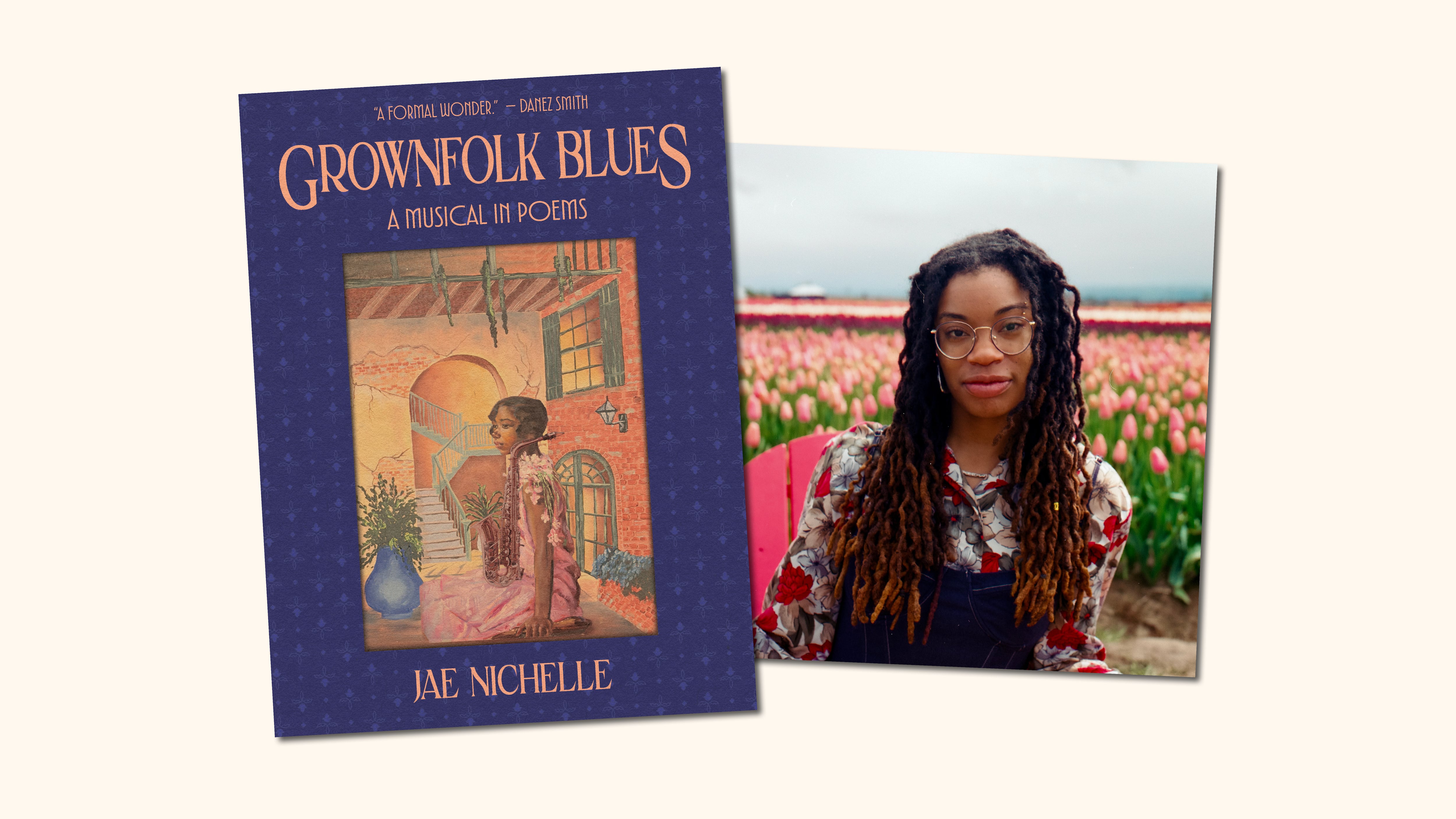
In Jae Nichelle’s Grownfolk Blues: A Musical in Poems (Host Publications, 144 pages, $20), “DEBT” in all caps is introduced in the volume’s first act as a “shifting & cracking papier-mâché mass of all white.” Once DEBT is welcomed to the stage, it “lurks in the background of every scene.” DEBT pervades; DEBT settles. Hustling and hoping, the characters in Grownfolk Blues work against it at every turn.
The premise of Nichelle’s book is simple: A queer Black woman moves from childhood to adulthood, from first love to financial and societal independence. On the collection’s imaginary stage, three neon signs are introduced at the beginning, reading, “A Job,” “A Lover” and “A Home.” Holy Grailing, these signs light up as the speaker achieves them in the course of her journey. For the speaker (introduced to the audience only as YOU), the goal in life is “to make music into / some kind of living where / I don’t mark time by disaster impending.”
The vehicle for this journey is the verse drama, two words apt to strike terror into any undergrad forced to take an intro to literature course. Hamlet is a verse drama. Oedipus Rex is a verse drama. Nichelle’s Grownfolk Blues is a verse drama also, albeit of a very different order. For one, it is not written in strict poetic form. Some poems rhyme, others don’t; some lines are short, others long. As the title suggests, Grownfolk Blues is also a musical, with a singing chorus tracking YOU’s progress, contextualizing her trials and tribulations:
bill collectors find me no matter where I move
been eying some comfy dr. scholl’s shoes
…
got no control over what other people do
defenseless against disaster or what I go through
yet people keep saying my life’s what I choose
I got the grownfolk blues
I got the grownfolk blues
Nichelle, who lives in Portland, is an award-winning slam poet, and the music in Grownfolk Blues is one of the collection’s touchstones. Euphony abounds, with lines and sentences rhythmically bouncing off one another. Consonance and assonance blossom beside direct rhymes and slant rhymes:
pocket list full of endless to-dos
options ain’t options when they all a lose-lose
dead dead dying say the grownfolk news
Sound follows sense in the book; the two are closely aligned in established forms like the sonnet. Nichelle uses those but also renders poems by way of bank statements, résumés and to-do lists, among other subtle innovations.
Hand in hand with the musical versification, the dramatic aspect of Grownfolk Blues relates a narrative of perseverance, filigreed with moments of joy and desperation. “I can count what I own / on no hands” imparts YOU midway through the text, but, dire as it is, such a realization lacks finality. YOU endures the death of her father and the toil of a mindless, relentless job. She loses her lover and the Narrator of the text, who guides the reader throughout, asserts, “Your hands are empty when you wake, the memory of holding anything eludes You.”
The world that YOU exists in is real. DEBT is forever whispering, “there’s something You is forgetting / to buy.” Happy endings are for fairy tales and, however beautifully told, Grownfolk Blues is not a fairy tale. Strife and bite are festooned within every syllable.
It shouldn’t have to be that way. But it is, and YOU makes do. If not exactly triumphing by the end of the book, YOU is living her proverbial best life. Her lover remains lost, but she has a home (sadly purchased with money accrued through her father’s life insurance policy), and a job that’s half-tolerable. DEBT is still there, will perhaps always be there, but YOU will coexist inside it, as best she can. Against its hovering, she exclaims, “say Debt, if I can’t get rid of you, you might as well / come have a damn drink.”
Most importantly, YOU has friends, real ones, the kind that grownfolk need in order to make it through. Just before the final curtain, ending stanzas of the collection read:
…what’s left after the copay,
the workdays’s last click and screen?
our voice, our voices, rehearsing to fight
again for our body. each day,
there are subtle options age provides.
we can, we can, & we do own ourselves
& today, we are building the world
with our friends.
my baby, it’s fragile.
YOU will face what’s next with her community behind her. The blues will come back, to be sure, but she will not be alone.
Grownfolk Blues: A Musical in Poems is the type of collection that widens the form, refusing to reduce poetry to one single thing. It is a play, it is a verse narrative, it is an exclamation of emotion and intellect and song. And it is emblematic of the current state of the art form, where poems are regularly not one thing but many things.
SEE IT: Jae Nichelle reads from Grownfolk Blues: A Musical in Poems and moderates a conversation between poets Hieu Minh Nguyen and Paisley Rekdal at Portland Book Festival on Saturday, Nov. 7. Reading: Portland Art Museum, 1219 SW Park Ave. 1–1:15 pm. Conversation: Brunish Theatre, 1111 SW Broadway, 4th floor. 3:45–4:45 pm. Portland Book Festival tickets are $23.