Skip to main content

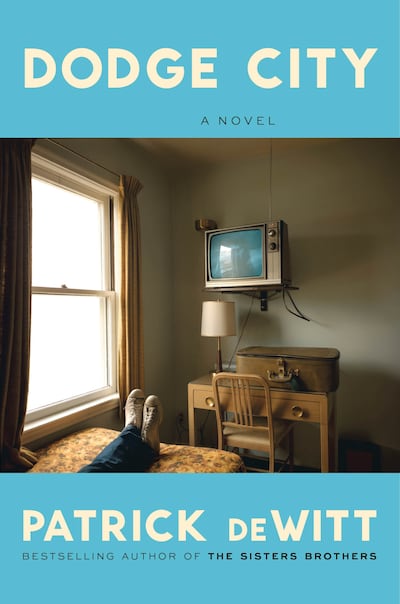
Lee Clarke has a problem. They’re throwing a war, and he doesn’t want to go. And so in Dodge City, Portland author Patrick deWitt’s latest novel, Clarke does what anyone would do: He sells his car, commandeers someone else’s Jaguar, and lights out for New Jersey with a bag full of amphetamines.
On its face, Dodge City (Ecco, 256 pages, $28) is a 1960s-era road novel set in California, maybe the most traveled American literary genre there is. Getting into a car and going nowhere is how Americans tend to find themselves, whether it’s Jack Kerouac leaning forward into goodbye and a “too-huge world,” or a perimenopausal Miranda July character discovering the end of her marriage over and over in the same motel.
But if the outline seems familiar, the texture is something else altogether. After six novels, deWitt still manages to surprise. From darkly comic Western The Sisters Brothers (2011) to the amoral fairy tale Undermajordomo Minor (2015) or surreal comedy of manners The French Exit (2018), deWitt’s books have inhabited one trodden genre after another, then twisted them from the inside like a screwdriver in the gut.
With Dodge City, deWitt shows he’s still one of the most entertaining literary novelists at work today. The America that deWitt chronicles is Charles Portis America, Joy Williams America: a rootless place inhabited by cheery maniacs, equal parts lonesome and unintentionally funny.
In the “lunatic reality” of a draft office presided over by a lithograph of a crying and bloody-taloned eagle, an error of paperwork that sends Lee to the Vietnam War can never actually be called a mistake. It is instead a bemusing curiosity, for a bureaucrat so becalmed at the war machine’s center he almost seems the only sane person in the book.
Draft officer Dewey is a brick wall of a creation, “a large man at a small desk drinking coffee from a paper cup and wearing the worn-down eyes of the individual who had come a long way for not so very much.” The arch dialogue that leads Clarke inexorably to Vietnam, and throughout much of the book, often lies somewhere between Zen koan and “Who’s on First.”
“I do not want to go to Vietnam.”
“No. I’m sensing that.”
“But what can I do?”
“What indeed.”
“Yes, what?”
Yet despite being a road-trip novel about draft dodging, Dodge City seems mostly uninterested in either subject. Lee Clarke is not a romantic or a sightseer, nor a member of the smug “new freedom” he sees going around in the Southern California of 1965. He is instead the sort of car-loving, shoulder-shrug nihilist you could meet in any small town in the Pacific Northwest, where libertarianism is less a form of politics than an in-born disposition.
Lee might go to school in Los Angeles, at least until an “event of violence” disenrolls him, but he comes from Concrete, Washington—a very real 800-person town at the northwestern edge of the country, forged from the confluence of two cement companies each named after Portland. It’s not far, really, from where deWitt himself was born, on Canada’s Vancouver Island a dozen or so miles west of the San Juans.
But the Concrete of Dodge City is not a place. It’s an idea, a half boarded-up Anywheresville with “dandelions growing from cracks” where men once worked at “the factory” but now might have to resort to being the town’s drunken dog catcher. It is a place not to be from, but to leave.
The real meat of the book is a farewell tunnel into Lee’s past. The whole idea behind this draft-dodging road trip is that Lee will visit each and every member of his family while on the way to Canada. Each sibling or parent is spread out conveniently in a line along America’s northern edge: his louse of a brother, his philandering sister, the mother who abandoned them, the father abandoned by them all. The net effect is a speed date with one’s own family, or a somewhat methy bout of encounter therapy.
Dodge can dawdle or founder, here and there, when the narration attempts to find the meaning in all of this—when Lee, not naturally prone to inward thoughts, is given too long to introspect while on the road. But these moments are rare. Dodge’s poignance, when it comes, arrives instead from moments of small but wondrous observation, as when a wrinkle-faced dog being fanned by its owner turned “its drooling face to meet the breeze, and delicately shut its eyes.”
It’s a surprisingly tender book at its heart, but it is not sentimental. It is a constantly amused American picaresque on par with the book it most resembles, Norwood by Charles Portis: in love mostly with the stubborn particularity of humans, who might dumbly take their shoes off in the rain to keep their feet from being wet, then endure open mockery on the street.
Like that book, Dodge again and again left me prone to laughing alarmingly in front of strangers, while on a bus or at a counter, myself also always underway.
SEE IT: Patrick deWitt appears in conversation with novelist Katherine Boland as part of Portland Book Festival at the Dolores Winningstad Theatre, 1111 SW Broadway, pdxbookfest.org. 1:45 pm Saturday, Nov. 7. Festival tickets sold out.