Skip to main content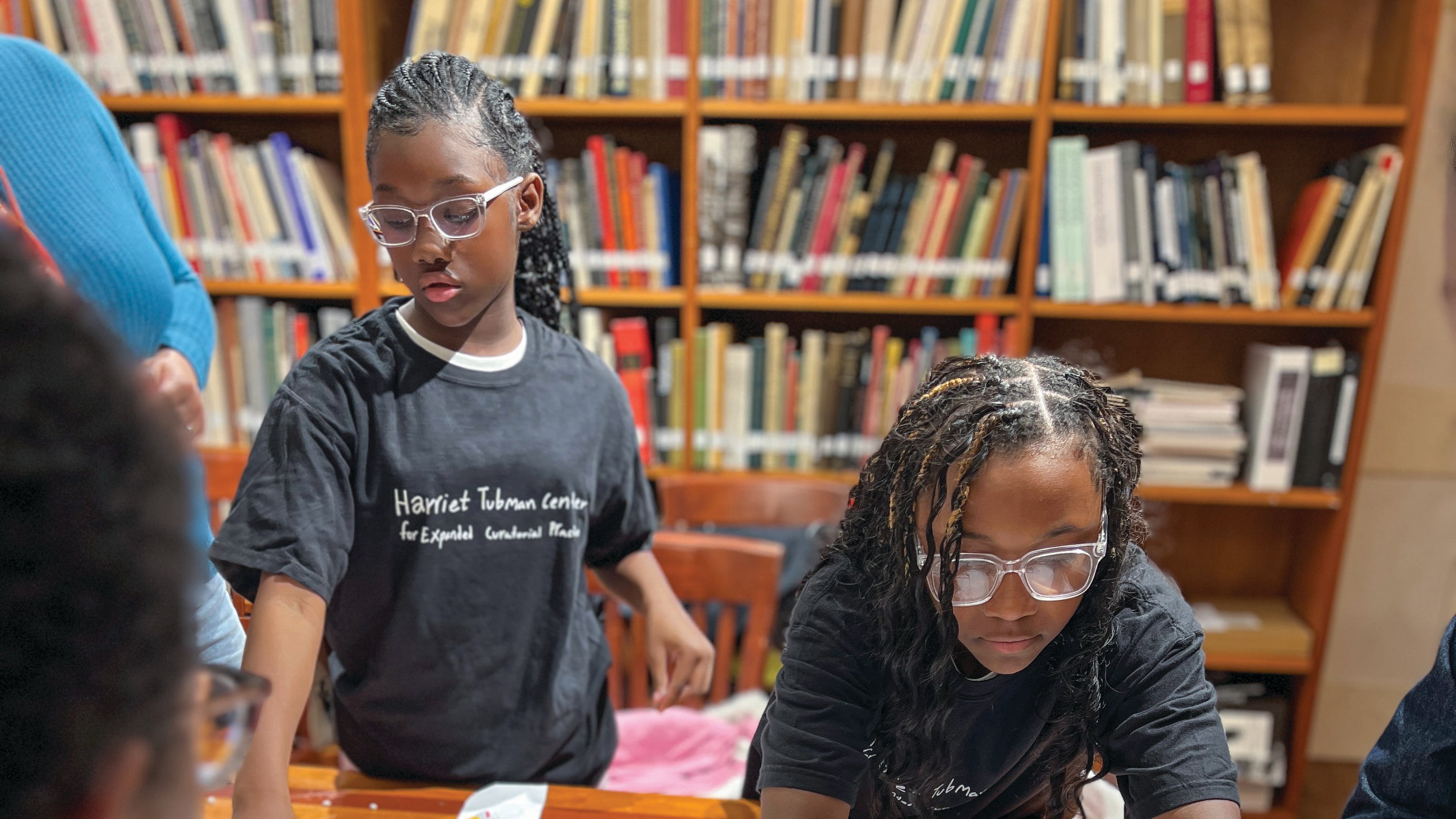
For the past year, a group of fourth and fifth graders have been curating an exhibition at the Portland Art Museum. They spent a lot of time in the vault, a secret warehouse holding everything in the museum’s extensive collection that’s not currently on display. After schmoozing the right bigwigs and much voting and discussion among themselves, the 9-, 10- and 11-year-olds realized their vision.
Now, school’s out and the exhibition is up in PAM’s new Black Art and Experiences gallery.
At a “meet the curators” tour earlier this month, the students led a few dozen visitors through the gallery, stopping to speak on the importance of specific works as they went, giggling only a little. They carried microphones and wore matching heart-shaped sunglasses and hoodies that read “CURATOR” across the back.
The show came out of a collaboration between PAM and the Dr. Martin Luther King Jr. School Museum of Contemporary Art, an education-focused museum inside King Elementary in Northeast Portland. Founded in 2014 by Portland State University professors and artists Lisa Jarrett and Harrell Fletcher, the program gives kids hands-on experience working as curators, preparators, artists, gallerists, writers and docents.
Jarrett, whose own exhibit Tenderhead is showing at PAM through January, led the students’ curatorial process. Seventeen students from King Elementary collaborated with grad students at PSU and other adults who usually hang around the museum.
“For most of us, we come to a museum and experience a show, but we have no idea how the work got here in reality, and most of us don’t even know that museums have vaults,” Jarrett told the tour group. “To be able to access these spaces and learn about them directly, as primary research as opposed to secondary research, was super valuable to the students.”
Jaleesa Johnston, a PAM curator who works in the Black Art and Experiences gallery, hosted the students’ visits and assisted in coordinating the show. “They’re just so fascinated by everything,” Johnston tells WW. “It made for a really engrossing experience. There was no way to be with them and not be fully present.”
Johnston credits her own career in the arts to a teacher who took her and a few students to visit an art museum. “At the core of it, it is really making sure that young people understand what’s available to them,” she says. “Some people really feel at home in museums, and there are a lot of people that don’t.”
In this setup, Johnston says, it took only a few visits for the kids to get comfortable. “They know the space,” she says. “They know the people that work here. And there’s familiarity and comfort that they have.”
The gallery features 27 different pieces the kids picked. They also orchestrated the layout and display methods for each work and even chose wall colors to complement their selections.
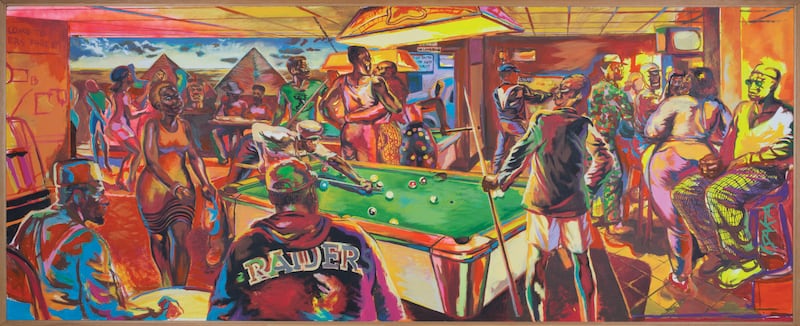
Brothers Phree, a 1990 painting by Portland artist and civil rights activist Isaka Shamsud-Din, is the first thing you see upon entering. It’s a rich, electrically colored scene of a group shooting pool at the now-closed Alberta bar the Welcome Inn.
“In Isaka’s piece, it looks like there’s community and people getting together to play something or do something,” says Laveah, one of the King School Museum’s students, in an audio guide that accompanies select works. “There’s all types of color on peoples’ clothes, their skin color, and that looks really cool because it looks like it’s not even real.”
Aniya, another King School Museum student, chose to display a letterpress print by Hank Willis Thomas. While Aniya might know Thomas is a world-renowned artist with work in the permanent collections of pretty much every major museum there is, in the audio guide, she notes that she chose Thomas’s 2019 print Keep the Faith, Baby because it makes her think of a friend who really likes the color red.
“I just like it because it says keep the faith,” she adds. “So it’s prompting you to keep your confidence or have positive thinking.”
Thomas’ piece was inspired by a phrase he first saw as a kid, a shortened version of civil rights activist and Congressman Adam Clayton Powell Jr.’s famed quote “Keep the faith, baby; spread it gently and walk together, children.”
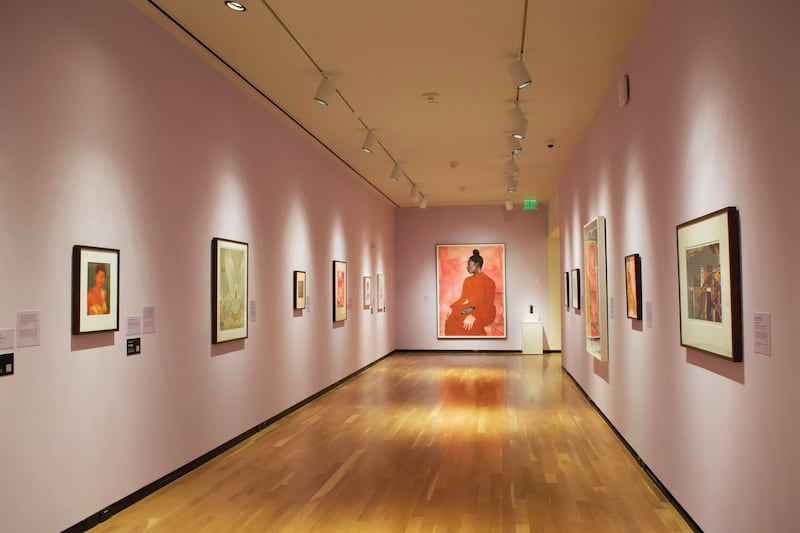
On another wall hangs a portrait by Portland multidisciplinary artist Intisar Abioto, known for her often experimental works—dance compositions, writings, photographs—documenting the Black diaspora. This photo, Nafisaria Scroggins, from 2015, portrays a young Black woman looking straight at the camera.
“She’s representing her hair,” Storie, another student, says in the audio guide. “I think she loves it, and I feel like a lot of people doesn’t like it. But she’s like: ‘You got this. Your hair is beautiful. Always represent it.’”
Beside Forrest Kirk’s 2021 painting Fist 42, a wall placard attributed to student La’Nayah reads: “BLM, Fist, Power. I am seeing a lot of colors and stripes. What I didn’t think about before is what art means!”
Kirk is known for layering unexpected materials—acrylics, spray paint and Gorilla Glue, here—into his paintings to point out and interrogate the connotations different materials carry. Per the title, Fist 42 depicts a fist held proud with swirling blue, yellow and white fingers clenched.
“I like how it represents Black power,” Storie adds in the audio guide. “It represents my culture, and I like how it represents my culture.”
SEE IT: The King School Museum of Contemporary Art show at the Portland Art Museum’s Black Art and Experiences gallery, 1219 SW Park Ave., 503-226-2811, portlandartmuseum.org. 10 am–5 pm Tuesday–Sunday, through Jan. 3, 2027. $22.50+, 17 and under free.