Skip to main content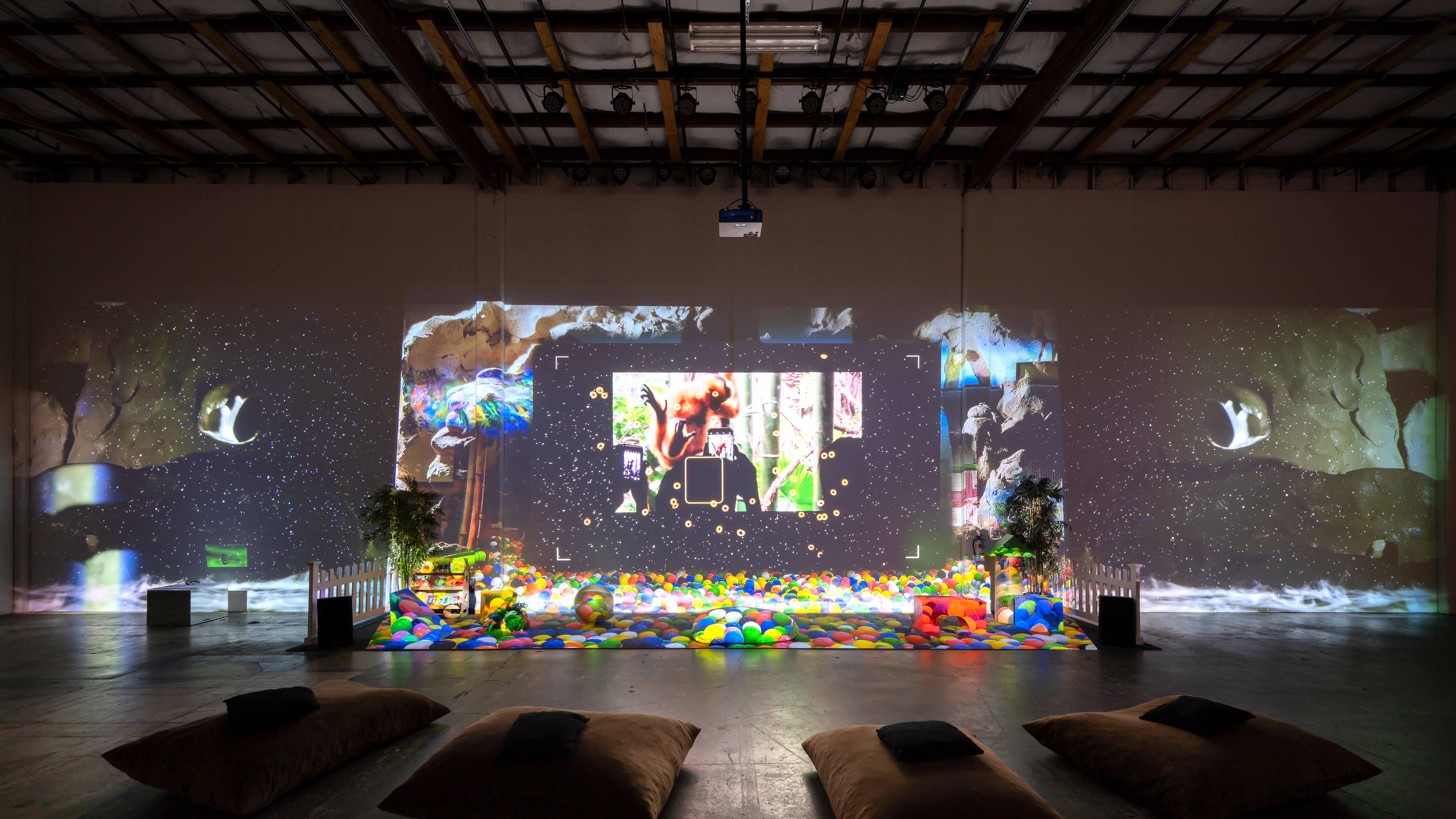
“Immersion” has become a dirty word. Whether filled with projections of van Gogh paintings or Kusama-esque Infinity Rooms, immersive art exhibitions promise a string of easy and kitsch visuals that are both attention-grabbing and, most importantly, very postable. The tourist trap vibes set an air around the whole genre, typecasting immersive art as the gimmicky little brother of serious gallery work.
Trisha Baga’s MORE is an exception. First shown in Berlin, the exhibition has been reworked for the Portland Institute for Contemporary Art as part of the Converge 45 triennial. Experiencing it involves traversing PICA’s warehouselike space while wearing 3D headgear and stumbling upon projected screens framed within staged theaters.
The title refers to one of the first words a child learns, “more,” an essential bit of human communication that’s also a greedy impulse. Splicing intimate scenes from Baga’s own home life with Silicon Valley spiels—and a healthy dose of anonymous internet joys and horrors—MORE simultaneously deploys, subverts and redefines commercialized art aesthetics.
After a brief prompting by a gallery attendant during a recent visit, I am given a pair of chunky 3D glasses and sent off into a sparsely lit room. I enter Silica, an Apple Store–esque space with dozens of clay objects on white tables. Upon study, they begin to resemble various bits of computer paraphernalia: mice, monitors, iPhone cameras. The sculptures look wet to the touch, as if they were just molded by messy fingers. Most have two holes bored through their surfaces, calling to mind the eyeholes on a pair of binoculars, or virtual reality goggles, or 3D glasses. In a short looping video that looms behind the sculptures, dachshund-sized shrimp swim around in a fish tank. A clip of Steve Jobs introducing the iMac is layered over it. Wall text explains that the objects were recovered from the wreckage of the Titanic.
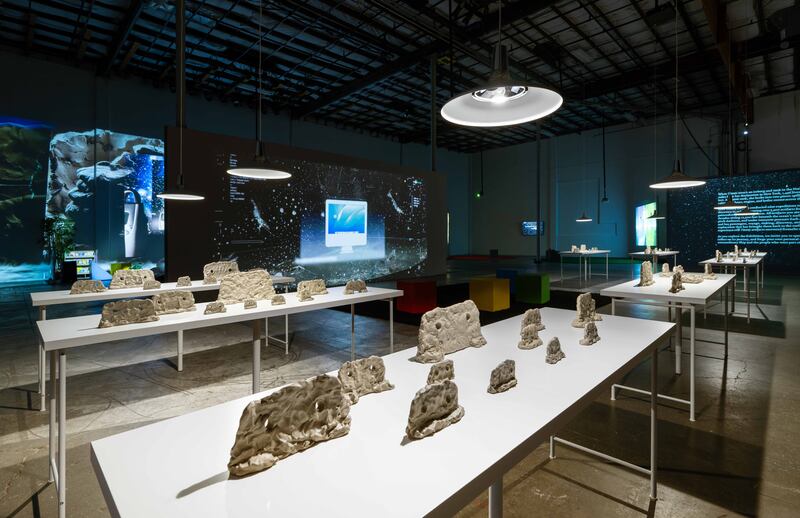
This first space warms the viewer to Baga’s logic. The New York artist is known as much for their many-layered video projections as for their expansive painting and ceramics practices, all of which thoroughly embrace the internet age. MORE breaks Baga’s five-year hiatus from video art, prompted by the new ability to shoot 3D on their iPhone.
After a few minutes in the first room, time begins to feel recursive, this wet-clay technology becomes ancient, and it all starts to feel like a playful joke. So I move past Steve Jobs and into the largest work, titled MORE and more.
I lounge on one of the bean bags placed in front of the screen, which is surrounded by props that insinuate a day care: plastic plants, a shelf of children’s books, a dehumidifier. Four overlapping projectors simultaneously transmit flurries of pirated movie clips, Baga’s iPhone home videos and a first-person view of Epcot’s Carousel of Progress. Most prominent is the launch trailer for Facebook’s Metaverse. The tech giant’s failed attempt at creating a virtual world is blown up to comedic effect through cheeky editing and proximity to Baga’s home movies.
Soon we’re in Baga’s studio and then their home, which becomes misshapen by their 3-year-old, who’s running around with a headlamp, sending leaning puddles of light across the floor. In extreme close-ups, the objects from Silica, the previous room, reappear and grow huge. The handmade becomes totemic, and the technologies ruling our lives become puny, a mere tool in the human project.
Then, alongside the videos, a buckshot of visual effects play off the day care props and obscure the reality onscreen. Shadows appear out of nowhere, silhouettes pace across the room, an outline of the physical projector is suddenly illuminated, and flashlights shine onto the screen—Baga chiming in to remind you that they made this world. I look over my shoulder multiple times, expecting someone to be causing the disruptions. Nobody is there. A low-bitrate poltergeist is toying with the viewer, with me.
A myriad of voices narrate through the visual noise. One rattles off questions that sound like a therapist or a machine desperate to understand human experience. Do you really know your parents? What is it like to taste…? Another draws parallels between raising a child and teaching a machine-learning algorithm.
I move to the final video work, which sits across from a simple looping clip of Baga’s kid playing with Snapchat filters. Titled Liquid Glass, it nods to Apple’s Vision Pro, the rarely seen AR headset the company launched in 2024. In lieu of a beanbag, I sit on a large cube and slip on the headphones that are resting on top of it. This space is smaller, more personal. An official showcase of the Apple Vision Pro’s features is interspersed with more footage of Baga’s kid and, in a meta-moment, the video editing software used to create the video shows onscreen. What is, what was, and what could be—it’s all flattened into a single plane.
Finally a familiar image reappears and I suspect the loop has restarted. It comes into focus as I take the headphones off: The branches of a tree and a roaring fire are layered atop an image of a headset-wearing man browsing the internet. He pinches to the air and the window closes, as if by magic.
“Now,” Baga’s voice echoes as I snake my way back through the room, “I prefer to do as water does, allow myself to be contained, and take on the shape of my container.” Baga has become the exhibition space, worlding their current perspective into a tender sci-fi wasteland, as contradictory as it is neat. It is an experience handcrafted to reveal the spectral undercurrent of technology. In doing so, it transfigures our collective anxiety into something human-scale, sublime and, yes, immersive.
SEE IT: MORE by Trisha Baga at the Portland Institute for Contemporary Art, 15 NE Hancock St., 503-242-1419, pica.org. Through Oct. 24. Free. All ages.