Skip to main content
Two weeks ago, Portland Parks & Recreation announced the new name it had come up with for the 6.3-acre Southwest Portland park previously known as Custer Park.
‘Scht Wiwnu, pronounced “ish-chit way-el-noo,” means “path of the huckleberry” in Ichishkin Sńwit, a language spoken by Native tribes in the Columbia River area, including the Umatilla, Warm Springs and Yakama.
The city had spent five and a half years and nearly $20,000 brainstorming possible new names to replace the one that honored the late Gen. George Armstrong Custer, the military oppressor of Indigenous peoples who died in 1876 at the Battle of the Little Bighorn in present-day Montana.
“As long as it’s a nice park and doesn’t have the name of a bad white guy, I think we’ll be good,” wrote one community member during the renaming process.
It definitely doesn’t have the name of a bad white guy, but the name PP&R chose faces backlash anyway.
The complaints vary. The resident of Southwest Custer Drive who started calling for a new park name in 2017 can’t believe it took nearly a decade. Starting in 2020, when the city officially took on renaming Custer Park, some longtime residents of Southwest Portland voiced suspicions that Custer Park was never named for the general at all, but a local family. Finally, in the past two weeks, other neighbors have been snickering about how difficult ‘Scht Wiwnu is to pronounce—and easy to turn into an obscenity.
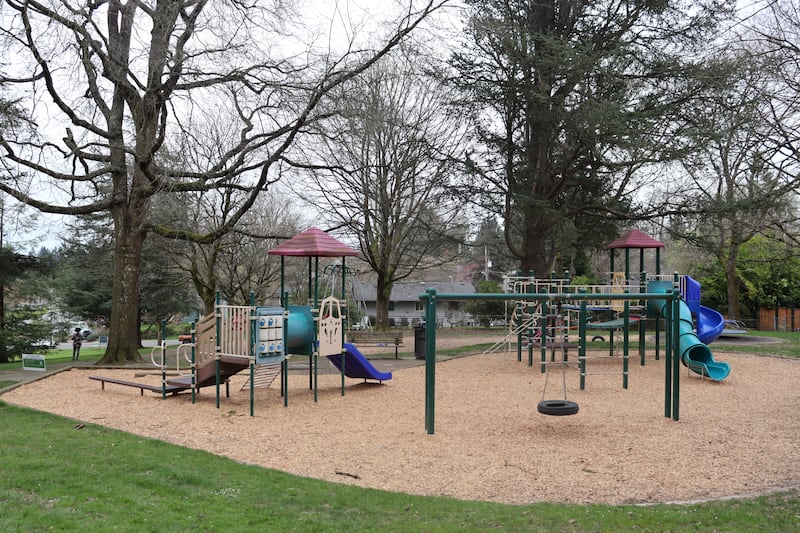
It’s a lot of history, racial tension and community dynamics for one parks bureau sign to hold. And in a city fixated on getting process right, the saga is a reminder that no result will please everyone.
The backlash is extra poignant in the aftermath of The New York Times’ investigation that uncovered that César E. Chávez abused multiple women and young girls throughout his career, leading Portland leaders to grapple with what to do about the names of César E. Chávez Boulevard and North Portland’s César Chávez K-8 School.
Amanda Fritz is the former city commissioner who stripped Custer Park of its name in 2020. She gave the park a placeholder name—“A Park”— while the city worked with neighbors, historians and Indigenous peoples to choose a permanent name.
“As we have learned this week, even with the best of intentions, you can choose a name that turns out to be problematic,” Fritz says of the Chávez fallout.
In 2017, activist Rachelle Dixon started calling city commissioners to change her neighborhood park’s name. As a Black and Indigenous woman, the name Custer Park felt like “a slap in the face,” she says. In 2018, she circulated a petition to name it Beatrice Morrow Cannady Park, in honor of the 20th century civil rights leader, publisher, and founding member of the Portland chapter of the NAACP.
Dixon has major gripes with how lengthy PP&R’s naming process was—almost a decade from when she began her informal campaign, though the formal process was five and a half years. It especially smarts that O’Bryant Square downtown was renamed Darcelle XV Plaza just four months after the death of Walter Cole (Darcelle XV), by a unanimous City Council vote.
“I’m not proud we spent nine years changing this,” she says. “The fact that it took this long makes a mockery of me.” Dixon was involved in the city’s naming committee but left partway through. She is happy with the resulting name, ‘Scht Wiwnu Park.
Nearly as soon as the renaming process started, dissent followed. Some complaints dig back into Portland history from 1954, when the city acquired the land. Greg McMickle has lived in Southwest Portland since 1967 and used to have a paper route along Southwest Vermont Street. He pedaled past many former and operating dairy farms—Raz, Gabriel, Custer and Cavanaugh (Alpenrose).
“I can remember being on my paper route as a kid and seeing cows and streams and rolling green grass—it looked just like Switzerland then,” he says.
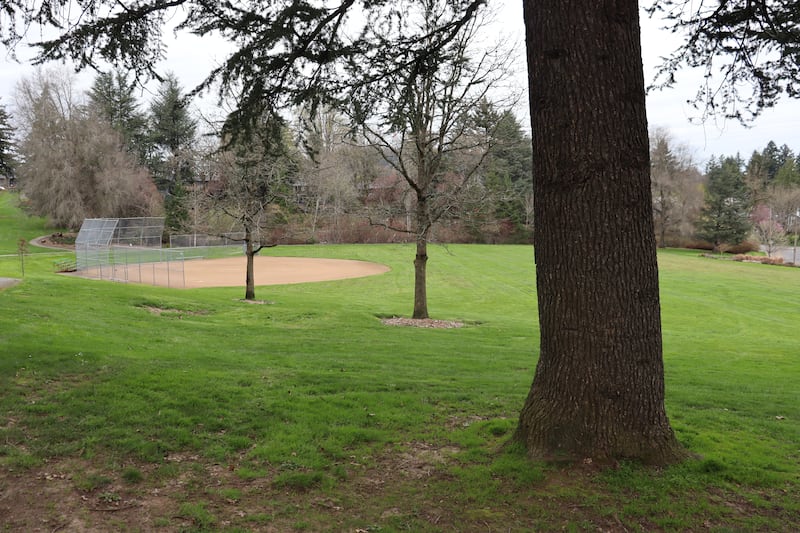
McMickle posted his hunch about Custer Park being named for Swiss dairy farmer Alois Custer on social media in 2021, but doesn’t have the documents to back it up. However, nearby Gabriel Park was acquired in 1950—four years before Custer Park—from Swiss dairy farmer Ulrich Gabriel.
“I think the city really needs to dig into the contract on that tract of land before they just nonchalantly rename it,” he says.
If it was named for the family, McMickle thinks the city should have left it alone and maybe focused its efforts on nearby Jackson Middle School instead, which is named after the seventh president, Andrew Jackson, a slave owner who also forced thousands of Indigenous people to relocate along the “Trail of Tears.”
When asked by WW, Maija Spencer, the parks bureau’s senior community engagement coordinator, unearthed the original land deed from the 1950s in the bureau’s records. The city purchased the land from the Raz family, not the Custers, in two transactions of $6,000 and $6,320—about $150,000 in today’s money. Spencer’s best guess is that the park superintendent at the time named it Custer Park because Southwest Custer Street leads right to it. Many of Portland’s older park names come from the adjacent street or neighborhood (Laurelhurst, Kenton, Overlook), not a formal naming process like that for ‘Scht Wiwnu.
The two streets on either side of Custer—Southwest Miles and Canby streets—were also named after 19th century generals.
Fritz heard this rumor throughout the naming process.
“It doesn’t seem reasonable or likely that they would name it for a dairy farmer who didn’t seem to have much connection to Portland parks, but also it doesn’t matter,” Fritz says. “When people hear ‘Custer Park’ they don’t think, oh, a dairy farmer.”
Finally, some neighbors’ complaints concern the pronunciation. For English speakers, the park name, when sounded out, lands somewhere near “shit we knew.”
Rob Melton, a former English teacher who lives nearby, says he’s taken his grandchildren to Custer and then A Park for years. Troublemakers quickly graffitied an obscenity on the sign, so for some of that time it was labeled “A Fucking Park.” Melton averted his grandchildren’s eyes on the way to the playground.
“I was just speechless,” Melton says, when he heard the park name ‘Scht Wiwnu. Not only does he fear it will be called Shitty Park, there’s an l sound in the second word that is not visible. “Did nobody even think of that? Did nobody even run that through?”
Melton intends to call it Huckleberry Park as a compromise.
Fritz discards this grievance as Eurocentric and says Portlanders will get used to the new name, just as we have Cully’s Khunamokwst Park and East Portland’s Luuwit View Park.
The parks bureau has attempted to get ahead of the language challenge with a phonetic video recorded by Dallas Winishut, Ichishkin Sńwit language teacher with the Confederated Tribes of Warm Springs.
Winishut says he was approached by the city about a year ago to help with the renaming process and proposed ‘Scht Wiwnu, after consulting with other Warm Springs elders. He says naming the park in Ichishkin Sńwit is “really something special.”
“I look at it this way,” Winishut says. “We’re exposing our names where other names took over, like Custer Park.”