Skip to main content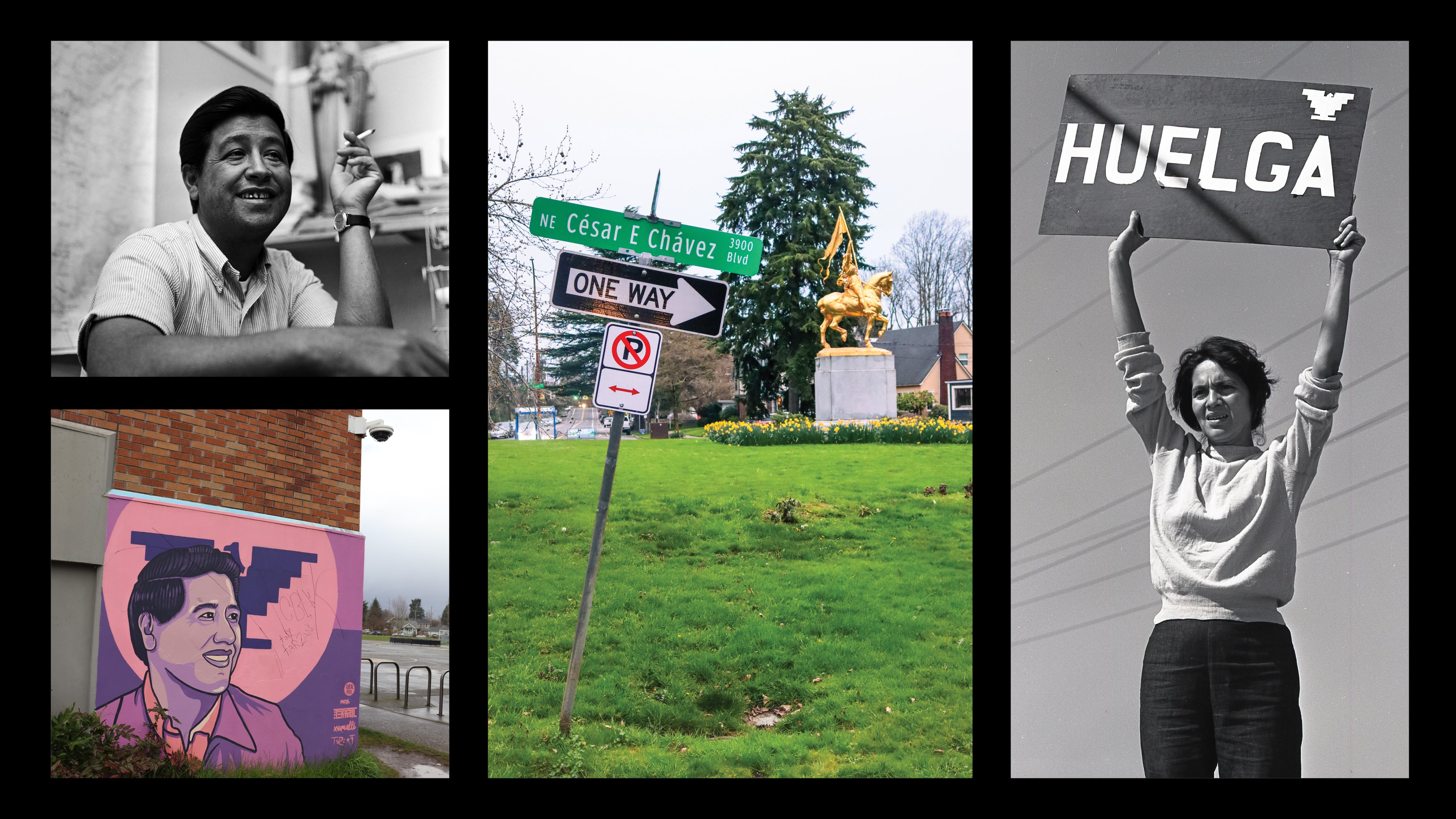
I struggled for hours to describe the way I felt after I hard the news that United Farm Workers co-founder and civil rights icon César E. Chávez was accused of sexual assault by a number of women who had worked with him throughout his storied career.
It’s surreal to identify the exact moment your heart starts to break. In an instant it dissolves away, settling down into a ball in the deepest part of your stomach and leaving a hole where it once was.
That was the best I could do.
The man who fought for farmworkers to be treated with dignity, people like my parents and grandparents, had himself enacted unimaginable violence on the women and girls who marched alongside him.
The hypocrisy was numbing.
For decades they watched as their abuser had streets, parks, holidays, and schools named after him, lauding him for his unflappable humanity. I wondered how many times they had to walk by murals with his face emblazoned on them, holding their tongues so as not to do any more harm to our already precarious communities.
One of my first coherent thoughts after feeling my heart break for the victims was that one of Portland’s main thoroughfares and, even more sickening, a K-8 school are now burdened with the name of this evil and deceitful man.
The street name was once a source of pride for me. The series of signs along the bustling corridor that runs through the heart of Portland’s eastside served as a regular reminder of my family’s heritage and an affirmation that my culture belongs here.
That changed literally overnight.
Attached to that now is a deep sense of shame and embarrassment for having celebrated a man who caused so much destruction to the people around him.
I remember coming home the day César Chávez died in April 1993. My mom was on the phone crying, the radio tuned to one of the local Mexican stations that was taking calls from grieving listeners. “A very important man died today,” my mom explained. I was 9 years old.
This was almost a year to the day after the Los Angeles riots in the wake of the Rodney King trial, where Latinos made up a third of the 63 deaths that occurred as a result, and almost half of the nearly 12,000 arrests by the LAPD.
Chávez’s death also happened a year before the passing of Proposition 187, California’s 1994 anti-immigrant law that sought to prevent undocumented people from accessing health care, schools, and other social services. Both events put Mexican and other Latino communities in California in a position where they needed to organize on a large scale. These conditions helped sweep him into instant sainthood in spite of his troubling and strange past, the details of which were not widely known or available at the time.
What followed was a wave of naming streets, parks, buildings, and schools after him. Growing up in the northern Sacramento Valley—the same valley he did a great deal of his work in—I found it easy to understand why he was being celebrated. Huge stretches of uninterrupted farmlands separate the tiny towns that lie scattered along Highway 99. You could see the dangers of picketing on roads that were never meant for pedestrians, or imagine driving to union meetings in the relentless dark. Connecting with that many people in an area like that is an accomplishment. The agricultural isolation that he used to take advantage of the people who trusted him was a constant presence.
As the century turned, his name and image were a refreshing counter to the xenophobia and hyperpatriotism that had infused popular culture after 9/11. In 2006, Congress considered yet another punitive immigration bill: The Comprehensive Immigration Reform Act necessitated widespread protests from the Latino community. (The bill ultimately failed.) Many of the events were scheduled to happen on Chávez’s birthday, bringing a renewed interest in César Chávez iconography.
In 2009, the city of Portland officially changed the name of 39th Avenue to César E. Chávez Boulevard.
Last week, Portland City Councilor Candace Avalos proposed changing the name to Dolores Huerta Boulevard, after the civil rights leader who co-founded the National Farm Workers Association. Huerta revealed in last week’s New York Times story that she too was a victim of sexual abuse at the hands of Chávez.
Whose name we replace Chávez’s with is a matter of discussion that should involve the greater Portland community, but for now the important thing is to remove any sign of that man’s name from our city.
That will be the easy part.
What will be more challenging is reckoning with the consequences of what happens when one person is allowed to become the face of a social justice movement. Over and over again, we see unchecked abuses of power revealed after the fact because a single person has been deemed “too important” to the movement to have any criticism leveraged against them. We need to remind ourselves—even if only through the simple fact that we are still here, fighting—that it is simply not true.