Skip to main content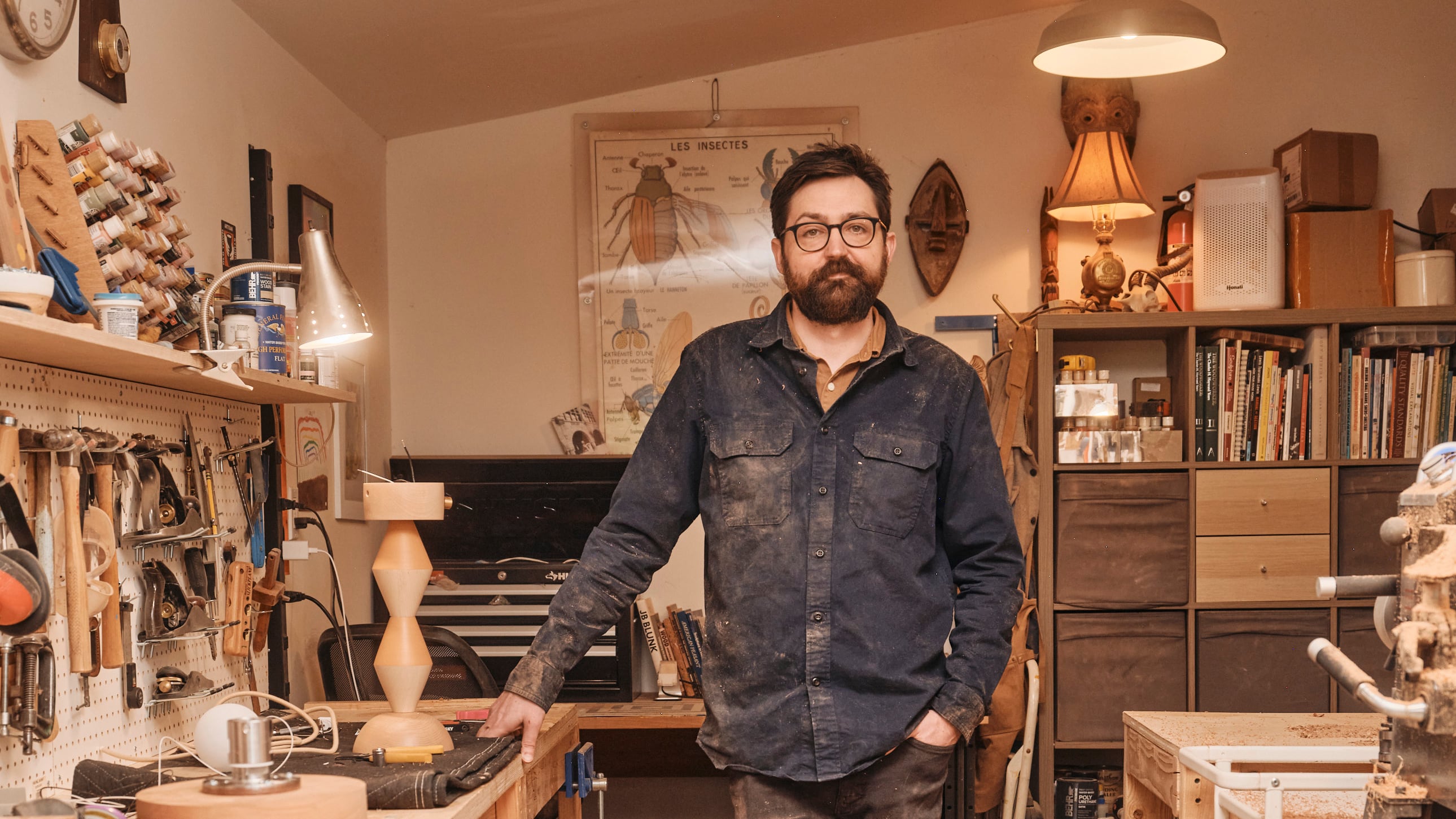
Early in his career, Brandon Walter worked as a draftsman at a fabrication shop, designing retail displays for major corporations, interactive museum exhibits, and other installations. It was rewarding work, well suited to his detail-oriented, problem-solving brain.
Soon, though, he started to feel a tad envious of his co-workers on the installation side responsible for bringing his drawings to life.
“I always wanted to do some of that hands-on work myself and not just be stuck in front of AutoCAD, drafting all day,” Walter tells Nester.
Six years after building a pocket-sized backyard workshop and rolling out his first wood lamp, Walter now has a catalog of distinctive home décor carried in galleries around the world. During the day, he still drafts. But now, at night, he crafts.
When Walter and his wife, Anna, bought their house on Southeast Yukon Street in 2017, it had no basement or garage. The following year, Anna got pregnant and Walter’s sense of urgency about building the shop intensified. He worked fast enough to dry-in his backyard workshop—barely—by the time his son, Elliott, arrived.
The shop is small—just a little less than 200 square feet. Any larger and the project would have required a city building permit, which would have doubled the $3,500 cost in fees, to say nothing of time and stress. Walter knows lots of people would have just gone ahead with a larger project, off the books. But he wanted the job done right.
Walter’s also learned strict limitations can yield clever results.
“I kind of like the constraints of a small shop,” he says. “It forces me to be creative.”
Walter built the shop before he figured out exactly what he wanted to do with it; the tiny size imposed some constraints. Scrolling social media one day, he came across a video of a man using a lathe. Then, more lathe videos.
“I guess the algorithm had me figured out,” Walter says.
He bought a small lathe and, like many a fledgling turner, started making bowls. Soon, though, he needed a new creative challenge.
“It was fun, but at a certain point, you run out of people you can give wood bowls to,” he says. “And you can only have so many wood bowls yourself.”
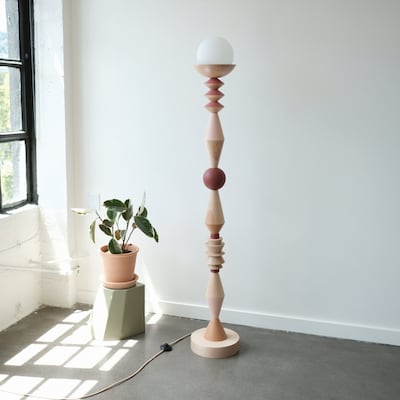
Lamps, it turned out, were a natural fit for Walter, who often works with interior lighting at his day job with Vanillawood Design Build in Lake Oswego. Thus Yukon House Lamps was born. His first homemade lighting pieces were traditional lampshade affairs. He started experimenting with form and showed a few creations to his friend Maya Rose of Lowell gallery on East Burnside Street who was impressed enough to carry several pieces, which sold quickly even at $500 each. She asked for more. (Rose tells Nester she and her friends loved the lamps so much they staged an “intervention” to get Walter to take his hobby more seriously.) He experimented some more. Interest continued to grow.
Today, Yukon House lamps are sold online and in select galleries around Portland—Lowell, Day Goods, SMG Collective—and at shops in New York, San Francisco and Tokyo.
Walter’s lamps feature clean, natural geometry in warm colors: coral, terra-cotta, dusty pink. He draws inspiration from 20th century modern organic furniture designers George Nakashima, Isamu Noguchi and Wharton Esherick, and contemporary light makers Anna Karlin, Rogan Gregory and Lindsey Adelman, who he says expand what “light fixture” can mean. He keeps sculptor JB Blunk’s monograph in his shop.
Walter prefers to work with American hardwoods. Many woodworkers these days use exotics as a shortcut for “artistic,” he says. Each piece starts as a rendering on a screen, but he’s learned AutoCAD can’t account for an engrossing whorl or a fine grain pattern. So it’s a hybrid process now.
“I never use stain because it feels sort of like lying,” he says. “I feel like if you want dark wood, use walnut. If you want a light color, use maple.”
Walter’s shop is essentially built around the lathe. On one wall is a portrait of Herman Melville; Walter once dreamed of becoming a novelist, but gradually let go of that. Above his workbench are sections of fused glass he’ll incorporate into his next pieces. He made them while visiting his mother, Kelly, an accomplished Palm Springs artist in the form. On another wall are several colorful paintings by Elliott, now 6 and younger than the shop by just a few days. He likes to be out here with his dad as much as possible.
By the time Walter commutes home from Lake Oswego, eats dinner with his family, and walks Elliott through his bedtime routine, he has only a few hours left to be in his shop.
Sometimes, he looks up at the clock and realizes it’s far later than he thought.
“I’m trying to take it slow and not push too hard,” Walter says. “I’m afraid of smothering it. I’m afraid of this becoming work.”
Find Walter’s Work: yukonhousedesign.com | @yukon.house
Make It: Lamps
Build a Lamp
If you want to try to building your own lamp, the ReBuilding Center offers precisely the class for you. The North Portland nonprofit’s three-hour Build a Lamp class covers basic electrical theory and safety; the tools you need to build, rewire or repair lamps; and inspiration for how to create lamps out of other materials. This class is suitable for beginners ages 18 and up; 16- and 17-year-olds can take the class with a parent’s permission. RBC classes are offered on a sliding-scale basis, with the Build a Lamp class starting at $60; check the website for more details and a full schedule of upcoming courses. 3625 N Mississippi Ave., 503-331-1877, rebuildingcenter.org. 9 am–5 pm Tuesday–Sunday.
Woodturning
If you want to learn how to use a lathe—the woodturning tool Brandon Walter uses to create his lamps—there are a few places to look. Northwest Woodturners regularly offers introductory and advanced classes in woodturning and spindle techniques, as well as open shop hours at the organization’s Tualatin shop. A $40 membership is required; bowl turning classes start at $65. 24250 SW 65th Ave., Tualatin, northwestwoodturners.com.
Hew Woodworking is a Lents wood shop that creates handmade furniture and home goods and teaches you how to make them. Upcoming courses on spoon carving and bowl turning are sold out, but a Turning for the Kitchen class (focused on spindle turning using a wood lathe), scheduled for April 24–26 at a cost of $335, still had space available at the time of this writing. The studio also offers private instruction for interested parties. 5716 SE 92nd Ave., hewwoodworking.com.
Nester, Makers Edition Magazine is free, distributed all over Portland, and can be found at these locations. Love Nester? Save the date for NestFest, where we bring the magazine to life at an event in Fall of 2026.