Skip to main content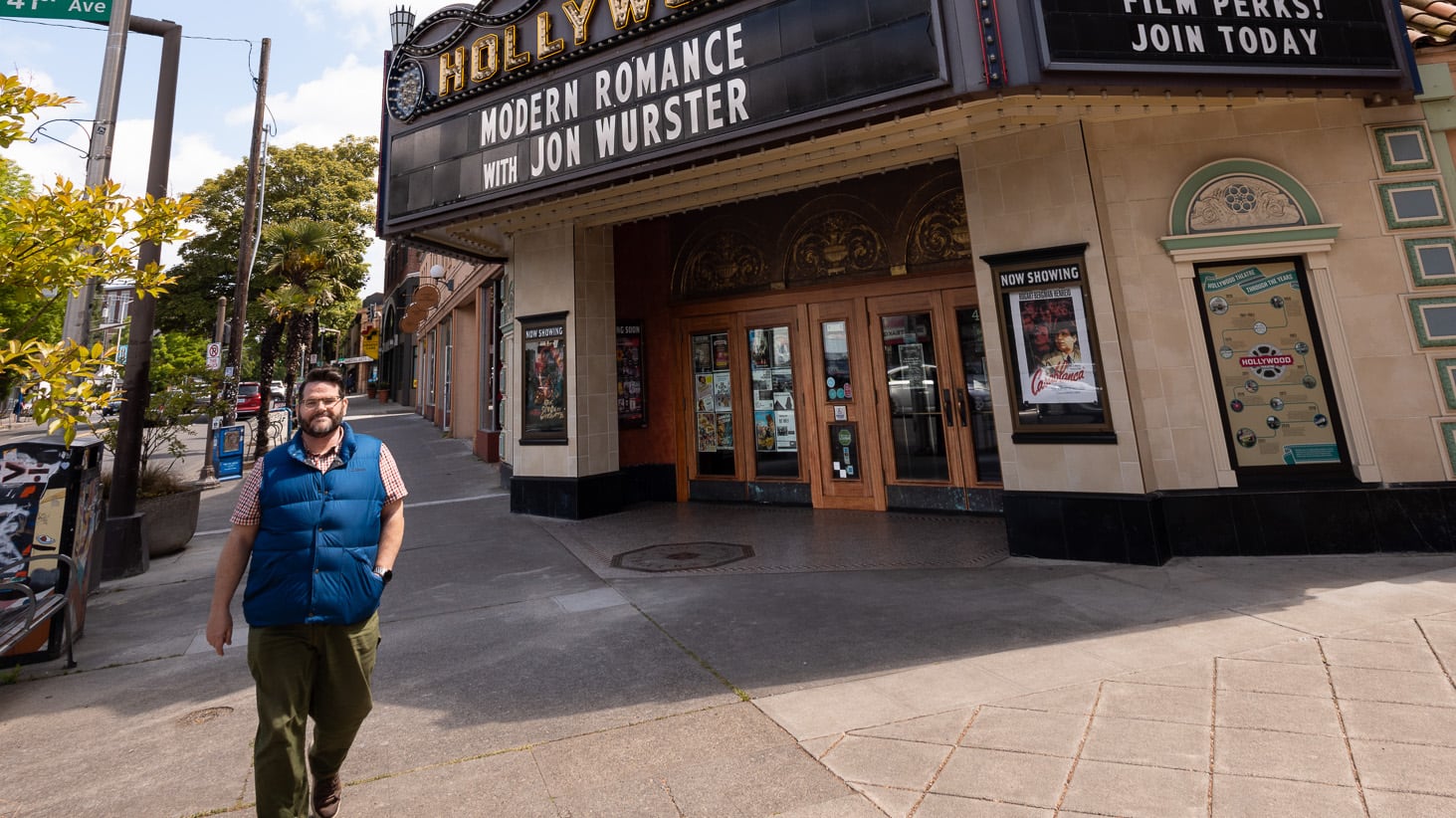
When we meet up for coffee, I find philanthropist Jeme Brelin sitting with his pool cue, sheathed in its carrying case and resting beside him near the window.
He’s planning to pop into Sam’s Billiards, where he is a regular, and he admits the iced coffee in front of him isn’t the first one he’s had today. “I have to burn off this coffee,” he says with a laugh.
For most of Brelin’s time in Portland, he and his family lived relatively modestly, with his wife working as a general practice doctor and him tutoring math students. Then a succession of COVID-era losses befell his family, leading to an unexpected inheritance, and he turned his attention to philanthropy—specifically into the transformation of Portland’s Hollywood District.
Though Brelin was born at Providence Medical Center nearby, he grew up in Eagle Creek, in unincorporated Clackamas County. As a kid, he continued to visit the Hollywood neighborhood, which he says he experienced as a glamorous microcosm of Portland itself—and a place where he fantasized about someday living. The buildings, the blocks and the businesses and the community they created remained etched in his memory even after he finished school at Tulane University, met his wife and started a family. (Their son just turned 10 the day before our walk.)
Brelin’s hand in developing the Hollywood Film District, a commercial district that expands on the historic Hollywood Theatre’s anchor to include a greatly expanded new location of the iconic Movie Madness video store, has pushed him into the spotlight as one of the neighborhood’s biggest boosters.
1. Cool Beans
We start our walk at Fleur de Lis Bakery & Cafe (3930 NE Hancock St., 503-459-4887, fleurdelisbakery.com). “Fleur de Lis pastries are fantastic,” Brelin says. “I don’t care for breakfast, but…” He trails off, sipping his iced coffee. “Their technique is among the best you’ll find in town, and they stick to the basics.” Gesturing to a small plate he’s cleaned, Brelin says, “I get a ham and Swiss croissant unless there’s a savory special. I leave the sweets for the oldsters.”
Once he’s both fed and fueled, we start walking toward the neighborhood nucleus at the intersection of Northeast 42nd Avenue and Sandy Boulevard, and he tells me more about his vision for the neighborhood.
“You want to position yourself in a place where you’re not only restoring these historic areas,” Brelin says as we walk, “but you’re also breathing life into the small community.”
2. Checking the Till
“I have strong opinions about the sandwich game in this city, and I love Tillie’s,” he says. “I go to lunch at Tillie’s again and again.” It’s a popular location; Johnny Franco, who’s also featured in this issue (see page 13), echoed a fondness for Aunt Tillie’s Deli & Pub (2000 NE 42nd Ave., 503-281-1834, aunttilliesdeli.org). “I often get a cold tuna sandwich with all the veggies,” Brelin says, “or Tillie’s Tickler if I’m in the mood for cold cuts.”
Aunt Tillie’s and its downstairs neighbor, Antique Alley, still carry the vibe of old Portland that first charmed a young Brelin. But as we walk, it’s hard not to notice the juxtapositions: Reo’s Ribs, a neighborhood stalwart that’s survived multiple fires, faces a glossy new Planet Fitness occupying the erstwhile Rite Aid storefront. The trendy (and acclaimed) neighborhood eatery Gado Gado sits in a charmingly aged strip mall beside the landmark miniature hobbyist shop the Hobby Smith and one of the city’s last Baskin-Robbins. A clandestine McDonald’s faces the ornate yet vacant Chameleon Restaurant & Bar, a real estate opportunity waiting patiently for its next incarnation. You can see the neighborhood’s transition before your eyes.
Brelin sees that transition as both necessary and exhilarating. “We have opportunities to help,” he says. “What can we make better?”
And if the response to the Movie Madness move and renovation is any indication, Brelin’s opportunistic instincts are serving not only the Hollywood neighborhood but the city overall.
“We need to ask: Can we redevelop old buildings? Can we restore them and put community-focused businesses in there? Can we save some of these empty storefronts?” he says.
Brelin’s vision of Hollywood is grounded equally in restoration and sweeping progress. As we continue our stroll, we talk about how impressively walkable the neighborhood remains.
“I can go to [Thu Fashion] and have my pants tailored, and I can get my shoes repaired right across the street,” Brelin says, referring to Hollywood Shoe Repair on Northeast 45th Avenue and Sandy Boulevard. “I mean, how many shoe repair shops are even left in town? This guy’s busy. Every time I go there, I have to wait in line.”
3. In Production
“We did this demo not for construction purposes but just to see what we were working with,” Brelin says as we step over the threshold of what was once Blackwell’s Grub Steak Grill. (Situated at 4071 NE Sandy Blvd., the storied dive bar closed in 2018.) It’s now cleared, wide open and ready for principal construction on the future location of Movie Madness, which will move from its longtime home on Southeast Belmont Street once the renovation is complete. (The current target date is spring 2027, according to the Hollywood Theatre.)
The Hollywood Theatre merged with Movie Madness in 2018. Both are owned and operated by the nonprofit Film Forever Northwest. In 2023 Brelin learned that both spaces were dealing with significant challenges: electrical and plumbing replacement projects plagued the theater, while Movie Madness had simply outgrown its Belmont location. And taking on additional debt to both secure a permanent location for Movie Madness and upgrade the theater would be risky for the nonprofit, potentially affecting donor perception and fundraising.
Brelin stepped in not only to support the theater’s renovations but to guide Movie Madness into a new era as a pillar of what he and others are working to transform into a full-fledged film district. Then he posed the question: “What if you don’t have to borrow the money?”
Brelin donated funds to the Hollywood Theatre’s renovation efforts, then bought outright the derelict and vacant Blackwell’s (for a purchase price of $1.6 million) directly across the street as the future home of Movie Madness. He’s renting the space to the nonprofit with highly favorable terms: a 10-year lease in which rent is tied directly to actual production costs. At the end of the lease term, the Hollywood Theatre receives an exclusive option to purchase the building at an inflation-adjusted cost, meaning Brelin ultimately recovers the investment rather than profits from it.
In this way, Brelin frames the project not as passive income or speculative real estate but as a civic intervention to stabilize the institution and breathe life into a neighborhood in transition.
“When you’re young, you think about all the big plans. You want to do big things,” Brelin says proudly. “And here I am, helping to fix up the neighborhood I essentially was born in.”
Brelin sees his contributions as a drop in the bucket but a substantial drop nonetheless. He gazes out from the freshly demoed 4,000-square-foot interior of the former Blackwell’s and into the hustle and bustle humming along the film district’s primary corridor before sighing.
“I’m just really proud to have done something so small.”
Editor’s Note: An earlier version of this story gave the wrong name for the tailoring business Brelin mentioned. WW regrets the error.
CHECK IT OUT: To learn more about the Hollywood Film District, visit hollywoodtheatre.org/film-district-campaign.