Skip to main content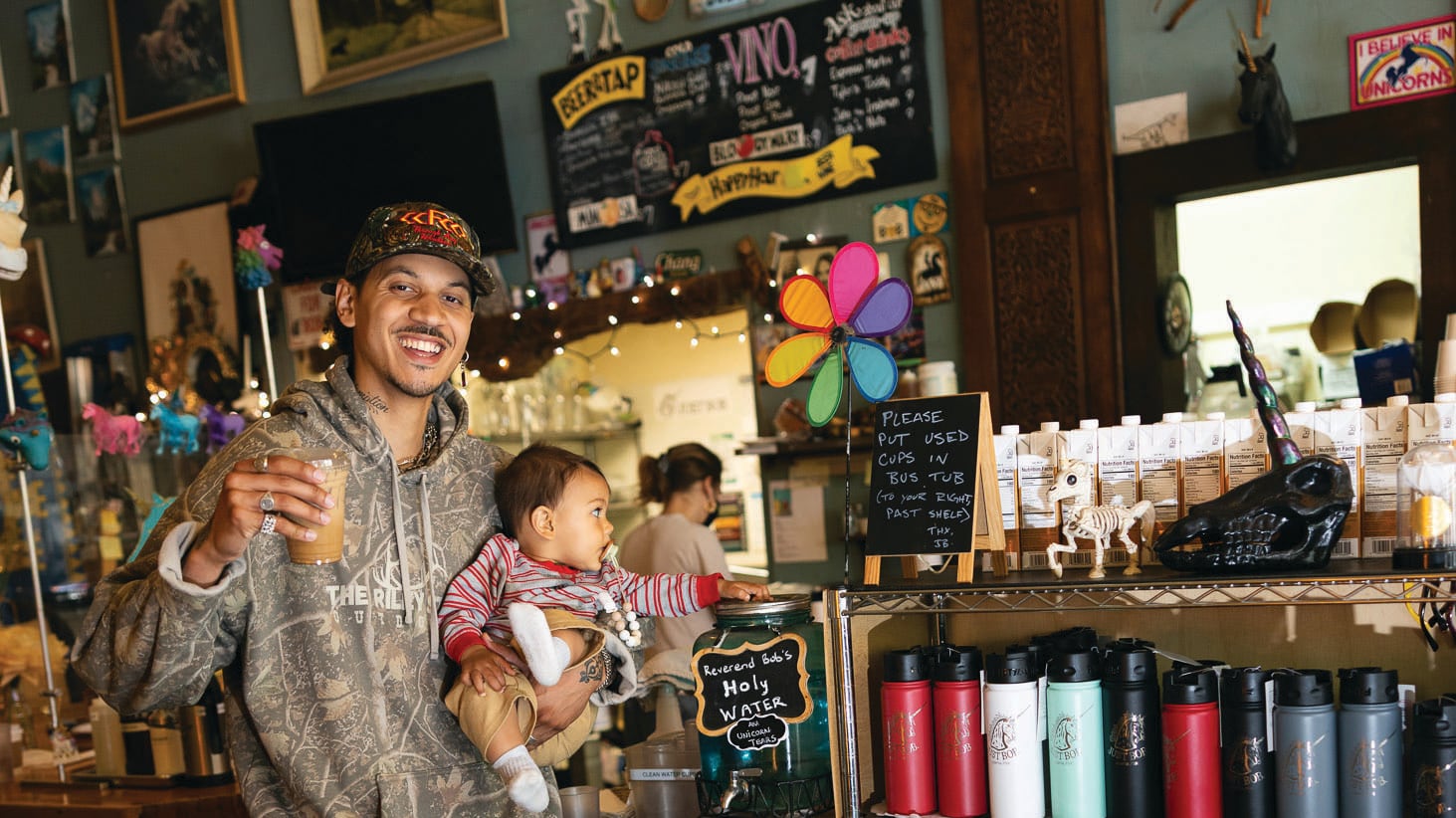
JT Flowers grew up near the intersection of Northeast Martin Luther King Jr. Boulevard and Alberta Street in the 1990s, then left to attend Yale University and, later, Oxford University. Before he headed to England, a reporter for the Portland Tribune asked if he could see himself coming back.
“I was like, I can’t see myself anywhere else,” Flowers says. “This is home for me.”
But when he returned to his hometown, he found his old neighborhood transformed almost beyond recognition.
“There was almost a mourning period where I felt a bit cooped up in my own space,” he says. “I didn’t really want to get out, because it felt like I had almost hallucinated my entire childhood as I walked around the streets here. Nothing looked or felt the same.”
Almost immediately upon his return to Portland, Flowers was hired as director of government affairs and communications for Albina Vision Trust, a nonprofit created to buy back land in Northeast Portland with the intention of rerooting its displaced Black community. Since January, he’s served as the organization’s senior adviser.
“I get to wake up every day and rebuild the district I grew up in from the ground up in a way that intentionally centers Black folks, historically displaced folks and working-class folks,” Flowers says. “I was able to step out of that mourning period into a period of imagining what this place could be—and I don’t think you can do that meaningfully without appreciating what a place is in the present tense. So I was like, ‘You know what? I’m gonna start beating up the pavement a little bit and get myself back out into the world.’”
We spent the morning in two different sections of the area known as Albina, talking about the neighborhood’s past and future, and what he loves about it right now.
1. Just Coffee
Flowers’ day typically starts at 7:30 or 8 am with meetings and calls. Then he kisses his eight-month-old son, Redemption (who joined us for the photo shoot), on the forehead, gets a cup of coffee at Just Bob (2403 NE Alberta St., 503-467-4656, justbobpdx.com) and heads to the office. He grabs a gluten-free vegan pistachio cake and chats briefly with Bob Chang, the café’s owner who opened the place in 2014 with his wife, Fayren.
“This is one of the first places I ended up landing,” Flowers says. “It’s a really special place,”
He explains that his wife’s given name is Emily, but her dad always wanted a son, so he—and the rest of the family—started calling her “Bob” for the first several years of her life. “There are pictures of her at elementary school, and her name tag says ‘Bob,’ not ‘Emily,’” Flowers says. He calls her Bob, too. When he first moved back to Northeast Portland, he and his wife were walking down Northeast Alberta Street, and when they stumbled on Just Bob, it felt like kismet.
“And lo and behold, we’ve been rocking with Just Bob ever since,” Flowers says. “I love this spot, and I think it encapsulates everything that’s special about Portland. It’s right-sized; it’s locally owned. Bob is literally behind the espresso machine right now. This is a place where it doesn’t matter who you are, how you look, how you talk, how you pray, where you’re from...everybody’s welcome within these doors. I think that’s special.”
2. A Fine Vintage
After washing down his pistachio cake with a glass of water, we continue down Alberta Street. He points out a food cart pod (the 23rd and Alberta Food Cart Pod) he loves. (Mole Mole is a particular favorite. His go-to order: the quesa birria tacos with consomé.)
Flowers is a fan of vintage shopping on Alberta. (On the day of our walk, he’s wearing a denim vest with “Austin, Texas” on it. His wife was living there when they first got together, he says.) One favorite spot: Hollywood Babylon (1237 NE Alberta St., babylonvintage.com). The store’s clothing selection is heavy on women’s items, and he likes shopping there for his wife, he says. He also loves the store’s selection of non-clothing items, like candles and VHS tapes.
But the downside of vintage shopping is that he gets “option fatigue,” he says. “So much stuff.”
3. Back to the Future
After our stroll down Alberta, we get in our respective cars and a head a little bit south and east, first stopping at Flowers’ office at Albina Vision Trust. Here he shows me three side-by-side aerial photos: one of Northeast Portland in 1948, one of the same area in 1962, and one in the present. Below them is the text “$1 BILLION IN STOLEN WEALTH.”
This article uses the term “Albina” loosely to refer to what’s now a set of other neighborhoods in close-in Northeast Portland. We started our day in Sabin and are now in Eliot, if you want to get precise. By the mid-20th century, these neighborhoods were the only majority-Black neighborhoods in Portland, due in large part to redlining practices that made it all but impossible for Black residents to buy property outside Northeast Portland.
But beginning in the 1950s, Black Portlanders were pushed out of the area, first due to a series of construction projects that razed homes (Memorial Coliseum, Interstate 5 and a hospital expansion that never happened). Over the past 30 years, rising property values have pushed lower-income residents farther to the margins.
AVT has already purchased several parcels of land in Northeast Portland. We walk to Albina One (1771 N Flint Ave., portland.gov/phb/construction/albina-one), a 94-unit affordable housing development the nonprofit developed with Edlen & Co. The organization also owns the nearby Paramount Apartments and is in the process of purchasing the 10.5-acre Portland Public Schools headquarters nearby. Within five years, AVT plans to develop 1,000 homes in Northeast Portland, and within 10 years, Flowers says, there will be 2,500 to 3,000 people living in the area.
“What I witnessed throughout my childhood here is the fragmentation of that community in a physical sense and, simultaneously, this really existential battle to maintain the spiritual and human connection to one another through distance,” he says. “This place still very much serves as a cultural, economic and spiritual anchor for Portland’s Black community.”
4. Courtside
For lunch we stop in at Cartside Food Carts (1825 N Williams Ave., cartsidepdx.com). Flowers briefly considers picking up a plate of tacos from Arelis Mexican Food but decides to hit Ko Sisters Seoul Food for a beef bibimbap bulgogi. (“Maybe I just like the alliteration,” he says.) Flowers seems to run into people he knows everywhere he goes, and this stop is no exception. After chats with both the cart owner and an acquaintance in line, we head to the adjacent Garden Tavern (1835 N Williams Ave., gardentavernpdx.com) to wait for our food.
At Oxford, Flowers studied musical performance (“I was the first rapper ever to graduate from Oxford’s music performance program,” he says) and U.S. history, focusing on the canon of Black intellectuals that have sought to legitimize Black musicians—especially rappers—as philosophers. He loved his studies but found the Oxford community stifling.
When he returned to the U.S., he found himself drawn not to Portland but to Oakridge, outside of Eugene. He’d always thought of himself as a city kid, but he was going through a difficult personal period and wanted to spend more time connecting with nature—and found he loved the community itself.
“I’d always thought of myself as a kid from Northeast Portland,” he says. “I think that [time in Oakridge] was the first time I really started to think of myself as an Oregonian, and I think that’s a testament to the beauty and magic of that small mountain community. People really look out for one another.”
He continues, “The only other place I’d ever experienced that level of intention, care and shared commitment to the joint prosperity of not just you and your household but your neighbor and their neighbor after them was right here in the heart of inner Northeast Portland and the neighborhood I grew up in.”
CHECK IT OUT: To learn more about Albina Vision Trust, visit albinavision.org.