Skip to main content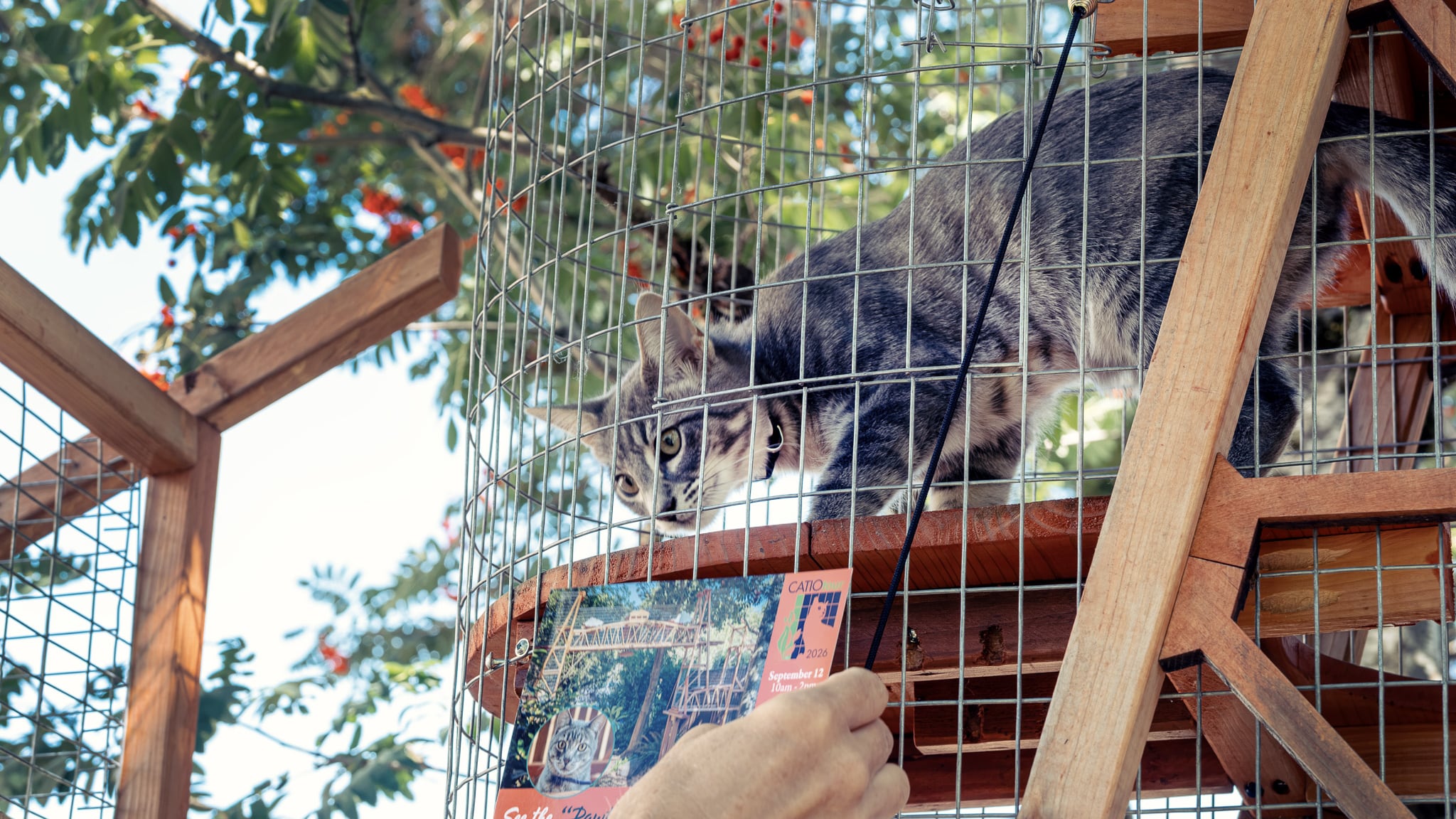
The catio, as a concept, is a compromise. It’s a way to let cats enjoy the outdoors while keeping them safe from cars and larger, predatory animals—and to keep smaller critters safe from cats and their bloodthirsty ways.
But just because something is born of compromise doesn’t mean it can’t be ambitious or beautiful.
Later this month, the Feral Cat Coalition of Oregon will host the 14th annual Catio Tour of Portland. It’s the first event of its kind in the country, born of an unlikely alliance between FCCO and the Bird Alliance of Oregon. FCCO is best known for running trap–neuter–return programs throughout the state; bird conservation groups like the American Bird Conservancy have often criticized TNR programs on the grounds that, despite the intent to control the outdoor feline population, letting cats roam free can do real damage to wildlife numbers.
“Most of the cat and bird groups are Sylvester and Tweety,” says Karen Kraus, FCCO’s executive director. “It’s different here, and people really do appreciate our local wildlife.”
In the 2010s, the concept of outdoor cat enclosures started to get more popular, especially in the Pacific Northwest. And FCCO, in partnership with the Bird Alliance (then known as Portland Audubon) hatched an idea that both groups could get behind: a tour of outdoor cat enclosures in Portlanders’ backyards.
“Our plan really is to inspire folks, so there’s a wide variety. We want them to dream—it’s not a tour without some dreaming—but they also need to see things [that make people say], ‘You know what? I could build it.’”
The tour is self-guided and the catios are dotted throughout Southeast Portland (it’s more bikeable than walkable). The $15 ticket price includes a guidebook with maps to each stop as well as a resource guide for aspiring catio owners. The coalition of sponsors, which also includes Multnomah County Animal Services and Bird Conservation Oregon, is known as Cats Safe at Home.
The tour will include 10 catios, ranging from rather straightforward kitty kennels to elaborate works of art. WW got the chance to visit a few in advance.
Stop 1: The Catwalk
In the spring of 2020, Alex Boyd—like a lot of us—found herself stuck at home with a lot of time on her hands. She decided to build a catio.
It started out as a simple, rectangular enclosure extending from her kitchen window. But later that year, Boyd, a senior manager at Nike, decided to add a tunnel across the railing of her deck, which, before terminating at a small, cat-sized gazebo, runs across the back of a couch on the porch.
“We can sit on the couch and they can come and hang out with us in the tunnel,” Boyd says.
Boyd says the initial construction took about a month, but she ended up rebuilding the tunnel to make it wider, which took another four to six weeks. (She did most of the construction herself, she says, though her father assisted with parts.) She’s unsure of the price tag but says it wasn’t “massively expensive.”
And it was worth it. Now Horatio, a 4-year-old orange and white cat, and Wellington, a 13-year-old brown tabby, can decide where they want to be, depending on the weather.
Stop 2: Moonrise Kittydom
When Goober and Mango Hirschbein want to get a little fresh air, they do what a lot of Portlanders do as part of their daily routine: They take a bridge.
An 80-foot bridge extends from a microchip-protected cat door in Sheryl Hirschbein’s bedroom to the enclosure in her backyard. Here, the 6-year-old Maine coon littermates can climb a real tree—an apple tree Hirschbein’s neighbors removed while building a shed. Or they can nap in a big dog bed, cross a series of bridges near the ceiling, or simply rest on one of a series of window perches.
Hirschbein built the catio five years ago, when her cats were kittens, with assistance from a neighbor.
“There was no design; we just broke ground,” Hirschbein says. She took out a dog pen that had previously occupied the space and had a landscaper put in pavers. “Then we just started building, just on a whim.” Originally, they thought the project might take three weeks; instead it took about five months. The projected $5,000 budget also swelled to $12,000.
While the end result has a whimsical vibe, it’s far from haphazard. The catio sits in the shade, where the 6-year-old littermates can run in their wheel or sit on a variety of perches and watch wildlife. Hirschbein notes that her yard is certified through Columbia Land Trust and Bird Alliance of Oregon’s Backyard Habitat program; homes with outdoor cats can’t be certified through the program, but those with catios can.
“I’ve had cats forever,” Hirschbein says. “When I lived in Chicago, they were indoor cats, and then I moved here and had cats, and then I had another set of cats. I was like, ‘When they’re gone, I’m not getting cats again until I have a catio.’ I just want them to be outside and I want them to be safe.”
Stop 3: Kitty Crossing
Like Goober and Mango, Dave and Debbie Dicks’ cats also enjoy a bridge-assisted commute. Blackadder, Earl Nimbus the Gray, Little Boy Puck and Fezzik range in ages from 4 months to 12 years.
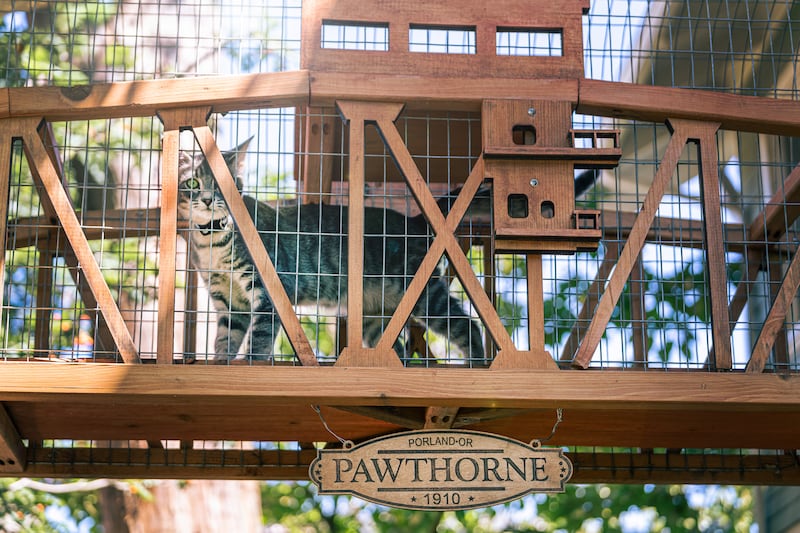
Unlike most Portland commuters, who must sit and wait when a bridge is raised for marine traffic, the Dickses’ menagerie can head over the Pawthorne Bridge whenever they feel like it.
The Dickses’ son-in-law, Thomas Arboren, finished building the Pawthorne Bridge last August. It’s the second catio constructed at the Dickses’ Brooklyn neighborhood home; the first, a simpler box-style catio completed three years ago, sits on their back porch. And it’s not the last: Arboren is working on a second bridge, modeled on the St. Johns Bridge (the CAThedral BRIDGE), and has plans for a third, modeled on Tilikum Crossing (the Tailikum Crossing).
Dave Dicks, a retired software engineer who helped with the project when he could, estimates it took “a few hundred hours” to complete, and he isn’t sure of the final price tag.
According to Debbie Dicks, Arboren had built a catio at his rental, which got his in-laws interested. In particular, she got excited about the idea of a catio that would act as functional art. The bridge, which spans the Dickses’ side yard, is permanently raised so nobody has to duck when walking through the backyard.
Now the Dickses say Arboren, who has been documenting his work on Instagram at @arboren_cathedrals, is considering building catios professionally.
GO: The 14th Annual Catio Tour of Portland, catssafeathome.org/catio. 10 am–2 pm Saturday, Sept. 12. $15, includes digital guidebook.