Skip to main content
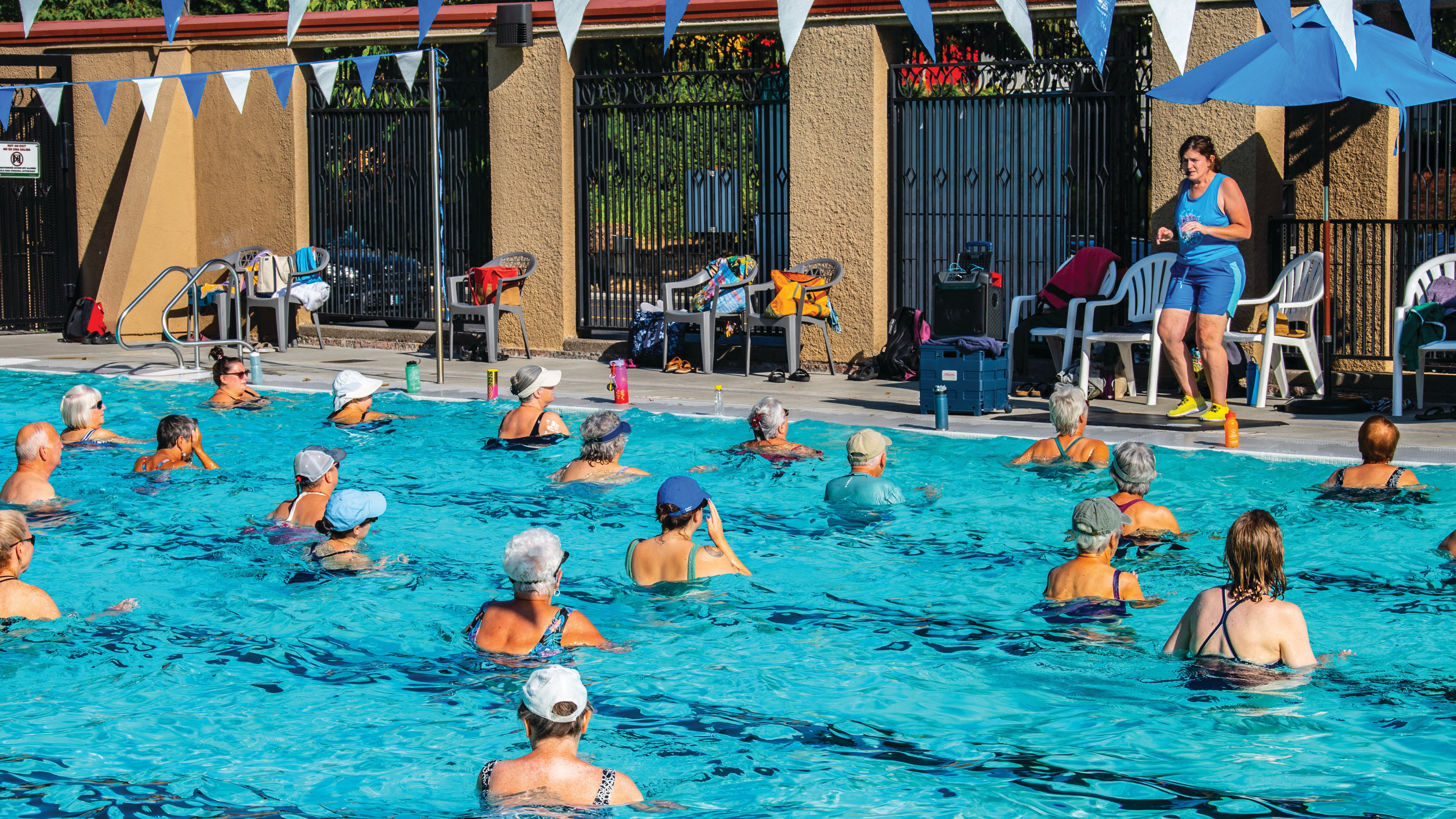
Aquafit has saved my life at least twice.
In 2012, I was riding my bike home late at night and hit a parked Suburban, clipping the rearview mirror with my shoulder. I fell into the street and, when I stood up, I felt a terrible stabbing pain right through the center of my left foot. I rode home, made a half-hearted attempt to sleep and took the bus to the emergency room the following morning. There I was diagnosed with a minor fracture and sent home with a bottle of painkillers and the walking boot in which I’d spend the next three months. At the time, I paid the bills with a combination of freelance journalism and caring for adults with disabilities; the injury forced me to go on unpaid leave at the latter job.
Did I mention this all happened in the middle of February?
I’m a near-textbook introvert, but I also loved working with people and making a concrete difference in their daily lives. Before the accident, I walked and biked almost everywhere; for the first few weeks afterward, hobbling to the corner store and back made me feel like my foot had filled up with broken glass. I was broke. I was restless, but also sedentary. A light had gone out in my brain, and I couldn’t find the switch anywhere.
Then I found out that a community pool near my house—walking distance even by my newly revised standards—was offering aqua aerobics classes. I’d written a story about water aerobics years before, and I knew it was popular with older people because it’s one of very few forms of exercise where you can fully avoid impacting your lower limbs. I was 31, but avoiding lower-limb impact was suddenly an urgent matter. A couple of times a week, I hobbled to the pool and got in the water, where a woman cheerfully coached us through an underwater workout—a mix of familiar moves (like jogging and jumping jacks) and ones involving pool noodles and other flotation devices to isolate specific muscle groups.
I almost immediately started feeling like myself again. The endorphin rush from the workout was most of it, but the cheerful, casual conversations I had with the instructor, my classmates, the pool’s receptionist—they all meant far more to me than I thought they would.
One day my instructor—whose day job, I learned, was cutting hair—saw me putting my walking boot back on in the locker room, and asked me what had happened, then said she was glad I was coming to class. “It’s saving my life,” she said. “Let me tell you.”
On the first day of 2025, I rolled my left ankle on one of Portland’s famously uneven sidewalks and fell to the ground, incurring a grade 3 sprain. By this time, I was well accustomed to the work-from-home life, but all the tricks that had made it work for me—like daily mental health walks—were no longer available. (In fact, one of those goddamn walks had gone very badly for me.)
I could feel the light in my brain dimming again. (Did I mention that all of this happened in January?)
Once I was medically cleared for light activity, I found a gym in my neighborhood that had a pool and offered aquafit classes, so called because they include some strength training as well as aerobics; the last half of each class involves moving big plastic dumbbells through the water. Nearly two years and a sorta-healed ankle later, I still go, though not as regularly as I did in the early months post-injury.
I’m often the youngest person in the class, and that’s one of my favorite things about it. So many of my experiences with gyms have involved young, thin men trying to sell me personal training sessions by asking me pointed questions about how I really feel about my body. My answer, which they never seem to believe, is that it’s the vehicle that has carried me everywhere, and if I can move it without pain, I can accept the rest. Peak performance, for me, is simply showing up. It’s water jogging to Fleetwood Mac and Elton John. Locker-room talk is weather patterns and knee surgery and the next No Kings march. It’s feeling so much better after I get out of class that everybody around me notices. It’s letting the water carry my body so my body can carry me more easily. It’s keeping the lights on.
Don’t Knock It Till You Try It
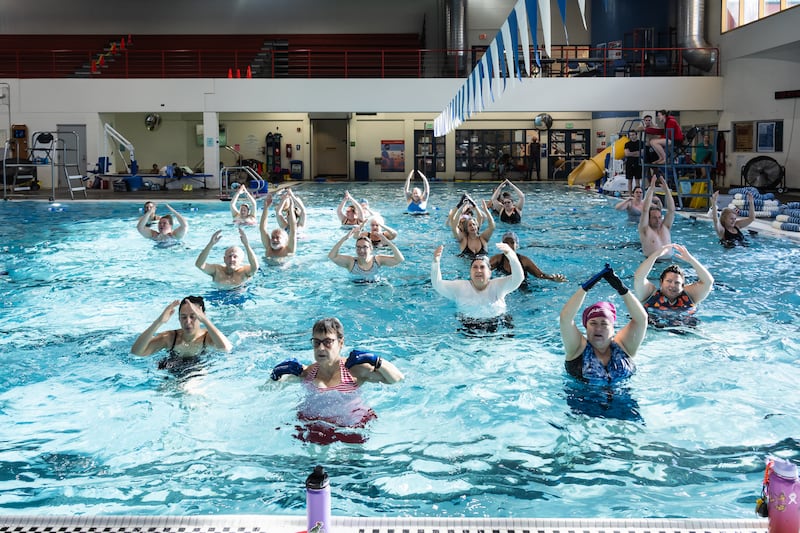
Water-based fitness is, in my opinion, for everybody, but there’s a reason it’s so popular with the over-60 crowd. Working out in water is easier on one’s joints, making it especially valuable for people with arthritis. Water also provides resistance to help build strength. If your parents are interested in giving it a try—or you are, or you want to try it along with them—there are plenty of local options. Private gyms with pools (like LA Fitness and 24 Hour Fitness) often offer some sort of guided, water-based workout class. But there are also a number of Portland community centers that offer aquafit or related classes.
Portland Parks & Recreation
The city operates four indoor pools, though one of them, Southwest Community Center, is temporarily closed. The other three—Matt Dishman, Mt. Scott and East Portland community centers—offer multiple water fitness classes per day, including Aqua Power, Aqua Zumba and Aqua Barre. Classes are included with a standard community center admission ticket, which costs $6. To find schedules online, visit portland.gov/parks/recreation/community-centers and navigate to the individual community center.
Northeast Community Center
This community center in the Hollywood neighborhood offers daily water workout classes Monday through Friday, water-based core power classes on Tuesdays and Thursdays, and deep water workouts in a warm-water pool on Saturday mornings. The adult drop-in fee is $15, monthly memberships are $74, and the organization also offers discounted memberships paid for through its community fund. 1630 NE 38th Ave., 503-284-3377, necommunitycenter.org.
Mittleman Jewish Community Center
This Southwest Portland community center offers aquafit, aqua power and water-based yoga and tai chi classes in a warm-water pool. Drop-in rate is $24 per day. 6651 SW Capitol Highway, 503-244-0111, oregonjcc.org.