Skip to main content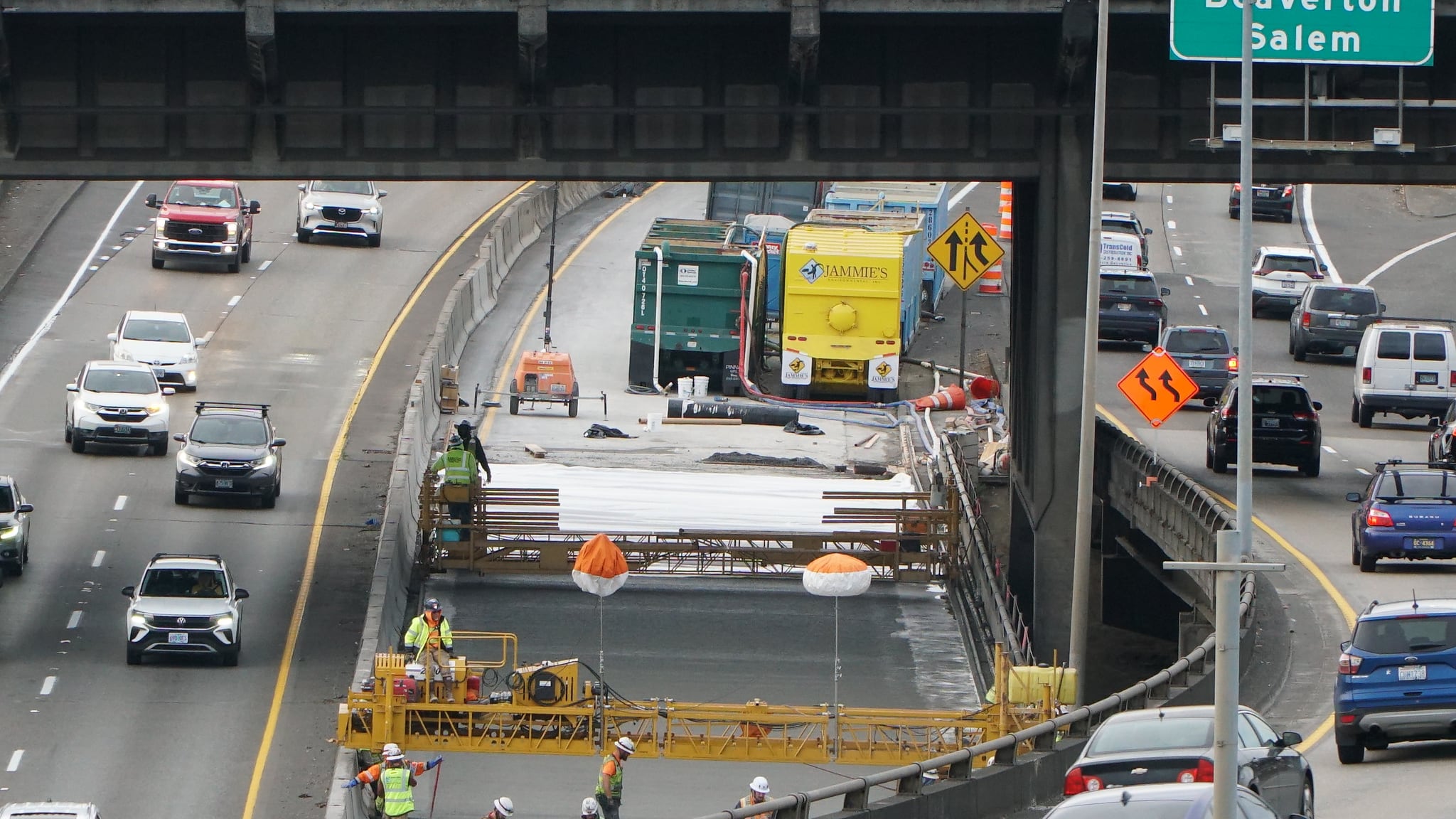
We’ve passed the halfway point of the five-week Interstate 5 southbound closure. Before the closure began Sept. 11, the Oregon Department of Transportation warned that travel times through the sticky parts—such as getting around the 2-mile closure via I-205 or I-405—could take 2 to 3 times longer than usual. It hasn’t been quite that bad, but almost: Travel times are 2 to 2.25 as long as normal during the afternoon peak.
“It’s not the worst-case scenario we could have anticipated,” says Rose Gerber of ODOT.
Gerber attributes that, in part, to the public-messaging campaign and travelers being willing to make a cultural change in how they get around town. This month has forced a unique partnership between the city, TriMet, ODOT and the public, Gerber says. Drivers are hopping on public transit, biking, walking, working from home and shifting their commutes earlier and later to ease the load on the streets.
The closure is on track to wrap up Oct. 16. A similar project is set to begin on I-5 northbound lanes in summer 2027.
Here are eight things we learned from ODOT about how freeway closure is going:
- Wednesdays and Thursdays have been the worst. Mondays have seen the lightest traffic while Wednesdays and Thursdays have gotten the most gummed up, Gerber says.
- Rush hour has spread out. Traffic data is showing that travelers are leaving earlier or later to adjust their trips, so peak hours are less intense but lasting longer, Gerber says. Morning rush hour begins as early as 6 a.m. and the evening rush goes until 7 p.m.
- Ridership on MAX’s yellow line and red line is up. TriMet’s MAX yellow line runs between the Portland Expo Center in North Portland and downtown Portland. The red line goes to the airport, through downtown, and out to Beaverton and Hillsboro. Gerber says ridership on both is up.
- We’ve gotten lucky on weather. Weather has had a very minimal impact on the schedule, Gerber says, other than one morning where the crew didn’t pour concrete due to high winds and above-normal precipitation (they need dry weather for that). “We’re still technically on our schedule, and as far as we can see, weather is not going to be a factor in the remaining work that we have,” Gerber says.
- St. Johns has been hit hard. “The St. Johns area has been hit a little harder than most during this time,” Gerber says. There is noticeably more traffic on local streets in that neighborhood, such as North Interstate Avenue, North Going Street, North Greeley Avenue and the St. Johns Bridge.
- Anything unusual—an accident or emergency vehicles—can wreak havoc. The St. Johns Bridge shut down on a Wednesday morning due to police activity, for example. Traffic stretched down to U.S. 30 and residents were seeing cars cutting through their streets to try to get around the mess.
- No bailouts for businesses. A few businesses have reached out to see if there is any compensation for revenue lost due to the freeway closure. “Unfortunately,” says Gerber, “ODOT doesn’t have a compensation fund when they do projects like this, so that’s not necessarily something we’re able to provide.” The department worked with Metro to raise awareness of the closure, put on webinars and provided a business-resource toolkit, which is still online.
- Don’t quit now. “This is the home stretch here, but stay vigilant,” Gerber says. “It is a marathon, not a sprint.” It’s important to continue leaving yourself plenty of time to travel until the closure is over mid-month. Gerber encourages businesses and commuters to look at the resources available at https://i5rosequarter.org/.