 Skip to main content
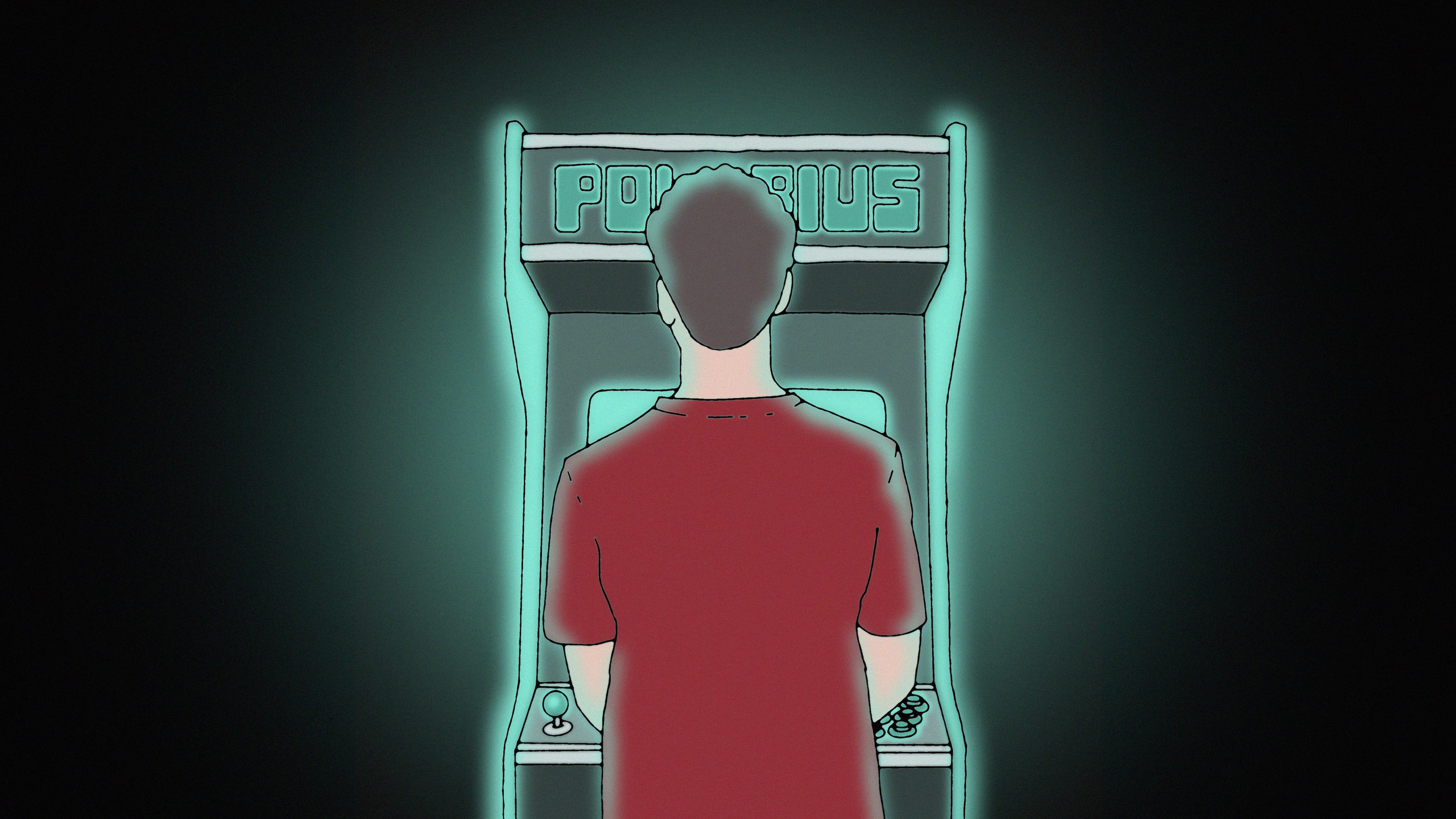
When it comes to urban legends surrounding arcade video game culture in the early 1980s, one game rules them all: Polybius. Aside from the many 21st century accounts of people who played (and reacted) to this malevolent machine, the first online mention appeared in a 1998 article at Coinop.org. Since then, stories of the brief November 1981 sightings of this rarest of black box cabinets have excited the imaginations of game nerds and journalistic sleuths.
What tantalizes about the evolving myth of Polybius is the threat it posed:
…in the early 1980s, mysterious video game cabinets cropped up in Portland’s arcades, cabinets intermittently serviced by mysterious men in black. These were the Polybius machines, and something in them wormed its way into players’ heads, destroying their memories and haunting their nights.
That’s the type of lurid description given in a 2017 Slate article anyway.
The same year, Portland Monthly wrote, “The game—a black box with no name that involved geometric patterns and colorful shapes—was instantly addictive, hypnotic, and, in some cases, dangerous.”
Investigative journalists like Cat DeSpira have been delving deep on Polybius for a long time. “Nobody ever researched it,” she tells WW. “I was the first person to ever do so. And then everybody else (no offense) kind of plagiarized me.”
DeSpira’s article, an extensive report of the legend originally published in Retrocade Magazine in 2012 and available today on her website, retro-bitch.com, calls the game “a multidecade exercise in how legends begin.”
One who followed in her wake was local journalist Joe Streckert. He gave a talk on Polybius at Jack London Revue in 2013, which was the last time WW covered the subject. Streckert elaborates today: “It was supposedly developed by some kind of weird military tech offshoot group who used some kind of proprietary behavior modification algorithms developed for the CIA. Kids who played it woke up at night screaming, having horrible nightmares. According to an operator who ran an arcade with one of these games, guys with black coats would come to collect records from the machines.”
DeSpira and Streckert are united in their skepticism. For most of the 2010s, every article on Polybius seemed bent on dispelling the myth. What has bothered me most about this cavalier treatment of Polybius’ existence is that I played the game back in 1981.
“I know all about the lore,” Quarterworld arcade COO Logan Bowden tells me via Zoom. “In ’81, ’82, every month, people would bring their pickup trucks over to these distribution centers, and they would just load up these arcade games and take them over to convenience stores and drop them off. It was the arcade boom. And anyone that had a little convenience store was taking them in. Jake’s Corner Market might have these games and Nancy’s Corner Market might have these games.”
Bowden went on: “The association with MKUltra. The CIA. The experimentation with the flashing lights. It puts you in a long-term hypnotic state. These were all the telltale signs that you’d been in touch with Polybius.”
It was inside a rural convenience store called Craig’s Market in Monroe, Ore., where I witnessed video game history unfurl month by month. After cutting my teeth on a neighbor’s home Pong system, I first played Space Invaders, followed by Asteroids, Battlezone, Pac-Man, Scramble, and Defender in that little concrete-floored store with its meat counter, seasonal fireworks displays, and comic book rack. Each month, a new cabinet would appear, and we would turn in bottles and cans for deposits, cash in our nickels and dimes for shiny quarters, and zap our way to space and beyond.
Anthony Dandrea is a co-owner of Portland’s Ground Kontrol Classic Arcade and Bar. He was at the right age, but in the wrong geography back in 1981. “I was a gangly 13-year-old in a distant wasteland known as Northern Ohio, completely obsessed with computer and video games. I did the rounds regularly because a crazy new game could appear anywhere one week and be gone by the time I told my friends at school. Someone witnessing a Polybius-like game that disappeared before they could get a record of it totally fits how things were then.”
The 2017 Portland Monthly article also mentioned that Ready Player One author Ernest Cline recalled “hearing about Polybius as a whisper across the arcade game floor as a teenage gamer in central Ohio.”
Polybius was a phenomenon local to Oregon, though. As Bowden, of Quarterworld, says, “It’s one of Oregon’s legends. We have to share Sasquatch, but we don’t have to share Polybius.”
I spent a great deal of time in the backwoods of Oregon’s midvalley and never spotted any signs of Sasquatch. But I have a vivid memory of plunking a quarter into a Polybius machine on a cold rainy November day in 1981. At age 8, I found the gameplay baffling; the memory is bereft of the fond association that so many other titles from the era earned. What I do recall that jibes with the legend, however, is intriguing.
There was a Monroe High School boy who excelled at these games. Give him a quarter and you could watch him beat the machine and roll over the high score. A small crowd would gather around him to watch. I once marveled as he collected the final base in Scramble eight times in a row. But it was during Polybius’ visitation that things went awry. It was the first time I’d seen someone stuff a leather wallet into a person’s mouth to keep them from biting off their own tongue during a seizure.
As Slate reported: “…there were stories circulating at the time about players having medical crises after diving into certain video games—most notably a title called Tempest. Second, federal investigators really were investigating the arcades of the day, which may explain those reports of men in black.”
While no writings on Polybius exist from its brief heyday, many news clippings of kids getting sick and having seizures and migraines after playing arcade games for long stretches do. DeSpira’s theory is that kids like to tell stories, and her article collects a web of felicitously timed news stories to re-create the Polybius story in reverse. In her telling, the myth of Polybius was born at a Beaverton go-kart track:
Malibu Grand Prix arcade, on November, 27, 1981, beginning at 11:00 am, 12-year old, Brian Mauro, as recorded by The Oregonian newspaper, blasted away at Asteroids over the Thanksgiving Day 3-day weekend, in a bid to break the world record of 30.1 million previously set by 16-year-old Dennis Hernandez of Geneva, NY.
Mauro tapped out after 28 hours of gameplay. “12-year-old fizzles out in video try,” was The O’s headline.
DeSpira chalks up my firsthand Polybius experience up to the Mandela Effect. I’m another ’80s kid with a story. Anything is possible, though I defy anyone to test my powers of recollection regarding obscure heavy metal bands and early D&D statistics. If anything, the game remains in my mind because I was turned off by it, which sets it apart from my timely obsessions with Star Castle and Donkey Kong.
“There are things I did uncover about it that I never told anybody,” DeSpira says today. “I received numerous letters from men who had claimed they had been in government experiments. I’m just naturally a skeptic. So anytime someone tells me something, I’m going to chase it. And damn, if I didn’t find some of the things that these men had told me. So there is some truth to this government stuff.”
Bowden seems convinced by recent momentum: “The files have been unclassified. DOGE has eliminated that division. We no longer have to fear the consequences of coming out publicly.”
Back in 2013, Streckert maintained that he was interested in Polybius as a cultural phenomenon, positioning the whole debacle as a fun ruse. It’s hard to tell if he’s still riding the same joke today: “Now, after so many decades, the true story of Polybius can finally be told.”
Dandrea, of Ground Kontrol, gets the final word: “Anyone who claims to have proof of [Polybius] not existing is full of it. It’s like the blind men and the elephant: Each witness account is a glimpse of the truth. The full story has yet to come to light. Honestly, part of me hopes it never will.”
