Skip to main content
Around 7 pm on Oct. 19, Mrs. Georgiana Pittock brought Elizabeth Taylor to the Oaks Park Dance Pavilion, with sticky leaves (evidence of aphids) and her scant remaining petals drained of their smoky, shocking pink, curling in like the witch’s feet in The Wizard of Oz.
In an otherwise deserted Oaks Park, which was dressed up with ScareGrounds’ spooky décor, light from the pavilion signaled the way to the Portland Rose Society’s first members meeting since May. Some of the approximately 100 attendees—about 20% of all members, who range in age from their early 20s to 80s—carried roses cut from their gardens to compete in the Portland rose show you probably haven’t heard of.
The Last Rose of Summer is a members-only show held each year after the more well-known Spring Rose, Miniature Rose and Fall Rose shows. October’s show is an intimate affair.
That night’s members meeting also served as a kind of pivot point at a time of uncertainty for the historic organization. October heralds the changing of Rose Society officers, and kicks off planning for the 2026–27 season. The anxiety among members these days is the aging majority of those who take on the most important roles in the Rose Society—and hold decades of rose-growing insight and lived experience. This and, after the closure of Lloyd Center, the location shift of Spring Rose Show, one of the most well attended in the country.
“It’ll be a transition,” said 70-year-old Kimberly Bowen, outgoing president. Though the show already has its next, perhaps temporary, location secured: the DoubleTree by Hilton at Lloyd Center. The society has also shifted the show dates from weekday slots to Saturday and Sunday, June 12 and 13, hoping to attract more working people and families with children.
“In the Rose Society, we’re actually doing the gardening that ensures there are roses in the Rose City,” said Bowen, who tends to 100 rose bushes of her own, as well as 100 more at All Saints Catholic School. “Our mission is not just being dedicated to and loving roses, but also helping people grow them.”
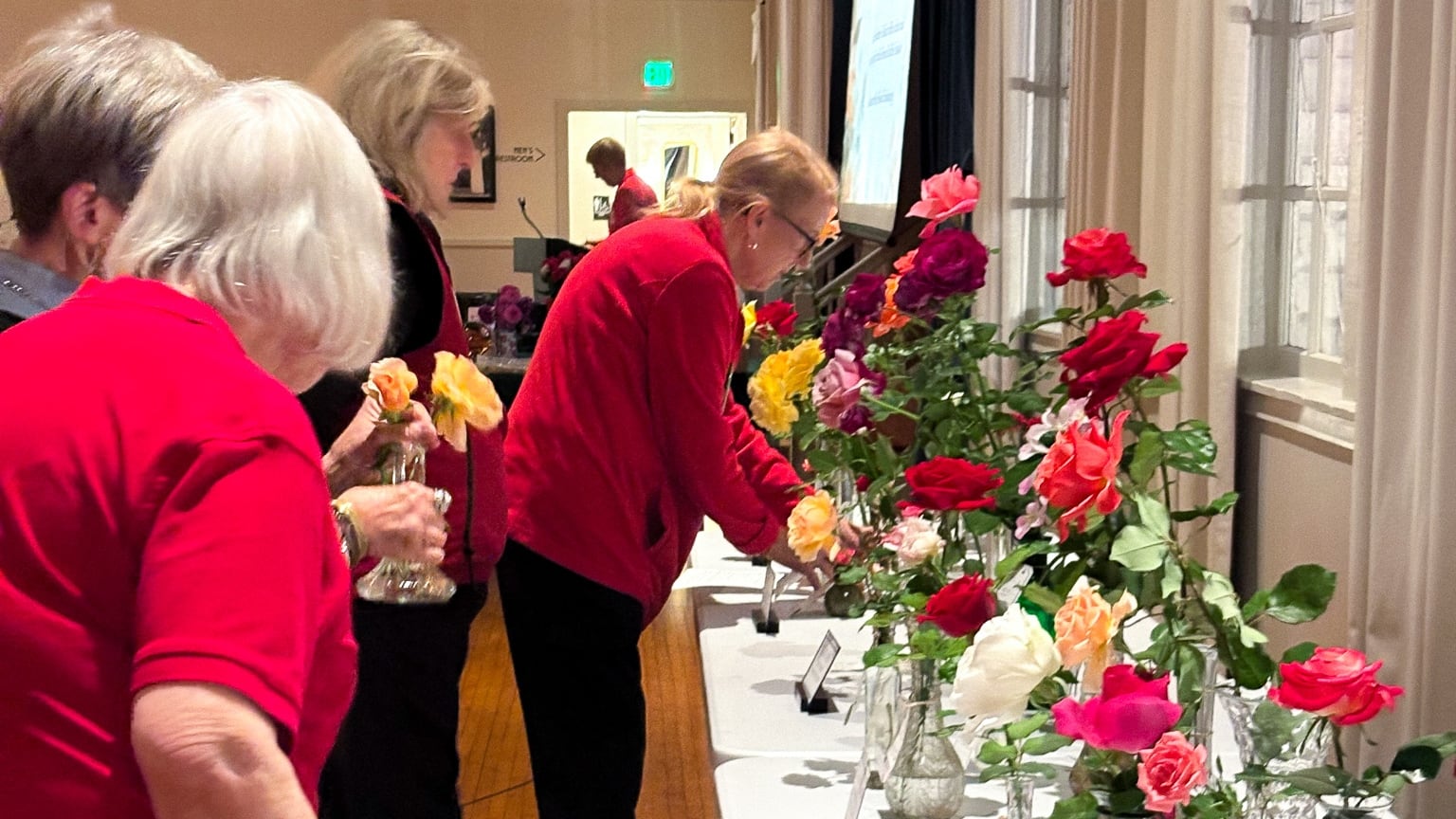
At 7:15 pm, the mood around the rose staging tables at Oaks Park wasn’t quite as hushed and focused as at other shows, and the complexity of rose-coiffing wasn’t as intricate. But there was the same impenetrable air of concentration among the 20 or so competitors who happened to have exhibition-worthy roses growing in their garden that day, and who bent over their entries attaching labels and massaging blooms open.
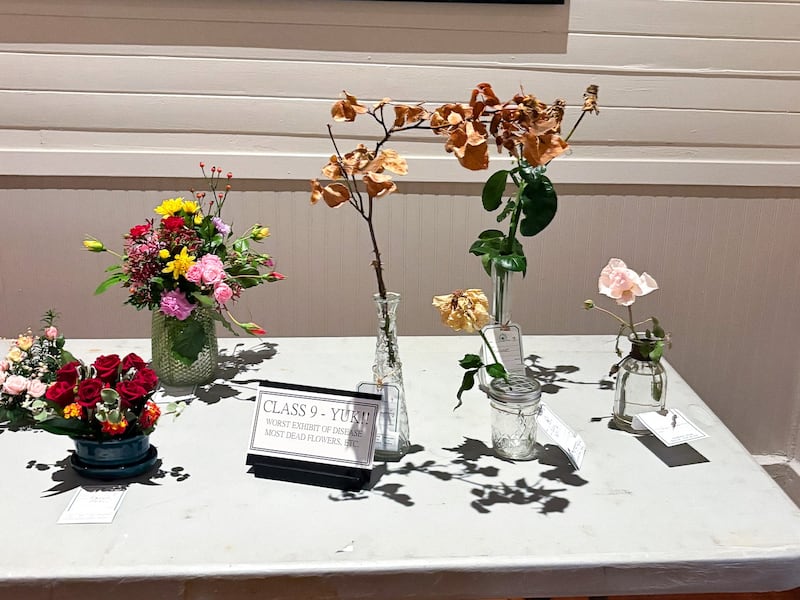
One of the most popular classes, which only appears at this show, is the most dead rose.
“It was just so awful looking,” Mary Hutchens, 78, member since 2006, told me of Elizabeth Taylor, her winning entry in the category “Class 9—Yuk!!” which is officially categorized as “best disease, best botrytis, most dead roses on one stem, etc.” Hutchens has played Georgiana Pittock, founder of Portland’s Rose Society—which in its 138th year is the oldest in the country—at official Rose Festival events for 20 years. “Isn’t that terrible,” she laughed, “for me to win the yuckiest rose? The irony is there.”
Rose Society meetings fill the offseason, running October through May, and are open to all members. Attendees receive a free ticket for the dozen or so door prizes upon entry—sometimes including rose bushes and PRS garden gold fertilizer from the “poo-crew,” which is the nonprofit’s most effective fundraiser. A household membership costs $25 annually and comes with a subscription to the Chatter, the rose society’s extensively researched newsletter covering everything from midseason rose care to the future of rose societies.
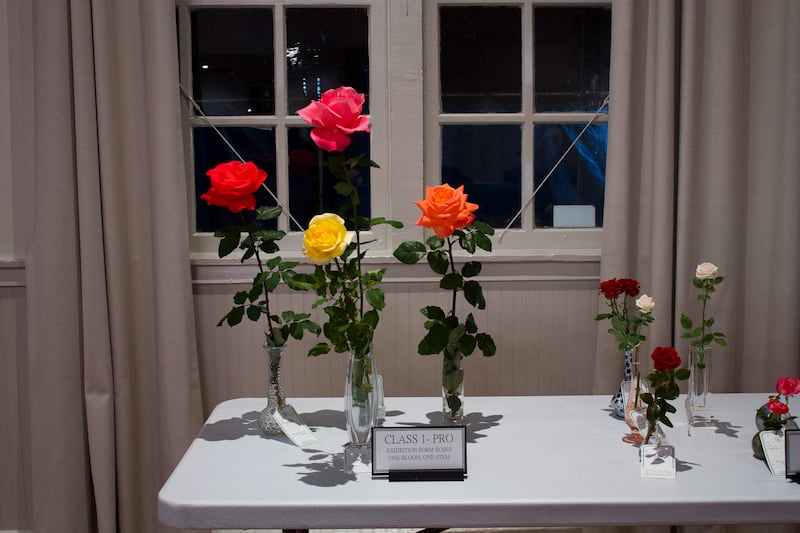
The October show marks the official end to a busy show season and gives members, especially novices, an extra chance to show their stuff. It’s a smaller show—only nine classes compared with Spring’s 158—and competitors bring their own vases. The look is a pleasing hodgepodge. But the rules and judging criteria are the same.
Members who weren’t exhibiting helped themselves to slices of sheet cake and punch, poured hot coffee into paper cups, and took their seats in fold-up plastic chairs to await the meeting’s guest speaker. Some wore official Rose Society merch—T-shirts or quarter-zips in Rose Society red, available for sale at one of several tables at the back of the room alongside cellophane-wrapped raffle prizes, a soil pH testing sign-up (a free service for members), and a library of rose-related books free for the taking.
“To win-win, you cannot have a rose that’s open too much,” said Irma Lagomarsino, 63, who had just placed a pink and yellow sunset–hued Love and Peace rose with a long stem and appropriately open bloom, all 5.5 inches of it, on the judging table. Lagomarsino works for NOAA Fisheries when she’s not tending to her 14 rose bushes. This was her very first Rose Society meeting, and she describes herself as a true novice—officially defined by PRS as an exhibitor with less than 50 rose show trophies.
Jennifer Huenink, 57, was contemplating the beauty of a more closed rose. “They’re so pretty for me, but not for rose judging,” she said of flowers in full bloom. By way of example, she gestured toward a burgundy and cream striped Floribunda whose bloom was halfway between bud stage and blown, the rose Scentimental—one of three roses she and her daughter Sophie Abbassain, 23, had entered for competition. “Some people stick the little Q-tips in there and wedge them open,” Abbassain said, amused, of the tactics some competitors use to nudge their roses along.
Abbassain and Huenink keep a handful of bushes in their personal garden—all competition roses must be grown on personal property—but Abbassain also stewards Lewis & Clark’s Memorial Rose Garden. She initiated the restoration project in 2022 and has since planted over 1,000 roses, many gifted by Rose Society members downsizing their gardens. “Everybody here has pretty much maxed out their yards,” she said. “They’ve already put roses everywhere they could possibly fit them.”
Cheryl and Gary McClain, both 79 and members since 2001, weren’t sure what to expect when their friends first urged them to join the society. “We thought ‘society’? That’s not us, we’re not society people!” Cheryl McClain told me. “But when we joined we found out that they were really nice people, that they’re down to earth, and they’re more interested in growing roses and talking about them than showing off about what they might have or do.”
The McClains won Professional Class 1 Monday night, for “one full rose at exhibition stage,” with Ring of Fire. The lightly fragrant, vivid coral bloom is one of their best exhibition roses—and it’s clear why. “The form,” the McClains said in unison. With petals whorling into a clear and symmetrical spiral when viewed from above, and a graceful chalicelike bloom in profile, its smooth verdant leaves and prickles forming an even ladder up to the bloom, the rose indeed seemed to have reached its “most perfect phase of possible beauty,” which is what the American Rose Society judging handbook requires of all winners.
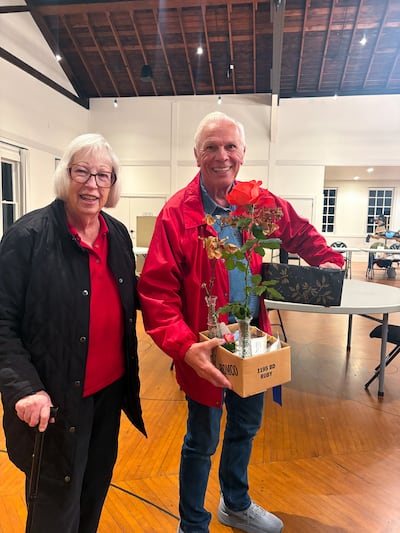
Their advice? “Stop calling it yardwork and start calling it gardening,” Cheryl McClain said. Gary McClain agreed: “It’s just very relaxing out there, you know?” But there aren’t as many rose societies or rose shows as there once were, Cheryl McClain told me: “I’m not sure why. It seems the rose has fallen out of favor.”
In addition to the show, the October meeting installed the 2026–2027 PRS officers, whose term lasts one year. They wore matching bright red blazers with an official Rose Society patch, many studded with rose-related buttons collected over years of service cascading down their lapel, setting them apart from the otherwise dressed-down crowd.
“Our society is analogous to the rose bush,” Rose Society vice president Charold Baer said onstage. “The leaves are you, the members.” Along with the PRS officers, the members in the audience took an oath that night. They promised to diligently serve the rose, to promote the visibility of the Rose Society, and to proclaim Portland as the City of Roses.