Skip to main content
It’s become conventional wisdom that mismanagement has kept Multnomah County from solving its homelessness crisis, despite an influx of cash from a 2020 Metro levy.
Critics, often quoted in this newspaper, have railed against the county’s inability to spend the Metro money early on and heaped scorn later when it ran out. Among the disgruntled: Oregon Gov. Tina Kotek, who balked at having the state fill a county budget hole in March.
But four years of figures for Metro’s Supportive Housing Services tax show that Multnomah County has been punching above its weight, as defined by the percentage of the levy that it receives: 45.3%, compared with 21.3% for Clackamas County and 33.3% for Washington.
For example: Multnomah County has placed 4,740 households into permanent housing, or 52.59% of the total 9,010 across the three counties. By that measure, Multnomah County did more with less, exceeding its share of funding by more than 7 percentage points. In terms of households kept from losing their homes through measures like rent assistance, Multnomah County kept 12,656, or 66.14%, housed, beating the bogey by about 21 percentage points.
The figures come from annual reports by the counties, including the most recent ones for fiscal year 2024–25, which ended June 30. Those came out earlier this month.
We’ve opened our spreadsheets, crunched some numbers, and taken a closer look at three facts that emerge from the reports—starting with a glaring one that arises from turning the data into ratios.
Multnomah County has far more homeless residents than either Clackamas or Washington.
Almost 90% of Metro residents experiencing some kind of homelessness live on the streets and in the shelters of Multnomah County. That’s double the percentage of Metro SHS money that the county gets, and it’s a long-festering sore point for Multnomah County leaders (see table, below).
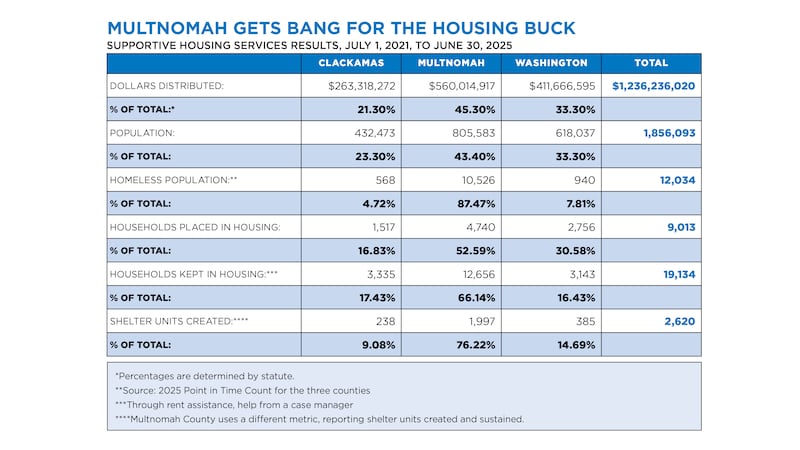
The measure distributes funds in amounts proportional to how much the levy would raise from taxpayers in the three counties. In short, it divvies up cash according to supply (tax receipts), not demand (homelessness).
Critics as disparate as Multnomah County Commissioner Shannon Singleton, a trained social worker, and Eric Fruits, a self-described right-of-center gadfly Ph.D. who teaches economics at Portland State University, say that selection method was a mistake.
“I think the dollars should follow the need,” Singleton says.
Multnomah County Chair Jessica Vega Pederson agrees.
“For the SHS measure to truly have the impact voters intended, we have to look at how dollars are connected to the needs in our region,” Vega Pederson says. “I have been a consistent advocate that funding should be allocated proportional to the need in each county—something Metro’s own auditor has recommended.”
The counties chose different priorities to address.
Before declaring Multnomah County the underdog winner in a Homeless Services 500, it’s important to note that the counties make different decisions about how to spend the SHS money, and some of the achievements don’t fit neatly into the three metrics that Metro highlights on its website: households housed; households kept in housing; and shelter units constructed.
Clackamas County, for example, chose to fund a “community paramedic” to provide basic health care to homeless residents. Starting in late 2024, the paramedic “served 126 individuals, treated more than 150 wounds, distributed more than 100 doses of Narcan, and facilitated 200 Uber transports, including 16 to hospitals, 24 to substance-use-disorder inpatient or outpatient treatment, and 40 to primary care appointments,” the county said in its annual report.
Washington County, too, pushed SHS money toward health care. It partnered with Virginia Garcia Memorial Health Center and Greater Good Northwest to create a “medical respite program” at the Hillsboro Bridge Shelter that serves houseless people who need medical care while stabilizing their lives in shelters, aiming for permanent housing.
Moreover, some of the comparisons aren’t apples to apples. Creation of shelter units is a big, basic one that can’t be made because Multnomah County counts both new units and those that would have closed some time in the past four years without SHS money. The shelters counted by Clackamas and Washington were created with SHS funds and are sustained by them. Washington County, for one, had no shelters before the SHS money began to flow. Now, it has three, in Beaverton, Hillsboro and Tigard.
Housing placements are skewed, too, because Multnomah County has more funding from the state and federal government that can be “braided” to create placements, a Metro spokesperson said. Despite the braid, those placements can be attributed to SHS funds.
Looking across the counties, Liam Frost, interim head of the Metro Housing Department, says he’s pleased with what counties have accomplished with SHS dollars.
“In the face of federal and state cuts to the homeless services system, we are incredibly fortunate that voters and taxpayers across the region took a leap of faith with the Supportive Housing Services initiative,” Frost said in a statement. “The road has been bumpy, but to have successfully housed more than 9,000 households in five years was no small feat.”
Three times as many people are becoming homeless than are being housed across the three counties.
The number of people seeking homeless services for the first time averages 3,068 per month, Metro says, compared with 1,001 getting into permanent housing.
That trend spells big trouble if it persists. Earlier this year, Metro proposed sending a new ballot measure to voters that would extend the SHS levy to 2050 from the current 2030 in exchange for cutting the rate and indexing the thresholds to ease the burden on taxpayers who get pushed into higher brackets only by inflation. Some county leaders balked, saying they couldn’t stomach a lower rate or indexing, which would cut collections. Metro abandoned the idea in June.
Since inception, SHS has been funded by a 1% tax on all taxable income of more than $125,000 for individuals and $200,000 for couples filing jointly, and a 1% tax on profits from businesses with gross receipts of more than $5 million. Indexing will begin next year, with the floor rising to $128,000 for individuals and $205,000 for joint filers.
Eyeing the $1.23 billion that’s been raised and distributed to counties, and the number of people who still live on the street, critics say the tax should be scrapped entirely or at least reworked. Among them is John DiLorenzo, a Portland lawyer who compelled the city to clear homeless camps because they prevented people with disabilities from using sidewalks.
“Truth be known, only a small percentage of people who have no housing are in that circumstance because they can’t afford to pay any rent,” DiLorenzo claims in an email to WW. “A large percentage (possibly the majority) of people on the street either choose to pay no rent or cannot live in a community environment due to their drug addictions or mental illness or both.”
That such a sentiment is widely held isn’t lost on Metro, or the counties. In the fiscal year that ended June 30, 2024, Multnomah County spent $15 million of its SHS money to expand drug treatment, or about 11% of the $140 million it got from Metro that year.
More recently, Clackamas County opened Clackamas Village, a cluster of 24 tiny homes that offers mental health and recovery services. Washington County bought a hotel to convert into transitional housing for people with substance use disorders. It’s set to open in 2026.