Skip to main content
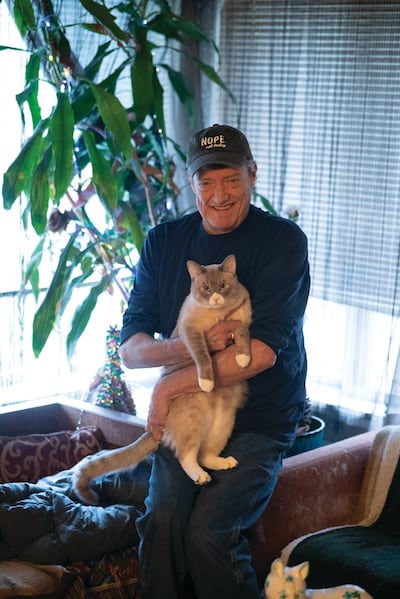
Gary Opel thought himself a lucky man when he first moved into the Dawson Park Apartments in 2007.
“I was like, damn, I lucked out. Look out my window,” says Opel, 62, pulling back gauzy blue shades. “A beautiful park.”
It’s Dawson Park, a North Portland greenspace better known in recent years for shootings and drug dealing. Tenants in the building that shares the park’s name say the scourge has moved into their hallways, and they’ve grown terrified of living there.
On a recent Thursday night, Opel approached a microphone set up at Vancouver Avenue First Baptist Church to describe the situation. He carried two pages of notes. His hands trembled. The last time he spoke in public, he warned the assembled city officials, he’d passed out.
Opel described people smoking from crack pipes on the steps outside his window, and dealers sitting in cars handing out baggies all day.
He’d been assaulted four times, he said, and followed when he told drug dealers to go away. He said a number of his neighbors deal drugs, and that one day, while recovering from surgery and with little else to do, he counted 122 visitors to his floor of fewer than 20 units.
“I’ve been assaulted four times. Hit by a metal pipe. Punched in the face. Thrown against the mailboxes,” Opel said, his voice cracking. “I can’t fight back. I’m 62 years old. Help us.”
Another six residents, all of them seniors, echoed his story. And to some onlookers, Dawson Park is just one example of failed policy and building management at Home Forward, the city’s housing authority.
Reporting by WW over the past two months—comprising two dozen interviews and hundreds of pages of public records—shows that Home Forward has loosened screening policies in recent years around whom it lets into its buildings and whom it kicks out, has failed to adequately fund security measures at Dawson Park, and has struggled to punish bad behavior by some tenants. As a result, it failed to keep a nearby drug market from setting up shop in the hallways outside Opel’s apartment door.
Home Forward spokesman Rylee Ahnen says the agency takes residents’ concerns “very seriously” and in response has hired two desk monitors who work from 3 pm to 7 am every day. He also says a security company now conducts nightly sweeps of the hallways and the exterior, and the agency is considering erecting a fence.
Home Forward is the state’s largest affordable housing provider, with 6,847 units. As such, its job is to offer housing to low-income Portlanders.
As WW recently reported (“Empty Gestures,” Dec. 10, 2025), Home Forward had 955 vacant units as of November—1 in 7 units in its portfolio. (Vacancy figures provided to WW show the average vacancy rate dropped to 11% as of late December.) The agency cited a number of factors, including flood damage at two buildings and a citywide dip in rent prices that means the nonprofit is in effect competing with landlords of market-rate apartments for tenants.
But the high vacancy rate opened up questions about Home Forward’s operations and the conditions of its buildings. For years, the agency, a nonprofit governed by a nine-member board of commissioners with an annual budget of $298 million largely made up of federal money, has operated with little scrutiny from city officials, even as it controls the largest stock of affordable housing across the metro area.
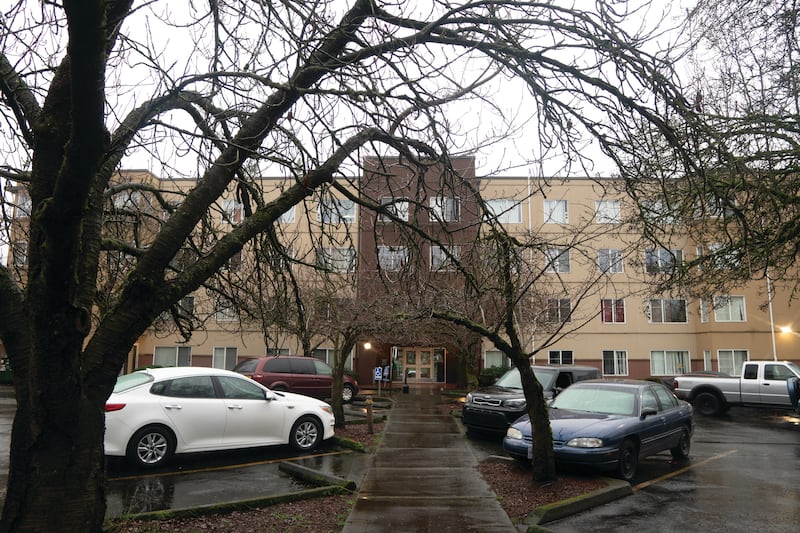
Sixty-seven of those vacant units are in Dawson Park Apartments. Rents range from $1,138 for a one-bedroom to $1,739 for a two-bedroom. The four-story building stands next to a park that WW previously examined because drug dealers had descended on a place cherished by the Black community, and shootings had become frequent (“The Trouble at Dawson Park,” Sept. 14, 2022).
Some of the drug activity, according to three tenants WW interviewed and others who spoke up at the church forum, was spurred by Stop N Go Mini Mart, a convenience store on North Williams Avenue. Until last spring, Donald Sharma ran the corner store. Sharma was indicted in March 2025 on charges of delivering cocaine, heroin and fentanyl, and is currently out of custody awaiting trial. (Police say he also allowed surrounding dealers to stash their goods at his store.)
Neighbors, law enforcement and Mayor Keith Wilson applauded the arrest, saying it removed a major source of neighborhood trouble. But the bust had a secondary effect: Dealers and buyers migrated one block north to the Dawson Park Apartments, and tenants say Home Forward took few measures to keep the drug market from moving inside.
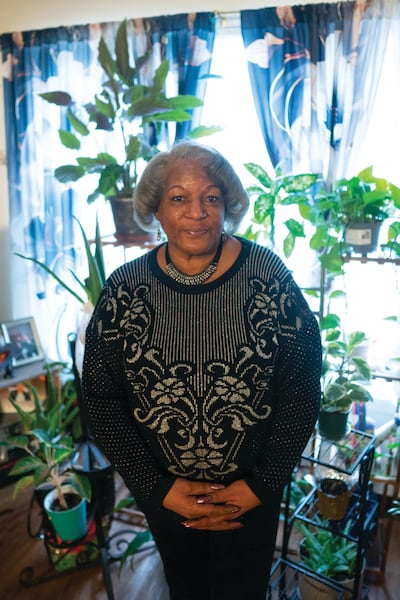
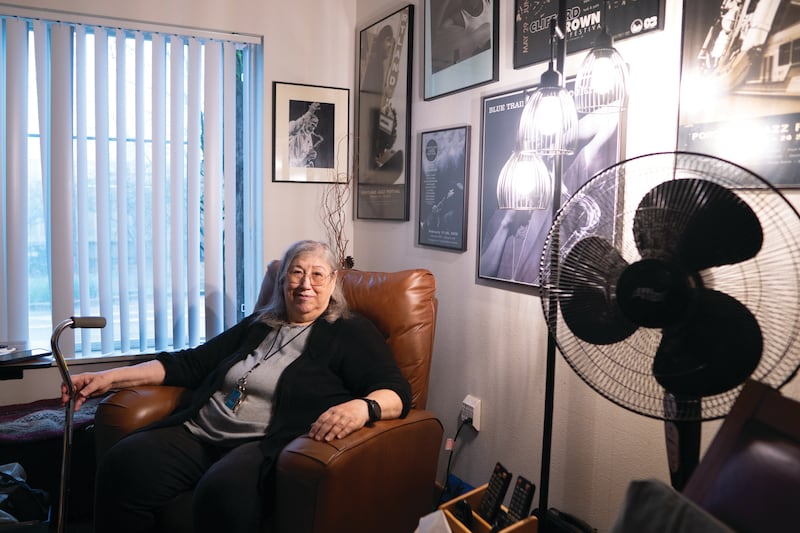
Yvette Wilson, 67, who’s lived at Dawson Park Apartments for the past 22 years, said at the church forum in January that the past two years have been “a wreck.”
“If it weren’t for my strength and faith in God, I would be rippin’ and runnin’ right there with them [addicts], because there’s so much activity in and outside the building,” Wilson said. “People are inside the laundry room that don’t even live here, and they do drugs in there, sleep in there, have sex in there.”
Every night, tenants say, dealers park outside the building and honk once to let buyers know they’re open for business, then twice to let buyers know they’ve run out of product. Other dealers live inside the building and are visited by buyers or ride down the elevator to meet buyers outside.
The Portland Police Bureau has another suggestion why drugs moved into the apartments: “Increased pressure on open-air drug dealing across Portland has resulted in some activity moving into more secure or less visible locations, including housing units,” said bureau spokesman Mike Benner.
Records provided by the Portland Bureau of Emergency Communications show that since November 2024, dispatchers have received 295 calls from Dawson Park Apartments. They included calls for service for assault, domestic violence, unwanted persons, death investigations, and harassment, and calls logged as “drugs, liquor, prostitution,” robbery, and theft. (It’s not clear whether the calls have increased from previous years.)
Tenants have begged for a fence around the property; for 24/7 security to monitor visitors; for Pinehurst Management, the company that manages the property, to reissue entry fobs; to require ID checks for all guests; and to report to law enforcement any drug activity in the building. “I think Home Forward has given up on us,” Kate Royston, 71, says, her dog Alice napping on her lap.
Ahnen, the Home Forward spokesman, says that while property managers can’t evict someone for suspected drug activity, Pinehurst will “monitor whether any lease-related violations, such as excessive or unusual traffic, noise complaints, or behavior that interferes with other residents’ enjoyment of the property, are occurring” and then tells the tenant to cut it out. Ahnen says Pinehurst has provided such warnings recently “in response to suspicion of drug-related activity.”
The timing of the drug market penetrating the building’s walls was particularly unfortunate because it dovetailed with policy changes at Home Forward that loosened screenings of tenants and raised the threshold of back rent that had to be owed before eviction.
Home Forward heavily amended its tenant screening policies in 2022. It did so in the name of racial justice. “When landlords like Home Forward screen for criminal history to determine eligibility for housing, we perpetuate the racist injustices of the criminal justice system,” the agency noted in a November 2021 document to its board.
Home Forward previously allowed each of the property management companies it contracted with to use their own screening criteria. But in 2022, Home Forward created a blanket screening policy for all of its properties, including those managed by third parties. Overall, it loosened restrictions by reducing “look-back periods” for an applicant’s criminal convictions.
For instance, instead of denying any applicant with an arson conviction in the past 10 years, the agency would consider that conviction only if it occurred in the past five years. Quantum, a property manager for Home Forward at the time of the change, would have under its own policy denied an applicant for a drug manufacturing or distribution conviction within the past seven years. Under the new policy, such a conviction was considered relevant only if it had occurred in the past three years. Convictions for financial fraud, theft, identity theft or misdemeanor drug possession would no longer be considered at all (see tables, below).
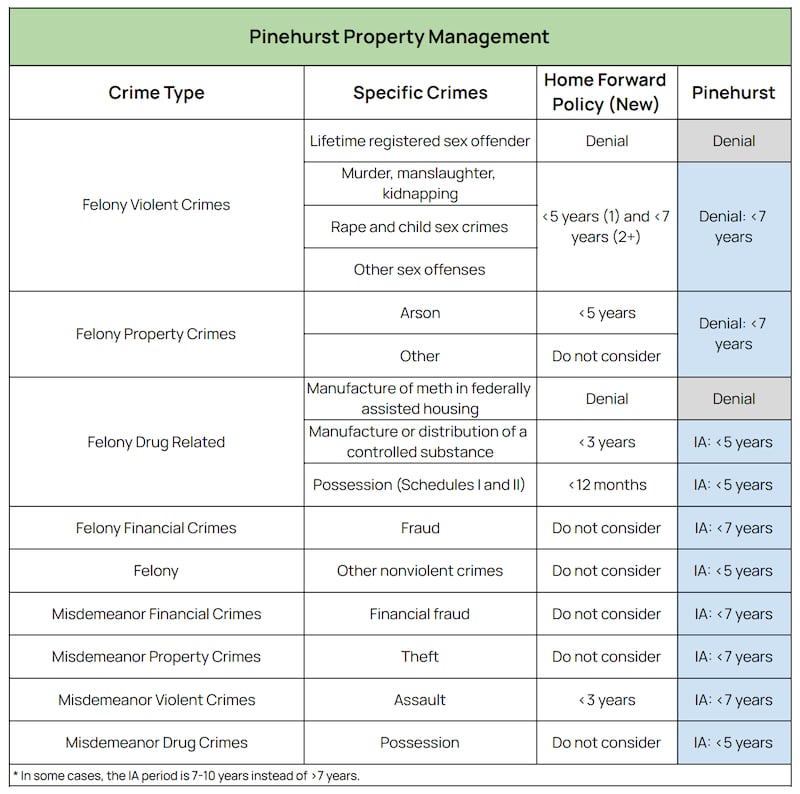
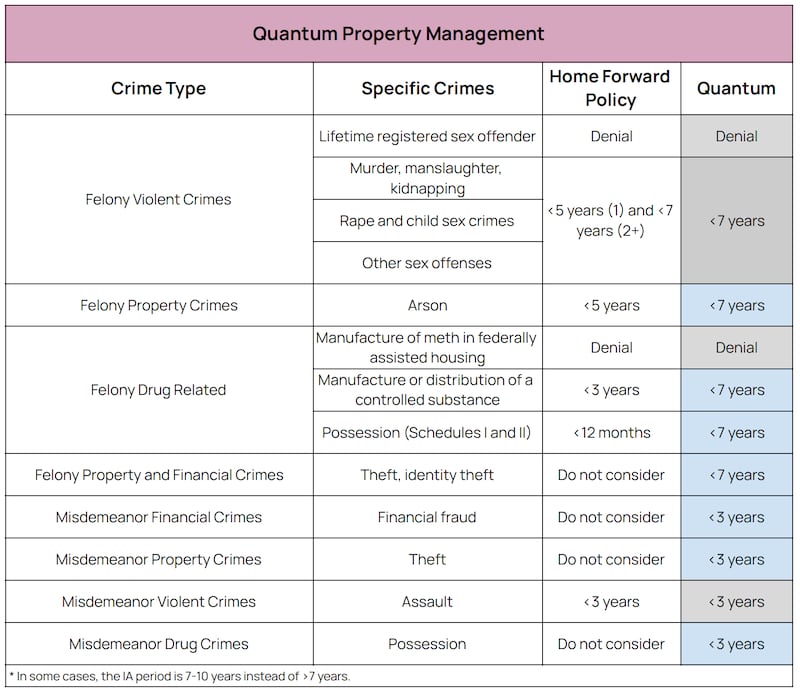
The November 2021 memo to the board noted, “There is insufficient evidence that criminal history has any relationship with an individual’s likelihood of posing an immediate threat to the health and safety of their neighbors.”
On top of that, Home Forward decided that until someone owed $500 or more in back rent, eviction would not be pursued.
City and state policies passed during the COVID years also required landlords—including Home Forward—to perform an “individualized assessment” on each applicant before denying on the grounds of past criminality; in essence, an exception process. Ahnen says Home Forward does not keep track of how many assessments end up overriding what would otherwise be a denial.
Criminal court records reviewed by WW show that some tenants arrested and convicted of serious crimes in recent months—some of whom caused consistent problems for fellow tenants—would not have been allowed to rent apartments at Dawson Park, or at least not without jumping significant hurdles, under the old policy.
One, a man named Tony who was convicted in May 2020 of delivery of methamphetamine and spent 18 months in federal prison, moved into Dawson in 2024. (Tony’s name has been changed to protect other tenants.) Under Home Forward’s old policy, IPM, the building’s former manager, would have flat out denied Tony an apartment. Under Pinehurst’s policy, he would have been denied an apartment but assessed to see if evidence existed that would suggest he could be a good tenant. Under Home Forward’s new policy, his conviction was irrelevant.
Tenants WW spoke to say Tony was often menacing toward other tenants, and they allege he regularly dealt drugs. One former tenant, named Cyanna, tells WW that Tony threatened her for talking about his dealing. She was so frightened she moved into a hotel in the Pearl District, an expense for which she had to take out a personal loan.
In March 2025, Milwaukie police found Tony in the driver’s seat of his truck, passed out intoxicated after having crashed into a utility pole. On him, they found meth and a Glock pistol. He has since pleaded guilty to being a felon in possession of a firearm, and is in federal custody awaiting sentencing.
A man named Freddy was accepted into Dawson Park Apartments early in 2024 despite a felony conviction for identity theft in 2019. (Freddy’s name has also been changed to protect other tenants.) Police records show officers found multiple shaved keys and credit cards and bank statements in different people’s names when they responded to a call from his ex-girlfriend, who alleged he had choked her and yelled that he was going to “split her fucking head open.”
Under former Pinehurst screening policies, Freddy would have been subject to an individual assessment to determine if, despite the convictions, he was fit for tenancy. They would have found that since his conviction he’d violated the terms of his probation multiple times, leading judges to sign five separate warrants for his arrest. Under Home Forward’s current policies, Pinehurst was barred from taking into account Freddy’s identity theft conviction.
He and his girlfriend posed problems, multiple tenants say. She stole packages from the mail room and was eventually excluded by the Pinehurst building manager for it, her picture printed and taped to a window in the lobby. Once, she stuck a sign on their apartment door that warned whoever took items should return them “before [Freddy] has to find out and come give you a visit.”
In November 2024, Freddy reoffended. His girlfriend alleged he’d choked her to near unconsciousness at the Dawson Park Apartments. He was sentenced to 365 days in jail, and they were evicted soon after for nonpayment of rent.
Ahnen says Home Forward has not studied the effects of its new screening policy across its buildings, but that success to the agency “looks like a reduction of racial disparities for those that access Home Forward housing and expanded access for those with criminal justice system engagement.”
Margaret Van Vliet, who worked as deputy executive director of Home Forward from 2000 to 2008, says making such drastic screening changes without putting in place more rigorous rules for tenant behavior is a recipe for disaster.
“The idea that we shouldn’t hold people to a standard of behavior is just patronizing and unhelpful,” Van Vliet says.“There’s ways to relax screening standards and still hold tenants accountable if they make the property and residents unsafe.”
It’s unclear whether Home Forward could do much to address drug issues even if it wanted to, given its current financial state.
The agency recently disclosed that it faces a $35 million budget shortfall, and data provided to WW by Home Forward in response to a public records request shows that 23 of the 38 buildings that have a required debt service coverage ratio—a measurement of an entity’s ability to pay off its debts—as of September 2025 had failed to meet the required ratio. The required ratio for most Home Forward buildings is at least 1.1. The ratio for the Dawson Park Apartments is 0.12, well below the required 1.15.
Ahnen says the low DSCR at Dawson “reflects increased vacancy, rising insurance premiums, and higher security and operating costs” than previously projected.
Home Forward isn’t facing pressure from just its tenants; Mayor Keith Wilson has turned his focus from homelessness to affordable housing in the new year, and told Dawson tenants at the church meeting in January that he would do whatever “needs to be done to ensure your safety.”
The mayor also shared that he’d joined police on nighttime patrols in recent weeks to observe drug activity. “We did find out, as we were touring the town—going to hot spots—when we drove by a second time, the dealers would go inside the regulated apartments and go up the elevators,” Wilson said.
In one of those apartments, Opel nurses a Pepsi, his cat Lucifer weaving between the legs of the table below. His eyes well up with tears as he points to a stun gun and a knife sitting atop a stereo speaker right by his front door.
“That’s how I live now,” he says, “right there.”