Skip to main content
Questions have swirled around Home Forward, Portland’s housing authority, since WW reported late last year that 955 of its nearly 7,000 subsidized units were vacant, about 14% of the agency’s total portfolio.
More recent figures from Home Forward suggest the vacancy rate is now closer to 11%. Home Forward is the state’s largest affordable housing provider, and those vacancies stand in sharp contrast to the 7,500 people that sleep homeless on Portland’s streets every night (“Empty Gestures,” WW, Dec. 10, 2025).
Now, another piece of the puzzle could bring Home Forward’s portfolio under further scrutiny.
New data provided to WW by Home Forward shows it took the agency an average of 185 days to fill a vacant unit in one of its buildings in 2025. That means the housing authority is often sitting on an empty unit for more than half a year before it can fill it.
That’s a remarkable figure, given that the city and state are in an affordable housing crisis and are scrambling to build more units. Tom Brenneke, a local affordable housing developer, says 185 days to fill a unit is appalling. “These numbers are egregious. I’ve never seen numbers this big. It doesn’t make any sense to me,” Brenneke says. “It’s so far off that it just begs the question: What’s going on? Ultimately, all this hurts is the tenant and taxpayer.”
Home Forward buildings include those that offer deeply subsidized rents and those that offer unsubsidized but still affordable rents.
Rylee Ahnen, a spokesman for Home Forward, says the agency knows the time frame to fill units is “too long” and that the agency is “working to address our overall occupancy rate and the speed at which we turn over and lease apartments.”
But Ahnen says filling a unit swiftly is made difficult by the scale of repairs needed in units, the time it takes to advertise and market them, and the time it takes to wade through a property’s waiting list.
“There are also many situations where the condition of the apartment is so damaged that it essentially requires a full rebuild of the unit,” Ahnen says, “where lighting, cabinetry, sheetrock, and occasionally flooring are all replaced as part of the repair process.”
Home Forward has previously said the high vacancy rate is largely due to reasons outside of its control. The biggest factor, according to Home Forward, is that market rates have dipped so low that they’re on par with rents charged by Home Forward for units reserved for tenants who make 60% or less of area median income. That means, essentially, that Home Forward is competing with private landlords to fill units that make up the majority of Home Forward’s portfolio. (Experts WW spoke to, however, say nothing prevents Home Forward from lowering rents on 60% AMI units. Late last year, Home Forward froze planned rent increases at a handful of buildings as well as rent hikes for all voucher recipients.)
Yet Home Forward’s modest pace to fill units stands in stark contrast to the speed with which it develops new ones. In just the past year and a half, Home Forward completed or launched a half-dozen new developments. Most of the units in those projects are 60% AMI apartments—the very units Home Forward says it’s having a hard time filling as market-rate rents begin to match what it charges for affordable units.
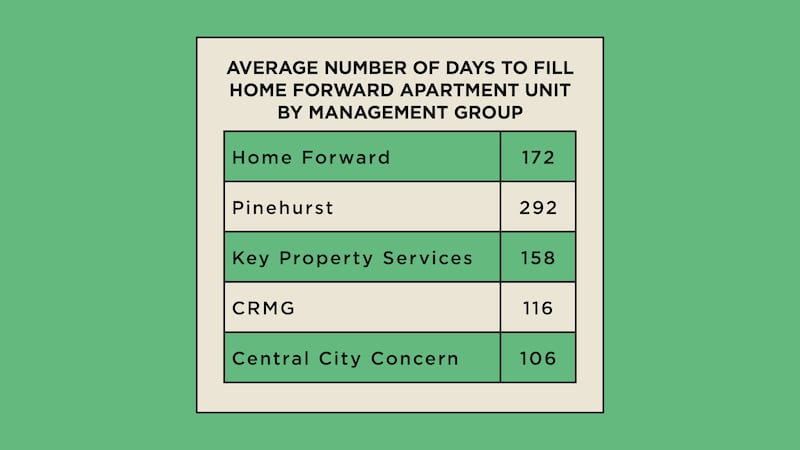
Home Forward says that at the properties it owns and directly manages—a total of 42, according to the agency—it took on average 172 days to fill a unit in 2025.
Three of the four contractors that Home Forward pays to manage its properties have averages below that, according to data provided by the agency: Key Property Services takes an average of 158 days to fill a unit at one of the properties it manages for Home Forward; CRMG takes 116 days to fill a unit, on average; Central City Concern, which manages just two buildings for Home Forward, takes 106 days. (A handful of Home Forward buildings are in lease-up periods, so WW did not include them in its calculations.)
And then there’s Pinehurst Management, which, according to data provided by Home Forward, takes on average 292 days to fill a unit in the Home Forward buildings it manages.
Pinehurst’s 292 days, Ahnen says, is “not an acceptable time frame for Home Forward.” To reduce that time, Ahnen says, the agency has begun holding monthly meetings with Pinehurst executives to review performance, has hired leasing consultants to find ways to attract tenants more quickly, and has lowered rents at a handful of properties.
Ultimate responsibility for Pinehurst’s long turnover time rests with Home Forward. Pinehurst is, after all, a contractor employed by the agency.
This much seems certain: The length of time it takes to rehab a unit and find a tenant is not because Home Forward is unusually choosy about who it lets into its buildings. Earlier this month, WW reported on policy changes made by Home Forward in 2022 that meaningfully loosened criminal screening requirements for tenants.
To be sure, managing Home Forward’s affordable housing portfolio is just one piece of what the agency does, and only one area of concern for an agency that’s struggling to control rising costs at the same time that the future of federal funding for rent assistance becomes more uncertain under the Trump administration.
Mayor Keith Wilson, who’s recently turned his eye toward Home Forward after learning of its high vacancy rates and tenant concerns about safety, did not directly respond to a request for comment about the turnover times for Home Forward units. But his spokesman, Cody Bowman, said the Portland Housing Bureau is seeking a “real-time affordable housing listing service that will help prospective tenants more quickly and easily locate available units and improve overall transparency.” Bowman added that Wilson is “strengthening coordination” with housing providers to “support faster, more consistent unit turnover” and that, although the mayor “does not direct Home Forward’s operations,” he meets with its leaders regularly and is “focused on supporting their efforts to fill units quickly and keep residents safe.”
All of Home Forward’s buildings have active waitlists, so it’s unclear how a listing service would be necessary or helpful to reduce turnover times at Home Forward properties.