Skip to main content
Drivers waiting on the Union Pacific train on a recent Saturday were headed to children’s recitals and breakfast with friends. They were on their way to pick up medication and see their mom for Mother’s Day weekend.
Machinist Benny Swager was going to his very first union meeting. Had he made it, they would have refunded $400 of union dues.
“I’ve been here a half an hour and [the meeting] starts now. I didn’t make it,” he said. “This is fucking with my life.”
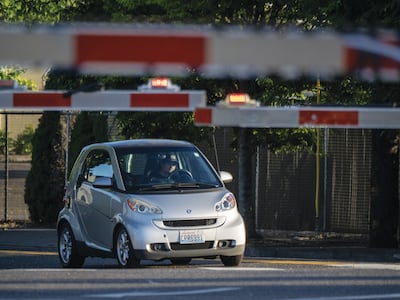
Swager, behind the wheel of a black Pontiac Executive, was one of about a dozen stopped drivers on Southeast 11th Avenue who’d just left the nearby Portland Transmission Spring Classic car show. The block of 11th south of Division Street had turned into a parking lot. A Chevrolet Nova, a Ford Thunderbird, and a shiny yellow lifted Dodge Ram idled alongside a green garbage truck.
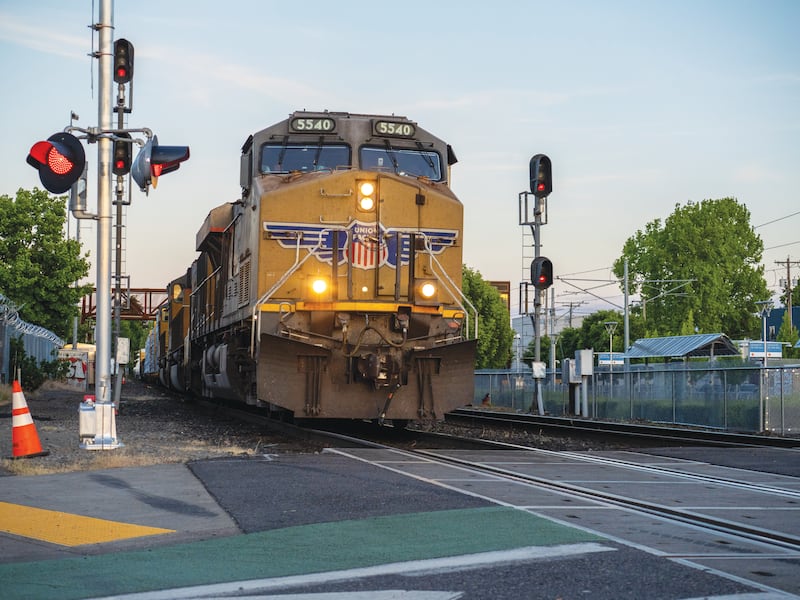
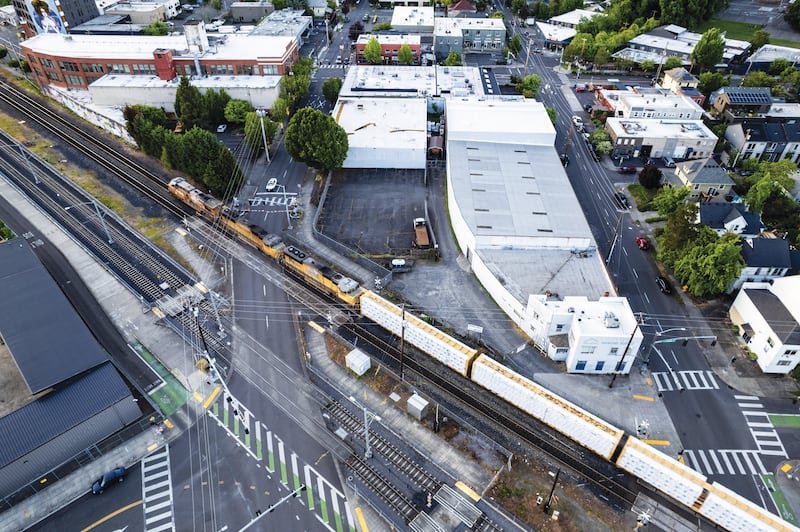
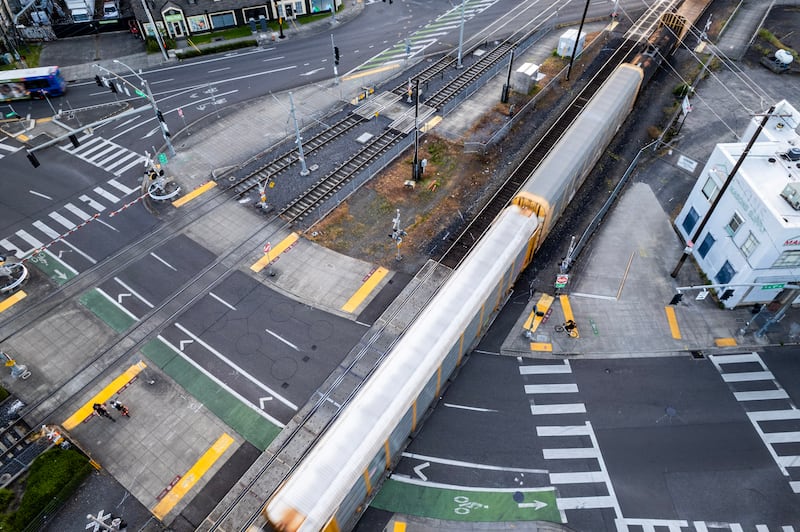
They were living one of Portland’s worst traffic nightmares: long, unplanned waits at three intersections—8th, 11th, 12th avenues—on the Central Eastside. A train passes here on average every eleven minutes: 135 times a day. The wait this May 9 morning ultimately lasted around 40 minutes. Later in the day, a separate stoppage lasted an hour and 45 minutes.
Waits of two, three and even four hours aren’t unheard of. In fact, the crossing gates stay down on average six hours a day or the equivalent of 91 days a year.
Regular drivers, neighboring residents and business owners attest that the mess has gotten much worse in recent years.
Where the train disruptions once stopped at 11th Avenue, they now stretch to 8th Avenue and regularly block crossings near the Oregon Rail Heritage Center and OMSI. The result is the most infuriating traffic delay in Portland. The locals have learned to build their days around waiting on the railroad.
Kaelyn Sharp, owner of Genie’s Cafe at the corner of Southeast 11th and Division, has seen waits grow longer and longer. Her staff now directs patrons to the free TrainSnap app—developed and headquartered in Portland—to monitor crossing blockages after booking a table.
“The train’s always been bad,” says Sharp, who took over as owner in 2020. “But, oh yeah, it’s definitely been getting worse. They’re really long trains. They’re getting longer.”
She’s right. Technological advancement has meant trains are much longer than they used to be. That’s one reason these waits are getting worse. The second is that trains entering Portland from the north must slow to 6 miles per hour at S curves behind the Louis Dreyfus grain terminal.
Long trains moving extremely slowly equals maddening waits for drivers.
Though the U.S. Government Accountability Office says railroads now regularly run trains of 12,000 to 16,000 feet (that’s 2.2 to 3 miles), an official length of Union Pacific’s trains on the Central Eastside isn’t easy to pin down. The federal government doesn’t regulate train length (or wait times at blocked crossings) and the Oregon Department of Transportation doesn’t keep data on it, either.
Union Pacific also won’t say how long its trains on the Central Eastside are. A spokesman directed WW to the company’s most recent annual report, which shows an average train length of 9,678 feet, or around a mile and a half. But that figure lumps together UP trains companywide—and may include short local trains and UP’s many conventional “unit” and “manifest” trains that haul products like lumber, soda ash and grain. Intermodal trains, on the other hand, haul shipping containers on lightweight railcars between Portland and Chicago and stretch much longer.
It’s not just drivers in Portland who feel the pain: Cyclists, pedestrians and buses all get stopped. And it’s not just the immediate neighborhoods—the ripple effect in traffic extends all the way to Portland’s arteries and interstates. Neighboring businesses and the flow of regional commerce are impacted. TrainSnap estimates the closure at Southeast 12th and Division costs the state $7,521 an hour, which equaled $4.1 million in the first quarter of this year.
“The worst time to drive across it is exactly when commuters are trying to,” TrainSnap founder MD Patel writes to Willamette Week.
A leading expert says it doesn’t need to be this way.
Bill Burgel is a railroad consultant for businesses such as Union Pacific, the 162-year-old operator of freight rail lines on Portland’s Central Eastside. He’s worked with state and local officials since 2018 to solve railway crossing delays. He’s frustrated that the Portland Bureau of Transportation has—in his view—misdirected federal funding on studies that went nowhere. (PBOT disagrees with that characterization.)
Wizened and slightly stooped, Burgel, 77, is passionate to say the least. He estimates he’s given more than 50 tours of Brooklyn Yard to public officials, including PBOT employees. He sometimes arrives with foam board slides to help illustrate what can be difficult to describe in words.
And during blockages, Burgel can often be found approaching stopped drivers on Southeast 11th Avenue and directing them to freedom. He thinks at some point someone here will have a medical emergency, possibly a fatal heart attack brought on by the wait. The emergency response could be hindered by the train, with first responders risking limbs to scramble through the stopped train.
“They’re going to kill somebody waiting,” he says.
Burgel thinks four relatively straightforward fixes could end much of the misery on the Central Eastside. They vary in cost and viability; two would address root causes while the others would provide relief to drivers.
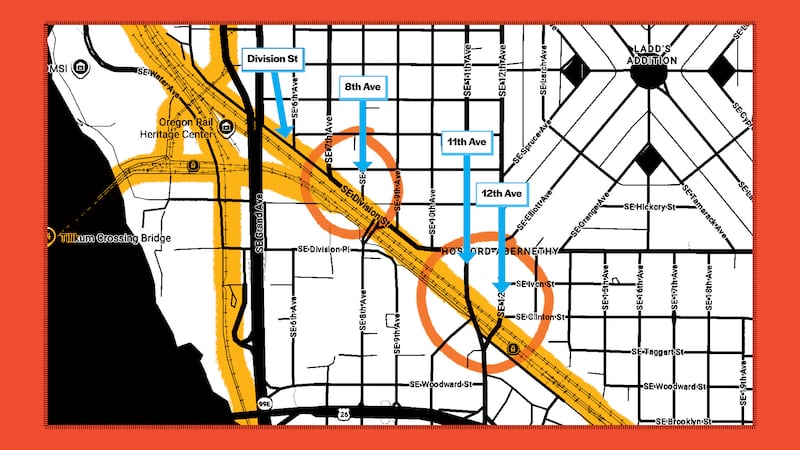
There are a few reasons for optimism. Burgel thinks Union Pacific might be willing to finally play ball and cover some of these costs. And he thinks the new Albina Riverside project, intended to restore a Black neighborhood on the Willamette waterfront, offers a unique opportunity to eliminate the S curve at the grain terminal.
PBOT is expected to soon begin a $650,000, 12- to 18-month study aimed at providing policymakers with options to combat train congestion on the Central Eastside. Bureau spokesman Dylan Rivera cautioned that the study, largely funded by the federal government, will consider numerous options beyond those on this list.
He pointed a finger at Union Pacific.
“It’s unacceptable,” Rivera says of the blockages at 11th and 12th avenues. “PBOT and the community in Portland have been frustrated with this for years now.”
Bolstered by court decisions, railroads in the U.S. largely enjoy the freedom to block crossings as long as they like. But starting in 2021, Congress approved billions to alleviate railroad congestion, and four years ago, the Biden administration included the Central Eastside study in a first round of federal funding.
For UP’s part, spokesman Daryl Bjoraas acknowledged the impacts and wrote in an email the railroad is “developing long-term strategies to keep critical goods moving.”
“We know this can be frustrating for the community,” he added, “and have collaborated with TriMet and the city to reduce the issues.”
Bjoraas declined to elaborate on the railroad’s plans or how it has reduced traffic problems in Portland. UP’s Portland-based public affairs director, Aaron Hunt, declined to be interviewed.
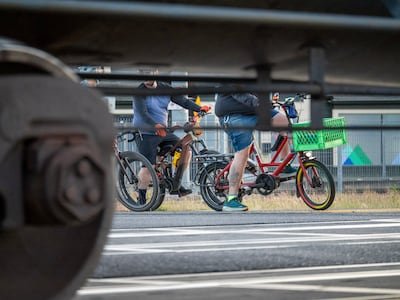
There are also reasons to be skeptical of these proposals. The region’s cash-strapped governments have many pressing priorities, and big changes rarely happen fast in government or at the railroad. But Portland’s train congestion issues are unlikely to just go away. In the rail industry, more freight equals more revenue, and rising fuel prices tend to increase reliance on freight rail.
Now might be a crucial moment. Union Pacific has announced a planned merger with Norfolk Southern, which UP expects would increase intermodal operations at Brooklyn Yard by 22%, according to a revised merger plan submitted April 30 to the U.S. Surface Transportation Board. That means if the plan goes through, congestion on the Central Eastside could get 22% worse.
The merger is still under review, and Burgel thinks this is the perfect time for the city to try to wring concessions from the railroad. During this narrow window of time, railroads often act fast to resolve conflicts.
“Indeed, this is the ONLY time they are receptive,” Burgel wrote to PBOT director Millicent Williams on May 11, urging her to act.
Here are the four possibilities, with cost estimates provided by Burgel.
Fix #1: The ‘Escape Route’
Estimated cost: $300,000
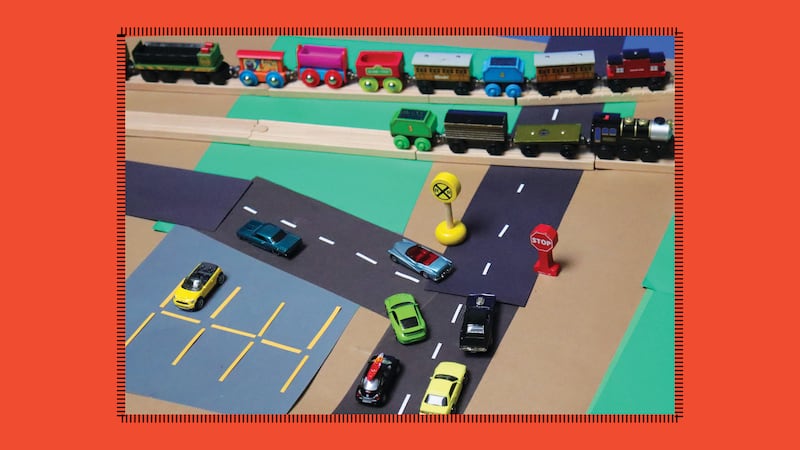
Several crossings on the Central Eastside regularly test drivers’ patience, but only 11th Avenue—a one-way street heading south from Division—offers no escape.
Once the gates go down, a wait here can last a minute—if it’s an Amtrak or MAX train—or, if it’s a Union Pacific intermodal train, it can mean a day-altering affair.
“It makes you want to just roll around on the ground and scream,” says Linda Nettekoven, a board member of the Hosford-Abernethy Neighborhood District who’s advocated for change for years.
But it wouldn’t take much to allow drivers an option to extricate themselves from this mess. A short road (320 feet) linking Southeast 11th Avenue to 12th Avenue represents a relatively cheap and straightforward solution. An “escape route,” as it’s called in planning docs, would be open to cars in both directions at all times, not only during blockages.
Supporters of the plan include state Rep. Rob Nosse (D-Portland), whose district covers the affected area and who’s been late to legislative hearings in Salem due to delays, and U.S. Rep. Suzanne Bonamici (D-Ore.), who helped secure the federal funding for the impending PBOT study.
The proposed escape route would cross two city-owned parking lots leased by Mason Supply, now bounded by concertina wire-topped chain-link fencing. One factor is that these lots, valued at a combined $1.8 million, generate revenue for the city. With an escape route, that revenue could go away. These days governments are loath to give up a revenue source, however small, PBOT’s Rivera says.
The escape route is specifically named in the bureau’s grant agreement to study train congestion. Rivera says simple-seeming ideas are often difficult to implement, though the bureau thinks the escape route “should be studied in depth.”
“The public would naturally want to evaluate the trade-offs of taking $2 million off the tax rolls in exchange for the potential transportation benefit,” Rivera says. “It could be well worth it, but we think it’s worth some consideration.”
Fix #2: Improvements to Brooklyn Yard
Estimated cost: $40–$50 million
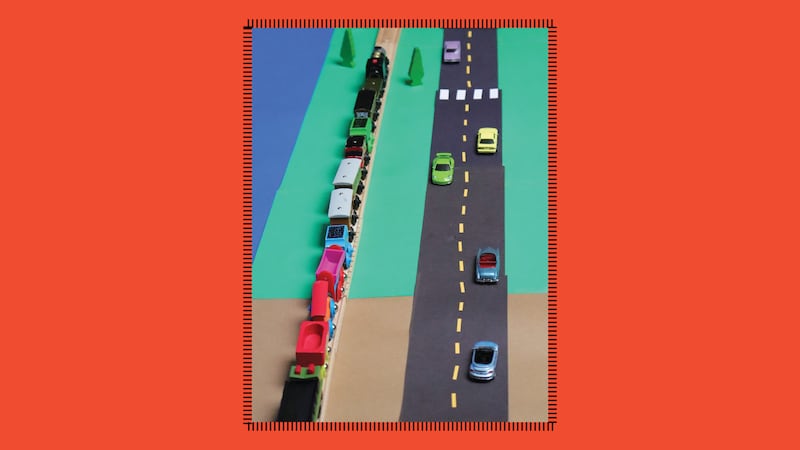
To add to the general sense of confusion, trains departing the Brooklyn Intermodal Rail Yard are rolled out in milelong segments before reversing direction to link up.
“This is insane,” said driver Noah Boleyn, sitting with his dog Sally in a 1973 Chevy Nova. “I’ve seen it stop. I’ve seen it back up.”
The reason lies within Brooklyn Yard, where Union Pacific transfers shipping containers to and from trains with mobile gantry cranes.
Boiled down, the problem at Brooklyn Yard is fairly straightforward. The yard is 5,000 feet long and Union Pacific now regularly runs intermodal trains that approach 15,000 feet. To assemble these trains, Union Pacific inches them through the Central Eastside.
In other words, Union Pacific assembles its trains not in its railyard, which is too small, but on tracks that intersect with surface streets. If a defective container or safety issue is discovered, it’s dealt with—all while blood pressures rise across the Central Eastside.
But Portland to the south of Brooklyn Yard looks a lot different. There’s less density, the rail lines are straighter, and there are fewer landowners and crossings. If one 18,000-foot rail line were added alongside the existing rail to the south, Union Pacific could assemble departing trains with minimal impact to vehicle traffic.
Burgel knows the idea would work. He helped develop a similar plan with UP’s engineering staff at its Omaha headquarters. “I told them, ‘You’re going to have to figure out how to build trains backwards here.’”
When completed, the project wouldn’t look like much—just another set of tracks running parallel to the two existing ones. Some easements would be needed, some earthwork required at the Bybee Overcrossing, and a new rail crossing added at Johnson Creek.
The main issue is that in many people’s minds, this is entirely Union Pacific’s problem.
Four years ago, elements of the project were studied by ODOT at the urging of then-U.S. Rep. Peter Defazio (D-Ore.), who wanted to expand passenger rail service between Portland and Eugene. Under that proposal, millions in tax dollars would have funded the Brooklyn Yard upgrade to compensate for any Amtrak disruptions.
Rising fuel costs and other factors have driven up construction estimates steeply in recent years. And without the passenger train component, the public funding argument is considered less compelling.
PBOT’s study won’t look at upgrades to Brooklyn Yard. “It’s unclear why the city would spend tax dollars on an uncertain operational benefit for the railroad,” Rivera says.
Fix #3: Overpass at Southeast 7th Avenue
Estimated cost: $70 million
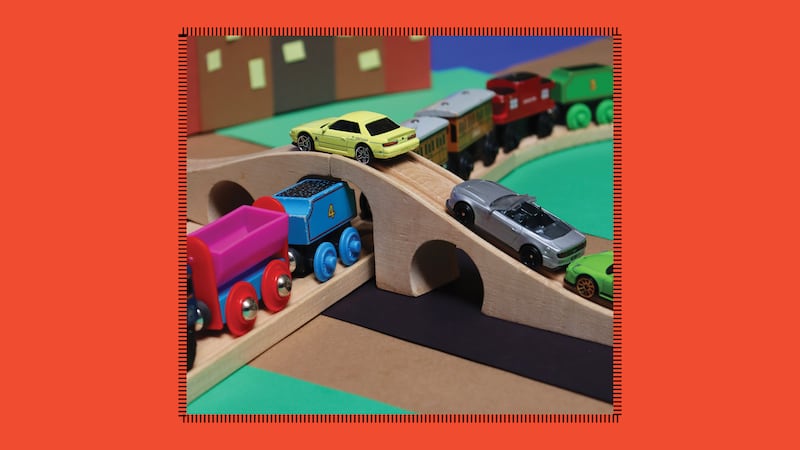
The third possible fix would be one welcomed by many on the Central Eastside even if—like the escape route—it doesn’t address the root causes of congestion.
An overpass on Southeast 7th Avenue beginning near Aprisa Mexican Cuisine is a popular idea with neighborhood groups and members of the Central Eastside Industrial Council. What’s more, to clear up congestion, multiple overpasses could be built at problem crossings on the Central Eastside. But, of course, overpasses are expensive: tens of millions of dollars each. By law, the railroad would cover a portion of the cost but only a small one.
Siting an overpass at 7th Avenue is considered the most economical option because it would start 20 feet above the tracks rather than at grade like the other crossings.
“Here you’d be starting with some height, so it’s an easier reach,” Michelle Sprague, a nearby resident and citizen-at-large on the Portland Freight Committee, explained on a walk through the area.
Overpasses, aside from being expensive, can also have potentially negative impacts on cyclists and pedestrians. That’s because when a new vehicle crossing is installed, railroads often eliminate other nearby crossings to reduce risk. Several visits to the affected area confirm the nearby at-grade crossings are widely used by cyclists, e-cyclists and pedestrians. Removing crossings would make for longer walks and pedals.
With scarce resources, PBOT’s Rivera says, the bureau must pay attention to priorities citywide. Portlanders regularly cite reducing danger at high-crash corridors and basic maintenance as top concerns.
“A single overpass could cost tens of millions of dollars and involve land acquisition and possibly eminent domain,” Rivera says. “And tens of millions of dollars would raise a lot of regional scrutiny around priorities.”
Fix #4: Albina trench
Estimated cost: $140–$180 million
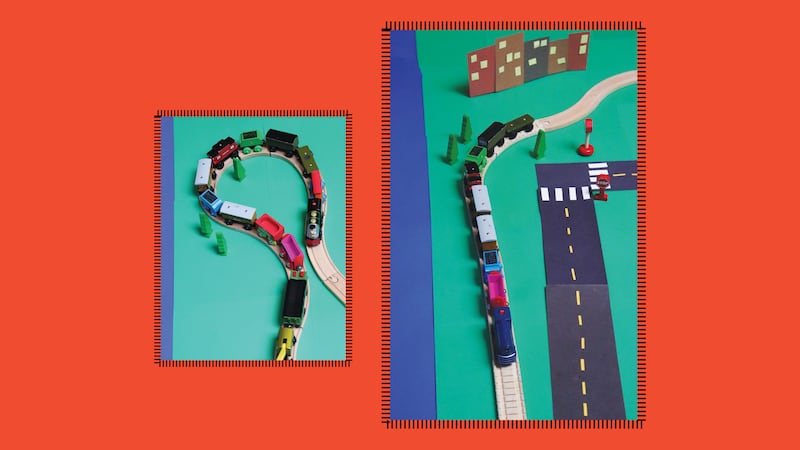
A fourth potential fix isn’t on the Central Eastside at all. It’s 2 miles north, at the former Louis Dreyfus grain terminal site. That’s where a pair of 17-degree curves now slow southbound trains to 6 mph throughout Portland. From there, 3-mile trains don’t speed up at all on their way to Brooklyn Yard.
The solution would relocate rail lines away from the Willamette River at the grain terminal into a nearby trench 30 feet deep and three-eighths of a mile long. This would eliminate the tight curves.
It would also cost far more than the other proposals, but it would free up a quarter-mile of prime riverfront. An ambitious plan to redevelop the former industrial site—Albina Riverside—has breathed new life into the trench idea.
So inspired was Ashland transportation consultant and former Union Pacific surveyor Greg Chiodo, he sent sketches to the railroad unprompted and offered his services.
“I became so excited by the possibilities that I prepared these documents,” Chiodo wrote in an email to Union Pacific’s Aaron Hunt. “That was because I saw the potential to create valuable waterfront property that would help to offset or even pay for the cost of construction and permanently increase the city’s tax base in addition to the benefits to the railroad and motoring public.”
The trench idea wasn’t Burgel’s; it was initially conceived in the 1990s by consultants hired by Paul Allen’s Vulcan Sports and Entertainment, which formerly owned nearby Moda Center.
The grain terminal closed its doors to business in 2019 after more than 100 years. The 3-acre site is now being redeveloped by the 1803 Fund into a public amenity. Recently released renderings show elegant tiered gardens, a park, and basketball courts.
Tom Cody, a real estate partner on the project, directed questions about the rail trench to an 1803 Fund spokeswoman who said Albina Riverside was too early in the conceptual stage to discuss it.
The project would need to account for a number of site issues, including access, environmental remediation, and rezoning. The city is still in volatile talks with new Trail Blazers owner Tom Dundon over the future of Moda Center. The trench proposal would also impact the current site of the Right 2 DreamToo encampment. But a trench would cut down on the squealing emitted by nearby trains—a consequence of the tight angle of the tracks—which now pervades the camp.
“Albina Riverside is still very much in the visioning stage, and there is just not enough information to share about where things stand or what the next steps look like,” a spokeswoman, Chelsea Punian, writes to Willamette Week.
PBOT is waiting on the signature of the city administrator to begin the train congestion study. TrainSnap is taking its model nationwide with lessons learned on the Central Eastside. (“Portland proved to be a great test bed,” says founder Patel.)
At the very least, Burgel says, officials could establish a complaint hotline for the mess at Southeast 11th Avenue. It would give stressed drivers something proactive to do and, perhaps more important, it could provide officials with better data about the scope of the problem. (Stopped drivers can still fill out an online complaint with the Federal Railroad Administration.)
The term “getting railroaded” hails from the days when rail barons bullied small towns and landowners. And though railroads can still seem all powerful, Burgel knows change can happen.
“The only reason Union Pacific hasn’t done anything is because no one’s pushed hard enough,” he says. “The city has to get serious about a solution.”
Correction: This story incorrectly identified Winta Yohannes as an executive with 1803 Project. She is the executive director of Albina Vision Trust and not involved with the Albina Riverside development. WW has removed her name from the story and regrets the error.