Skip to main content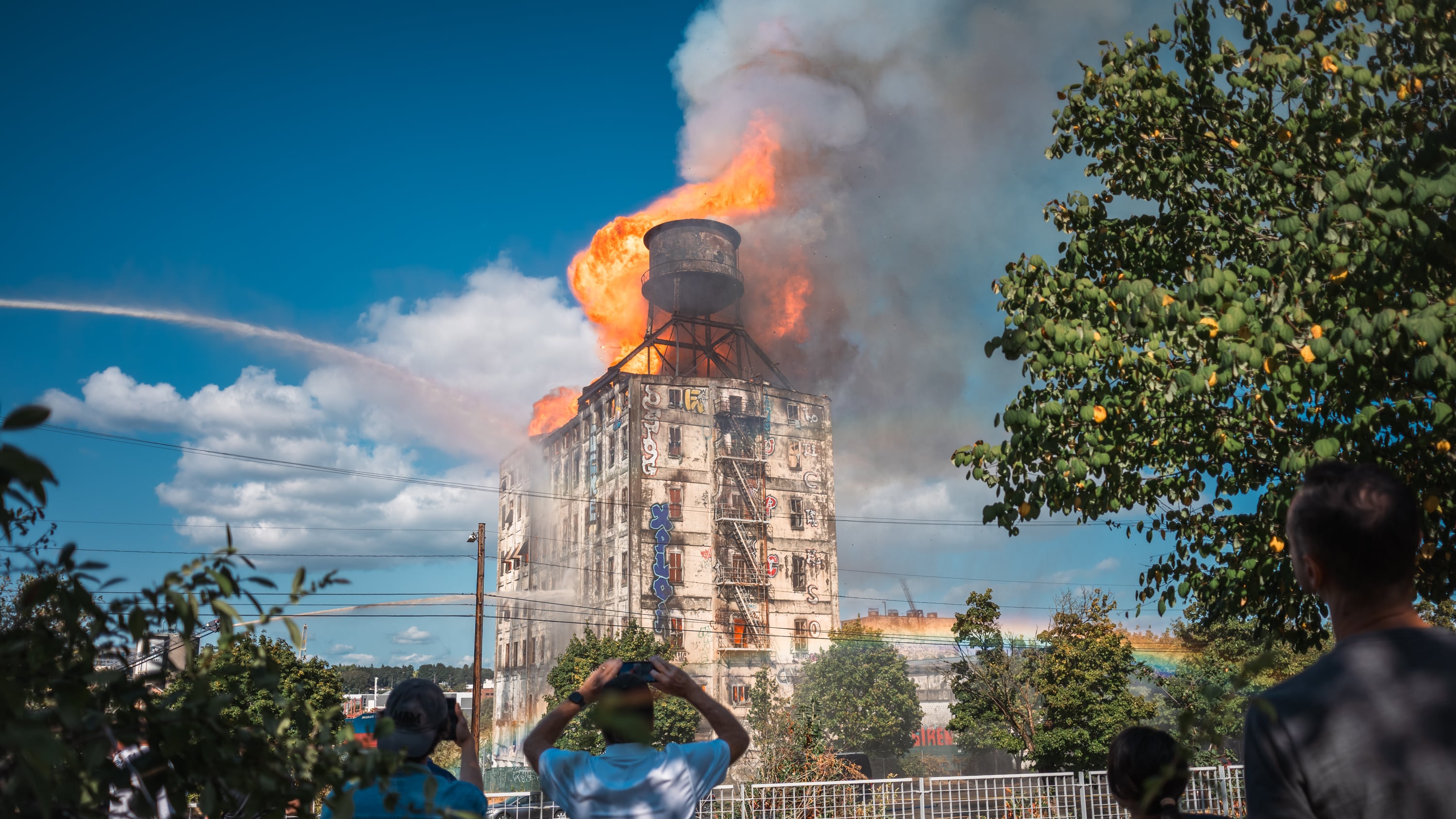
A four-alarm fire ripped through a vacant, 116-year-old riverfront mill on Sunday afternoon in the Pearl District, collapsing every floor of an industrial warehouse that for a quarter-century has flummoxed city officials and private developers alike.
More than 100 firefighters and more than a dozen fire trucks responded to the fire at Centennial Mills on Northwest Naito Parkway shortly before 4 pm. Hundreds of people gathered in adjacent The Fields Park to watch the eight-story abandoned building burn.
A woman who lives at The Abigail condo tower on Northwest 13th Avenue told WW that when she arrived home at around 4 pm, the top floor was in flames, but the fire was still relatively small. Within about 35 minutes, flames engulfed the whole building. She says she often walks by the building and sees squatters—mostly teens—coming and going from the building.
Given the structural concerns of the building, firefighters weren’t able to enter. Most watched from the street below while hoses doused the building from above.
Every floor of the building was ablaze, Portland Fire & Rescue said in a statement.
“This significant amount of fire led to the collapse of each floor of the thick timber flooring placing much available fuel now in the bottom of the large masonry building that was now just funneling the flames and smoke upward like a large chimney,” the fire bureau’s statement said. “Roof failure occurred at one point just below the water tower, with flames and smoke blasting out the top [which] completely encapsulated the water tower structure for a short time.”
The external walls of the building did not collapse, but the fire bureau closed Northwest Naito Parkway overnight because it lies in the warehouse’s collapse zone—an area one and a half times the building’s height. The bureau will use 3D mapping on Monday to try to identify the source of the fire and evaluate the structure’s integrity. So far, no fatalities have been reported.
Centennial Mills was a working merchant flour mill from 1910 to 2000, when the city’s economic development agency, now called Prosper Portland, bought it as part of a bid to remake the industrial waterfront along the Willamette River.
In 2004, economic development officials “recommended demolitions of the existing buildings based on previous planning work and a lack of funding to rehabilitate the structures,” according to a planning document. “This decision was protested by local historic preservationists and neighborhood advocates.” The Portland City Council issued a resolution that celebrated Centennial Mills “as a symbol of Portland’s rich history of maritime commerce and [as] a valuable artifact of the industrial working waterfront.” It directed Prosper to study how to integrate the old building into future plans, in the mode of Gas Works Park in Seattle.
For the better part of two decades, Prosper officials floated ideas for how to make the site a neighborhood anchor; concepts included a wharf with a shopping district, and a multiplex cinema. Nothing stuck. In 2023, the city sold the property to developers, who in turn sold it to Stuart Lindquist, a real estate owner best known as the landlord for the U.S. Immigration and Customs Enforcement facility on the South Waterfront.
As recently as last month, a Vancouver, Wash., developer said he was seeking to rent a portion of the Centennial Mills property from Lindquist and turn it into a nightclub—“a No. 1 club in the Northwest on the Willamette River”—but claimed that onerous permitting requirements had discouraged him.