Skip to main content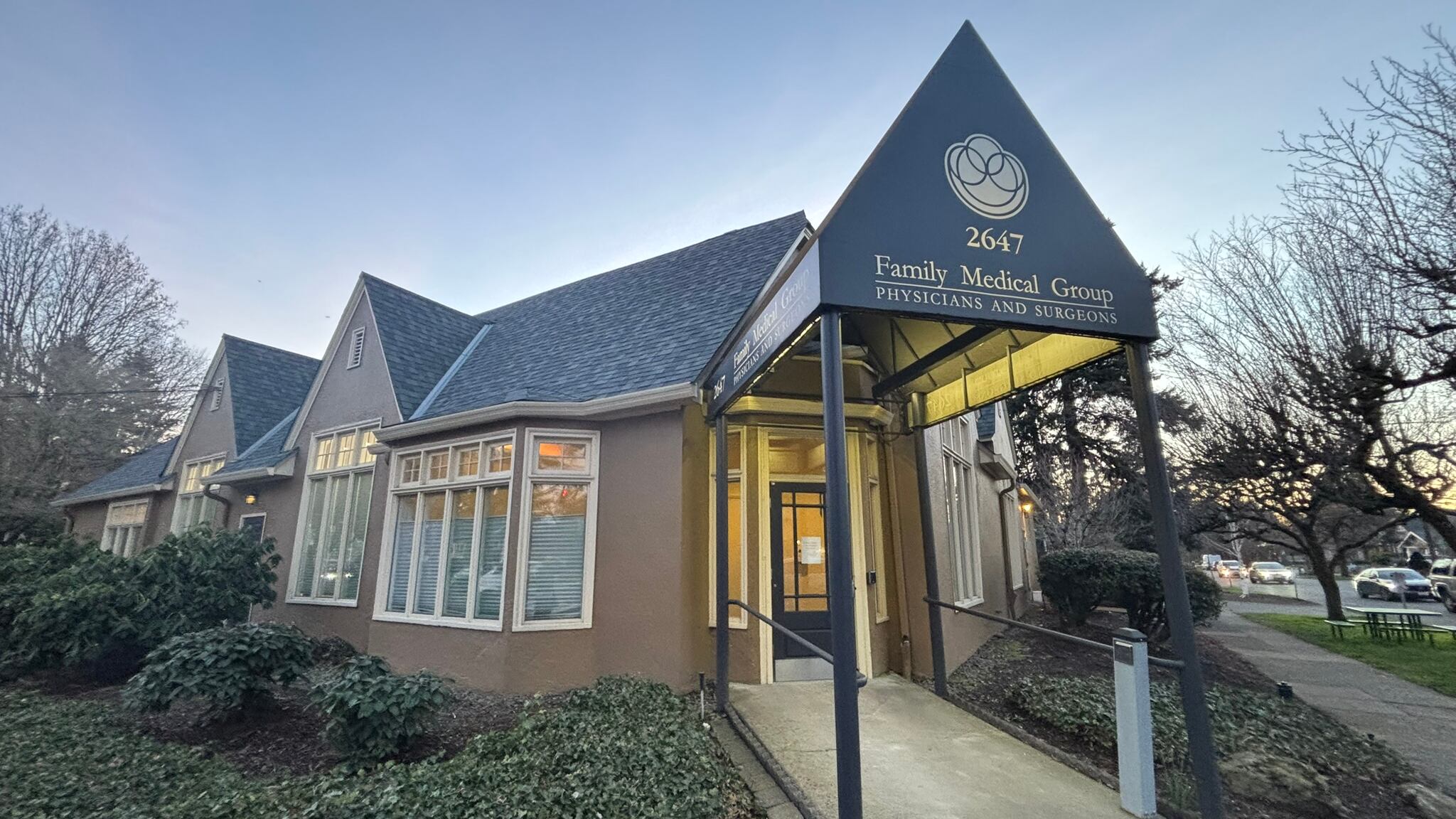
On the corner of Northeast Knott Street and 33rd Avenue stands a neighborhood stalwart. It’s called Family Medical Group NE. The other day, Dave, who lives a few blocks away, stood under his blooming magnolia tree and recalled the sinus infections, blood draws, and annual checks that have been bringing him to this place for more than 40 years.
“Convenient, nicely run,” he says of the clinic. It had labs, X-rays—all the basic stuff so you didn’t have to drive around town. If you needed urgent care on Saturdays, maybe you didn’t get the doc you wanted but, hey, at least it was open, and the care was reliable. One time, Dave recalls, he was fishing and a misstep caused him to lurch, such that his walking stick jammed into the ground and torqued his arm. At first, he doubted his doctor’s analysis that he’d torn a tendon. “It turned out he was absolutely right.”
Not long ago, a big company bought Family Medical Group NE. Then a separate clinic, also newly acquired by that big company, closed up shop and folded into Family Medical Group NE—boosting, for its time, the clinic’s ranks of physicians.
Then at some point last year, archived webpages show, doctors started leaving Family Medical Group en masse. Early this year, the website listed just two remaining providers. Nonetheless, for Dave, 80, a loyal patient for all these decades, the recent letter he received informing him that the clinic would close later this month for good still felt like it came completely “out of the blue.”
The company that took over around 2021 was Optum—a subsidiary of UnitedHealth Group, one of America’s most profitable publicly traded corporations. The purchase did not occur in isolation. Also in 2021, Optum bought a separate Portland concierge medicine firm. The year before, it bought a large primary care network in Eugene. A few years later, it bought a major primary care network in Corvallis.
After these acquisitions, a pattern emerged: Doctors or staff left the clinics—leading to the ejection of untold numbers of Oregon patients from their established care, leaving them to find a new doctor elsewhere.
Other places have been hit too; Optum closed dozens of clinics in New Jersey late last year. But the pattern makes observers wonder what the state of Oregon, which only months ago passed a law restricting corporate control over medical practices, is doing about the matter. For Dave and many others, it also raises a question. “What’s driving them to just kind of cruise around and shut longtime clinics down?” he asks of Optum. “I don’t quite see what the benefit is.”

Family Medical Group NE dates to 1985—a project, as an old webpage says, of “physician doctors desiring a premier neighborhood primary care clinic,” and a “mission is to provide the highest quality medical care available in a caring, compassionate, personable and welcoming environment.”
A webpage archived from 2010 lists about 14 staffers and five providers. In 2016, it listed 21 staffers and six providers. WW calls and voicemails to most of those doctors received no response. An exception was Dr. Steve Aguilu, who says he won’t comment on the Optum era, but is happy to discuss what came before.
Aguilu has spent decades in the Northwest doing the broad-based work of family medicine. “I delivered babies for almost 30 years,” he says. He arrived at the Portland practice well into its run, in 2015. He recalls that one of the early physicians was leaving, but many longtimers remained, and the clinic was still the center of medical care in its immediate community: He estimates a quarter of the long-term patients could walk to the office, and most of the doctors lived in the neighborhood too. He himself lived a five-minute bike ride away.
And yet by the late 2010s, the family medicine model had changed quite a bit. Where generally physicians had registered nurses at their side, now they tended to have medical assistants. The novel burdens of electronic medical records drove many older doctors out of practice altogether. Meanwhile, insurance companies were getting ever more intrusive, incentivizing private practices to join forces—or join the bigger systems, which could ease administrative burdens and confer more negotiating power.
Still, for years Family Medical Group remained a vestige of the old school—privately owned by physicians and bolstered, Aguilu says, by long-tenured in-house support staff. He stepped away for a few years in 2019 and sold his interest in the practice, but felt it remained a vital institution. “When you’re working with sick, ill people—and sometimes angry people and that sort of thing—there’s always some issues and there’s always personnel stuff,” he says. “But in general, it was one of the best places I worked.”
It remains unclear why or how Family Medical Group sold to Optum, though experts can think of plenty of good reasons. Courtni Dresser of the Oregon Medical Association says an array of forces conspire to hinder primary care operations. Some easy examples: Regulations bloom and reimbursements don’t. And the ever-more byzantine administrative mess of the health system shrivels not just pocketbooks but souls.
“It’s not only a cost burden, but it is a burnout issue,” Dresser says. Where Optum is buying in, she adds, it may well be that no one else will.
There was another context to all of this. The health care industry for years saw a growing trend of vertical consolidation between insurers and medical providers. Such partnerships offer many advantages. By law, health insurers must spend a certain portion of their revenue on actual health care services for their members, but this was an easier pill to swallow if these “expenses” simply flowed into companies they already owned.
And as Optum hoovered up providers nationwide, researchers have documented another dynamic. UnitedHealthcare—the other major arm of Optum’s parent company, UnitedHealth Group—is a dominant player in the Medicaid Advantage insurance market, where the federal government pays out higher rates when companies insure sicker people.
Thus, says Brown University researcher Erin Fuse Brown, an incentive emerged for insurers to buy up practices with Medicare Advantage patients and mine their charts to make additional diagnoses. The patients themselves might not even realize it is happening, she tells WW, and yet the data is clear. “The coding intensity increases after Optum buys a practice,” she says, “but the amount of service provided changes not at all.”
Optum, itself a sprawling apparatus with numerous subsidiaries of its own, is huge. It reported $270 billion in revenue last year. (A spokesperson did not respond to questions for this story.) The company’s buying spree hit Oregon as early as 2019. A surgery center here. A hospice center there. By 2024 Optum had made more than a dozen acquisitions, and the Oregon Health Authority estimated well over 100,000 Oregonians had received primary or specialty care that year from an Optum care provider.
Observers like The Lund Report noted at the time that many deals were struck quietly, with no announcement. And the rationales for the acquisitions could be hard to parse before Oregon’s Health Care Market Oversight program went into effect in March 2022, forcing would-be merging companies to show some of their cards in public documents.
In 2023, when Optum was making its case for an emergency acquisition of the large Corvallis Clinic, the parties warned that financial forecasts for the clinic network were dour, and that poorly paid doctors might even leave the service area—a bad outcome for patients of the mid-Willamette Valley. “The proposed transaction,” Optum told regulators, “will significantly stabilize health care services in the area.”
The OHA approved the deal, though at this point there was ample reason for skepticism. As the agency noted in a later analysis, at the four family medicine clinics Optum acquired around this time, “clinician departures” followed.
Some of this was well publicized. The Oregonian and others reported in early 2024 how Optum-owned Oregon Medical Group told numerous Lane County residents that they would be booted from their primary care clinics, which could no longer care for them because so many doctors had left.
The case of GreenField Health in Portland was less closely tracked. Founded by former Oregon Health & Science University chief medical officer Chuck Kilo, the company touted the concierge model, where, for a membership fee, patients pay to get more, and higher-quality, attention from their doctors.
As of 2020, GreenField listed two clinics—on Portland’s westside and eastside, respectively—and noted partnerships with companies like Intel and Laika. One archived webpage from this time said it had more than 5,000 members.
Optum bought in the next year, and archived staff webpages show the brisk diminishment of its employee core in the coming years. By December 2023, those two clinics were gone, and the remaining staff moved in at Family Medical Group, which by this point was also part of Optum.
Optum had an explanation for the move. GreenField Health and Family Medical Group, it later told the state, had “consolidated to provide better support and coverage for patients, staff and clinicians.” State regulators then posed the obvious question: “Please explain how the closure of the GreenField Health System Barnes Road location improved coverage for patients.”
Optum responded that it was mitigating the effects of worker shortages. By consolidating offices, GreenField Health was in fact preserving patient access, it argued, by ensuring clinicians had sufficient support staffing.
Lawmakers were starting to lose their patience. In 2025, the Legislature passed a bill widely regarded as the strongest check on corporate control of medical practices in the nation. It sought to close loopholes allowing for-profit conglomerates to manage the patient care decisions in clinics and doctors’ offices, and restricted nondisclosure and nondisparagement agreements that can dissuade doctors from speaking out.
Whether Optum is currently complying with the law is unclear. For existing entities and arrangements, certain aspects of the law have a three-year phase-in period, and “Optum has not shared their final plans to come into compliance,” says Bailey Langley, a director for state Rep. Ben Bowman (D-Beaverton), who sponsored the bill.
But the question of Optum’s endgame remains. Langley has a take. Operations like Optum, he tells WW, often buy long‑standing local clinics not because each site is uniquely valuable, but because owning them can help the company rapidly expand market share and gain control over patient flow.
“The core incentive is profit,” he writes. “By acquiring primary care clinics, Optum can steer patients into insurance products owned by the same parent company, direct referrals to in‑network specialists and services it also controls. Once the company has absorbed the clinic’s patient base, contracts, and data, the physical site itself becomes less important. That’s why a clinic may be purchased, consolidated with another acquisition, and then shut down within a few years. The real incentive can be in integrating the clinic into a larger corporate system, not in preserving the clinic as a community institution.”
When Dave found out his longtime community institution was closing, he wondered where he would go. He asked around, and someone recommended a doctor at a clinic in Gateway: “I called that clinic and they said, ‘Well, yeah, we know it says on the website he’s taking new patients, but our soonest new patient visit is more than six months out.’”
Dave says he was able to pull some strings and get an appointment scheduled sooner, though he feels others who didn’t so swiftly scramble won’t be so lucky. His son, for example, has been a patient at Family Medical Group since childhood and now brings his own family there. He has not, to Dave’s knowledge, yet found a new doctor. “They’re flopping around,” Dave says. “I’m sure they’re one of many.”