Skip to main content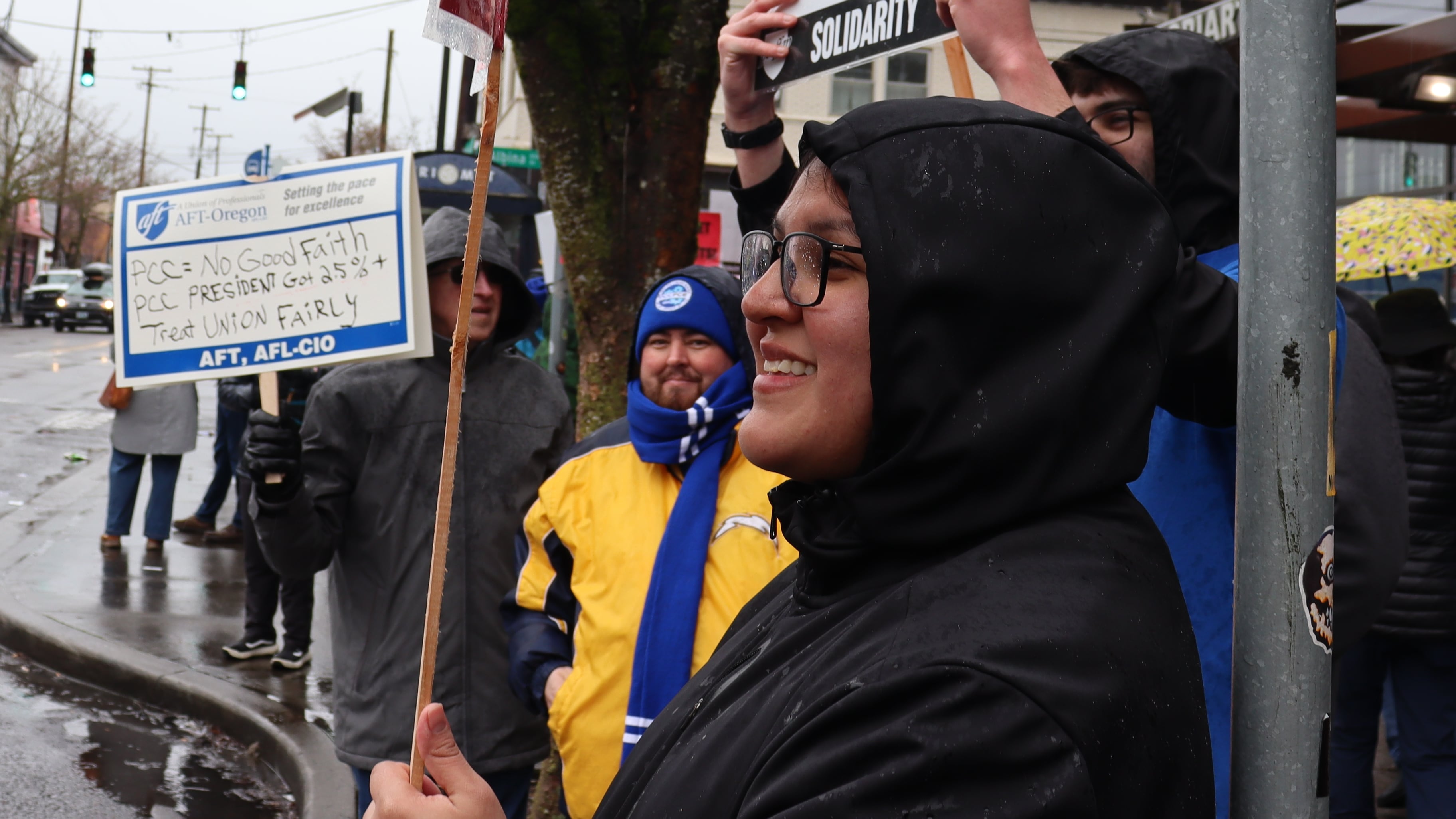
Portland Community College’s largest union, the Federation of Faculty and Academic Professionals, reached a tentative agreement with the college’s administration to end a weeks-long strike late Monday night.
The two parties have been close to a deal for much of the third week of the strike, which began March 11, but disagreed on whether workers should receive back pay for the time they spent on the picket line. In the end, the union closed on a deal with PCC that doesn’t explicitly list back pay, but instead offers a lump sum payment to each member that union leaders said would effectively accomplish the same thing.
The agreement means that about 1,600 of PCCFFAP’s members will return to work on Tuesday across PCC’s four campuses, which should allow for most student services to resume. The strike, the first at a community college in Oregon’s history, has so far interrupted the end of PCC’s winter term, including final exams and grade submissions.
The college announced March 25 it would delay spring term classes from March 30 to April 6, and move winter grading deadlines to April 1. (Despite delaying spring term by a week, the college maintains it will not adjust the ending date of the term, set for June 15.)
Michelle DuBarry, executive vice president of FFAP, tells WW that as part of the agreement, faculty and academic professionals will return to work before ratification, but the college’s offer is good enough that the union feels fine about that. Under the tentative agreement, faculty members are expected to submit final grades by 8 pm April 1, though it includes exceptions. “It’s going to vary,” she says of when final grades will be in for everyone, noting some instructors still might administer final exams or need time to grade large final projects.
DuBarry says the union’s members were increasingly concerned about how a prolonged strike would affect spring term and that the tentative agreement put to rest many of those concerns.
“Our students were becoming increasingly nervous that spring term would be interrupted beyond the point they could make up for it,” she says. “We were bracing ourselves to make some huge concessions at the last minute because we felt like the college was willing to let that happen to students, and we didn’t have a stomach for it.”
In the end, however, DuBarry says many elected officials, including Oregon Gov. Tina Kotek, amped up pressure on PCC to reach a deal. DuBarry says she thinks involvement by elected officials proved key.
PCC officials say that the deal, cut in time not to further delay spring term, will have lasting consequences as the college faces financial uncertainties and tries to plan ahead years into the future.
“This tentative agreement is an important step toward stability for PCC and the students we serve,” PCC president Dr. Adrien Bennings said in a statement. “We are pleased to be moving forward and refocusing on our core mission of educating students and serving our community. At the same time, our hearts are heavy because we know that this agreement is so far outside of our budget that it will result in significant additional cuts in the future.”
The strike began after months of stalled negotiations between unions and PCC management. PCCFFAP’s contract runs from 2023 to 2027, but the union has been engaged in midterm conversations around salary and benefits. (That conversation is baked into the union’s contract.)
The final offer will give PCCFFAP members a 2% cost-of-living increase in the third year of the contract and a 3% cost-of-living increase in the fourth year. This was the major sticking point in negotiations, as PCCFFAP members said their wages were struggling to keep up with the affordability crisis. Full-time faculty will receive a $5,475 lump sum payment, academic professionals will receive $5,000, and part-time academic professionals and faculty who have taught a course during the 2025–26 academic year will receive $1,400. The college will also increase the part-time pay schedule, among other agreements.
DuBarry says a separate agreement with the college also reinstated dynamic scheduling for courses, giving faculty department chairs more control over the offerings PCC can provide.
Notably, because the college did not agree to a back-pay mechanism to compensate workers for time spent on the picket line, workers will not be required to repay any unemployment received through Senate Bill 916, the controversial 2025 bill that allows striking workers to access unemployment insurance after two weeks (an unpaid strike week and a regular waiting week).
Up until March 25, PCCFFAP had company on the picket line, as PCC’s classified employees union also demanded better compensation and benefits in the third and fourth year of their contract.
But the classified employees union ratified an agreement with the college on March 26, which offered no cost-of-living increase in the third year of the contract and a 5% cost-of-living increase in the fourth year. Upon ratification, classified employees also received a $1,350 lump sum payment, and there were assorted provisions around benefits and workers protections, union leaders said.
Even as classified employees returned to work Monday, however, classes still hung in the balance. Notably, the tentative agreement will relieve about 350 international students at PCC whose F-1 visas were in jeopardy as PCC pushed back classes.
DuBarry says PCCFFAP members are some of the closest on the ground to the college’s students. She says many students who had not seen the college’s communications around the strike came to campuses earlier Monday morning expecting to begin spring term. An English as a second language instructor, for example, had to explain to students why classrooms were empty, DuBarry says.
“That’s the kind of thing that a faculty member would just know,” DuBarry says. “The impact on the students is felt much more deeply by the people who serve students every day.”