Skip to main content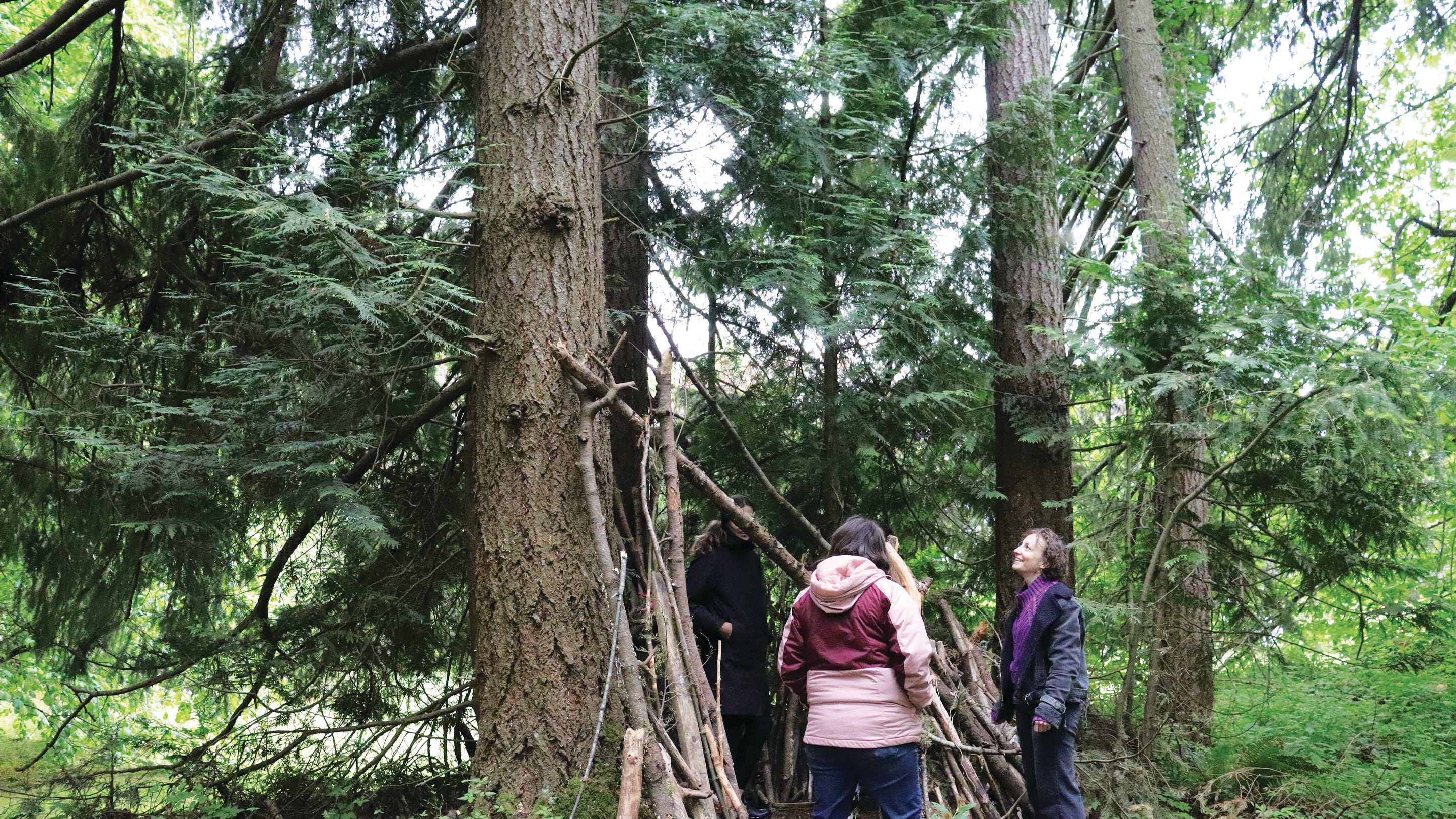
On a rainy Friday afternoon, Shanon Melling takes shelter beneath the trees. The dense forest that borders Sauvie Island School’s playground filters out just about all of the downpour.
Melling is one of a group of moms leading this reporter on a field trip along trails their children have maintained. They describe some of the projects their kids have undertaken in the forest: a survival skills class in which they learn to start fires without matches, or nature journaling time, when they practice mindfulness.
Melling’s sixth grader and fifth grader have both attended Sauvie Island School for years. (Thanks to a competitive lottery, it was no easy task getting both enrolled.) It’s a serious commute: Her family lives north of Scappoose, so dropping the kids off at the K-8 charter school on the southern end of the island, then picking them up, means two-hour drives each day.
It’s all worth it, she says. “When I walk in the woods with my kids, they’re able to point out each native species and tell me the history of, you know, the trilliums, and why they are called trilliums, and the different various trees,” she says.
But today, Melling is combing the woods for bright pink survey markers. Signs of intruders.
The markers represent an unwelcome change for these moms. They mark a section of the forest, less than 200 feet from the school, where Verizon is seeking to erect a 150-foot cellular tower. The tower would be disguised as a tree.
The stretch of property earmarked for the tower is privately owned by Sauvie Island Grange, a fraternal organization that hosts a community gathering space for the island’s residents. (The grange did not return a request for comment.) Concerned parents and islanders say they recently learned the grange had entered into a contract with Verizon over a year ago, and that a pre-file meeting for the cell tower had been held in December.
A preliminary plan shared with WW includes drawings featuring the tower, a number of accompanying pieces of equipment (think a generator), and a 6-foot-tall, 50-foot-long fence to surround the 2,500-square-foot site.
More than 600 community members have signed a petition opposing the tower.
Sauvie Island School enrolls 203 students in the current academic year, 25.6% of them from the island, while the remaining 74.4% hail from its sponsor district, Scappoose School District, or from even beyond that. The school’s got a waiting list almost half the size of its enrollment. In the upcoming academic year, 216 students will have a spot, and 80 are on the waitlist, executive director Darla Meeuwsen tells WW.
Yet parents worry that the school’s popularity is delicate, shaped heavily by demand for an education that feels wholly remote, one that isn’t so dependent on the tablets and laptops that all but pervade many metro-area classrooms. They say the cell tower could disrupt the school’s focus on place-based education and jeopardize its very existence. (For that matter, many of the parents who choose this school are also wary of the health effects a nearby cell tower might have on their children.)
“I’m convinced that parents will be so upset about this that they will no longer enroll their kids in the school,” says Kimberly Artisan, a parent of two. “All of us that have sent our kids to that school are doing it because it provides such a rich, small community nature-based experience, and the cell tower directly contradicts that message.”
The Sauvie Island School Board said it would not take a position on the matter. Paje Stelling, a spokeswoman for the Scappoose School District, says the district is not taking a formal position on it either.
“Because the proposed site is on private property and not district-owned, the district does not have decision-making authority over the tower’s placement,” Stelling says. “We understand that families may have questions and concerns, and we support a transparent process that allows those concerns to be heard by the appropriate decision makers.”
It turned out that the bright pink survey markers were just a couple of feet away. Students had used them to construct a fort, anchoring thick fallen branches in the ground and overlapping them to create a structure. KaraLyn DeWalt, a neighbor with two young children soon set to enter the school, says she often comes across little structures the kids have assembled in this forest.
DeWalt’s kids have long looked forward to the days where they’ll be able to attend the school next door. She quite literally has a front-row seat to the school: Her kids watch older students meander around town grounds by the school and hear their chattering outside the windows.
DeWalt’s also got a front-row seat to some of the happenings at the grange, which she joined as a member recently. She says she’s been trying to have conversations in good faith with the organization about where it’s at in the process, but that it’s been hard to get transparent answers. It’s also been hard for her, she says, to think about what she might do if the cell tower is installed.
“Is this a two-month problem or a two-year problem? I have no idea,” she says. “How do I pace myself? I don’t know how long the race is, I don’t know how far into the race I am. It’s a really uncomfortable space to be in.”
DeWalt is among several community members who say they wish there was more clarity in the motivations for the project and its status. A Verizon spokesperson tells WW the company is currently working to ensure it strictly complies with all applicable laws and permitting and environmental regulations.
“Verizon is committed to adding critically needed connectivity in the Sauvie Island area,” the spokesperson says. “New cell infrastructure is essential to ensuring residents, local businesses, and emergency services have the reliable, high-speed wireless coverage they need.”
Denis Theriault, a spokesman for Multnomah County, says the pre-file meeting in December was not a formal application for development, which has not been filed with the county. If the county receives an applicatoin, its land use planning staff would solicit public comment. The application would be approved or denied based on whether it meets regulations in place at the time of its filing, he says, adding there are a couple of routes to appeal.
The process brings little assurance to Jennifer Herrick, a parent who lives just a couple of houses away from the school. It should have fallen on the grange to engage its next-door neighbors, she says. “The lack of public process has been incredibly discouraging. I think it’s really fractured the community.”
And as long as the timeline stays vague and the plans remain on the table, parents like Melling say they’re thinking about heading elsewhere, some in the name of safety.
While research on the health implications of radiation caused by cell towers is inconclusive at best, Melling says she’s concerned because one of her children suffers from neuroinflammation, and her family just addressed a different environmental hazard that was worsening the condition. She says in good conscience it’d be wrong to subject her child to any semblance of risk.
Yet, as she’s begun to look for other schools to enroll her kids in, she can’t help but think about what they might miss out on. “It’s literally winning the lottery,” she says, noting she hasn’t found any comparable alternative. It’s at this school that her children, who are dyslexic and at times struggle with traditional ways to learn, have blossomed and learned to embrace self-confidence. “I have to decide between what’s good for their reading brain and what’s good for their heart and their whole person,” she says of the choice.
What perhaps speaks best to the school’s place-based learning curriculum is how Melling’s kids have reacted to the proposed cell tower. They’ve thought about it less as a personal hardship, she says, and more about its effects on the place they’ve grown to love.
“My daughter literally raised her voice; she was like, ‘What about the birds? What about the animals? You can’t just cut down a forest,’” Melling says. “My son just looks sad. For both of the kids, it’s about the forest, about how they won’t have that.”
Correction: An earlier version of this story noted the proposed surrounding fence was 50 feet tall. It is six feet tall, and 50 feet long. WW regrets the error.