Skip to main content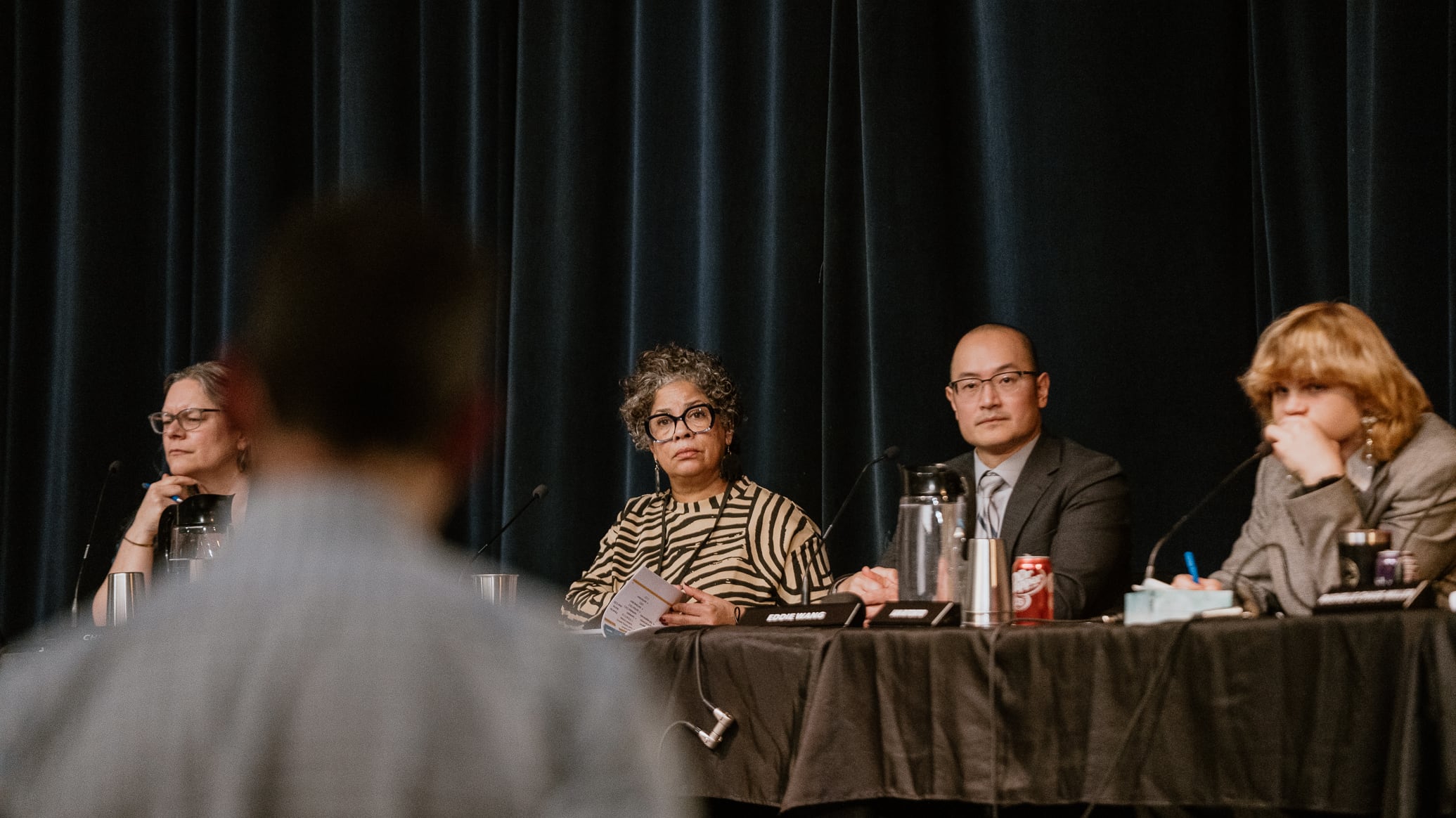
In the late hours of June 23, members of the Portland School Board were presented with a vote that seemed to offer no good outcome.
Before them lay an amendment to Portland Public Schools’ 2026–27 budget. Brought forth by board member Stephanie Engelsman, the amendment would restore about $13.2 million toward “staffing in schools in student-facing positions.” That meant, among other things, sparing at least 87 educators’ jobs.
The source of the $13.2 million, however, was unclear. For months, district officials had warned the School Board of another painful round of budget cuts to bridge a $56.3 million deficit as they struggled with declining enrollment and rising costs. But some board members, including Engelsman, insisted late that night that the school district must have left some rock unturned.
And they were joined by formidable allies: more than 60 members of the Portland Association of Teachers had packed the board room, eager to see Engelsman’s amendment passed.
“A few people have asked me, where does this money come from? First, it’s not my job, or our job, to come up with finding the money,” Engelsman said as she put the budget amendment on the table, to cheers from the crowd. “It’s our job to protect the students…We cannot balance another budget on the backs of our students.”
Board members—most of whom PAT had endorsed for election—were faced with a union whose values they’d espoused as they campaigned. PAT played hardball as the night went on, too. Board members heard from public commenters, including Niki Trueblood, one of the district’s only Indigenous counselors, whom PPS had laid off, and Portland City Councilor Tiffany Koyama Lane, who insisted board members should look harder for the money.
Then, there was the bigger picture: what the teachers union might do if disappointed.
In the last School Board election, PAT-endorsed candidates won three of four contested seats and came within a hair’s breadth of winning the fourth. The broader Oregon Education Association, the statewide teachers union, recently notched key victories in closely watched Oregon legislative primaries just west of Portland. In Hillsboro and Beaverton, the union’s financial backing all but ushered primary challengers Myrna Muñoz and Tammy Carpenter into seats in the Oregon Senate and House, respectively. And the budget vote came at the start of what is shaping up as a year of contention between PPS and its biggest labor union, one that will be marked by school closures, another round of contract negotiations, and a spring election for four available School Board seats.
So when the School Board, which PAT had largely handpicked, ultimately rejected Engelsman’s amendment by a vote of 1–6, the room fell silent. And it seemed a new fire blazed in PAT’s ranks.
Shortly after the vote, an email written by outgoing PAT president Angela Bonilla hit union members’ inboxes. It sets the stage for what appears to be a concerted effort by the union to recruit and fund candidates for spring 2027 races. It calls for volunteers to phone bank and for donors to fund challenger campaigns, noting that the decisions School Board members make could affect students, families and educators for generations.
In short, it suggests PAT is making ready to lay off members of the School Board.
“We need leaders, not followers, who listen and believe us when we, in community with families and students, demand more from PPS leadership,” the email read. “We have four open School Board seats in May 2027. Now is the time to find candidates that believe that the mission of public schooling is aligned with the rights of workers.”
It was in some ways surprising to see what Chair Eddie Wang deemed “the most pro-teacher board I’ve ever seen” dismiss an amendment meant to preserve teaching positions. But for the School Board’s members, there was one big deterrent to taking the bait: recent history.
The conversation of where the district might be able to scrimp and save left the board’s longtime members—and some district officials—with serious feelings of déjà vu. PPS has, after all, ended up in its current budget position in no small part because it relied heavily on one-time funds to patch holes in previous budgets (“Cutting Into Bone,” WW, May 6).
Without a readily available source of funding to tap into, board members eager to bring classroom positions back started drumming up a number of ideas, some with PAT’s help. There was an opportunity, one suggested, to tap PPS’s reserves, already at the board-approved floor of 5%, or $41 million, if the district could provide an aggressive rebuilding plan. Others suggested renegotiating contracts.
But enough of the board was convinced that even if the district were to dig up another round of savings, it would be forced to confront a similar process in the years after. For many, it was time to pick up the can that had been kicked down the road.
“Sometimes we need to display courage and do hard things. And this is one of those times that we need to do really hard things,” said Michelle DePass, the board’s vice chair, who strongly opposed modifying the budget. “All of us here, we can’t say yes to every single thing that comes across our desk.”
The board’s decision to stand its ground and refuse a key constituency will have implications in the months to come. And PAT, for its part, has no intention of backing down. The union already plans to return to the board at its meeting July 7 to continue pressing for an amendment to restore teaching positions, and criticized the board harshly for killing Engelsman’s amendment altogether instead of tweaking it.
Bonilla’s email outlines a list of items the district could consider to find more money for staffing, including funding a “meaningful retirement incentive,” canceling AI contracts, and pausing cost-of-living adjustments for nonrepresented administrators making more than $150,000 a year.
Tension seems to be mounting between the union and PPS Superintendent Dr. Kimberlee Armstrong as well. In an email she sent to board members, a copy of which PPS gave to WW, the superintendent clapped back at each of the union’s suggestions in order. In it, she argues some suggestions, like pausing cost-of-living adjustments, save so little money they are value statements that won’t help the district realize cost savings in the long term. Other asks, like encouraging retirement, could mean the district incurs additional expenses, she wrote.
“At this point, it is important to separate true cost savings from one-time funding shifts,” Armstrong wrote. “Some of the options listed may appear to create relief in the short term, but they do not reduce ongoing expenses. In some cases, they would deepen the structural deficit and create greater budget pressure in future years.”
The spring 2027 election marks the next opportunity for PAT to again shake up the School Board. In the last election, the sole incumbent running for reelection, Herman Greene, lost his seat in no small part thanks to PAT’s backing of his opponent. And at least one seat will be wide open next year: Christy Splitt has opted not to run again.
Wang, the board chair, tells WW he’s still on the fence about whether he’ll run for reelection. He says he stands by his belief that the current board is friendly to teachers. He says student enrollment since 2019 has declined at a pace much sharper than the number of teachers laid off. The board has passed policies in the classroom to make teaching easier, he says, including one that bans cellphones during the school day. And he says the final 87 educator layoffs were significantly lower in number than earlier estimates, which, at times, hit close to 150 positions.
Wang says he voted against the amendment because he felt the district had made a concerted effort to preserve teaching positions. PAT supported Wang’s election campaign in 2023, he says, because of his values to do what’s best for the classroom. Yet he says he didn’t let mounting pressure from the union sway his decision.
“What I want to do is to be able to sleep at night, so as long as I know that I’m making decisions that are what’s best for students and teachers, then whatever they decide they want to do, that’s on them,” he says. “The way I voted was not just looking at this year, but looking at future years.”
If PAT disagrees with his decisions, he adds, “then it is their every right to try to find someone different. But I will continue to do what I was charged to do when I got elected.”