Skip to main content
For years, Portland Public Schools has tried to stave off a reality of its budget.
The 2026–27 school year will mark the fifth consecutive year in which the district has faced a multimillion-dollar shortfall in its $868.6 million general fund, a gap that only seems to grow each spring. The next gap is projected to be among the largest ever: $56.3 million, which Superintendent Dr. Kimberlee Armstrong plans to bridge with layoffs. She proposes PPS lose 336 of its roughly 8,000 employees.
School Board members sound despondent. “The situation we’re at right now is that there’s no more fat to cut. We are literally beyond the meat. We’re into the bone, and every cut that we’re doing is going to hurt, whether now or in the long run,” School Board Chair Eddie Wang said at an April 29 press conference. “Loving teachers are being let go. Essential services that support the kids that need extra help are being let go. These are really dire times.”
They could get worse. PPS leaders have produced charts indicating that if the district keeps running as is, it will dig itself into progressively larger budget holes with each passing year. Officials have already forecast the district will face a $65.2 million deficit in the 2027–28 school year. In other words, this year’s record budget crunch could soon look like the salad days.
In the early years of PPS’s budget cuts, leaders prioritized reductions that largely took place away from classrooms. In recent years, classroom cuts have become more routine, outpacing central office cuts. The Portland Association of Teachers says 180 educators would be affected under the proposed cuts.
Parents and community members may look at the string of deficits—and the predictions of ones to come—and wonder how it is that PPS never seems to balance its checkbook. WW took a closer look at the numbers and reached three conclusions.
Enrollment is falling as expenses increase.
PPS’s enrollment decline began almost in tandem with the COVID-19 pandemic. The 2018–19 school year was the last high point for the district, when it enrolled 48,708 students. Enrollment sharply dropped in both the 2020–21 and 2021–22 academic years, and decline has continued in the years since. This academic year, the district enrolled 42,622 students as of an Oct. 1 count—a 12.5% drop in seven years.
There’s one major reason declining enrollment matters. Enrollment numbers help determine how much revenue PPS receives from the State School Fund, which helps fund a sizable portion of the district’s general fund. Because the SSF is growing, the amount of money flowing from the state to PPS has actually increased as enrollment has fallen. (PPS is forecast to get about $7,170 per student from the SSF grant in the coming year.)
If enrollment had simply stayed flat, the revenue boost might have kept pace with spending. But enrollment fell—and much more steeply at PPS than in the rest of the state. Since the 2018–19 school year, enrollment at Oregon’s schools has dropped about 7.5%. The difference is a problem for PPS because the SSF is a shared pool distributed across districts. “Our faster-than-average enrollment decline means we are losing a larger percentage of that total funding to other districts,” says Dr. Renard Adams, the district’s chief accountability and equity officer.
“Two things can be true—the SSF has provided more funds than ever before and those funds haven’t been enough or kept pace with the costs of educating our students,” says Michelle Morrison, the district’s chief financial officer. “Think of it like this: The Quality Education Model says we need a dollar. The SSF gives us 75 cents, which is more than the 70 cents we previously received, but still short of the dollar we need to operate.”
Like a losing horse at the Kentucky Derby, the district is spending at a gallop but keeps watching the rear end of its expenses getting farther away. The district is seeing rising costs in every aspect of its operations, from more costly health care benefits and cost-of-living adjustments for its employees, to services whose costs will increase with inflation. Costs for maintenance and utilities of the district’s facilities are a consideration. And PPS spends handsomely on the Public Employees Retirement System. (The district’s PERS rates will rise from 4% to close to 21% in upcoming years, in large part because some of its short-term cushioning methods are set to expire in July 2027.)
To make matters worse, the other main stream of revenue for PPS’s general fund, property taxes, is taking some hits. The district reports a $6.5 million loss in property tax revenue. (Its teachers levy has hauled in less than expected.) Portland’s stagnant commercial real estate market doesn’t just leave towers empty: It hits the pockets of PPS.
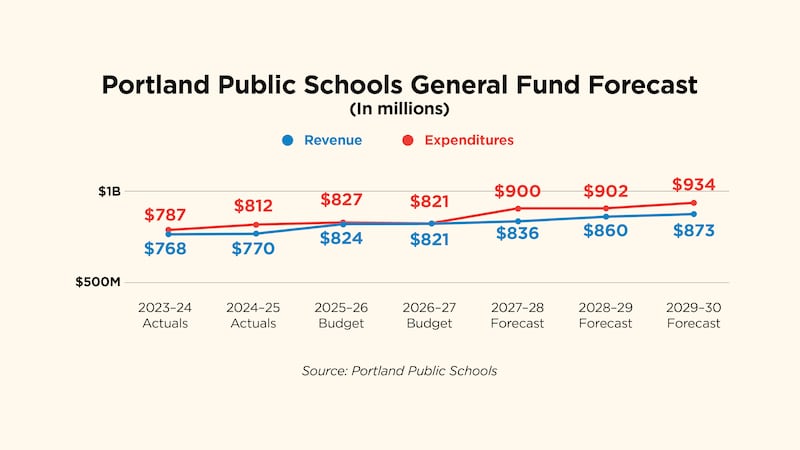
The district used one-time money to paper over ongoing deficits.
Understanding PPS’s early strategy to patching budget gaps requires taking a trip into the past. In the spring of 2022—the first time in recent memory that PPS needed to fill a hole—a number of Portland School Board members expressed their reluctance to balance the budget with one-time dollars.
One of those people was former School Board member Andrew Scott, who, as KOIN-TV reported then, warned that using one-time funds just “puts cuts off until later.” In other words, by building a budget around money that would not be available in the following years, the district was guaranteeing that the floor would collapse the following year. “It’s like using your tax return to pay your rent,” he says now.
But PPS used at least $7 million in one-time funding that year to tide over staff positions, and gave in to similar temptations in subsequent years. Like districts nationwide, PPS received a significant amount of money from federal COVID-19 relief programs, including Elementary and Secondary School Emergency Relief, or ESSER, and like many districts nationwide, PPS used those dollars at times to fund full-time employee positions.
In building its budget for the current academic year, the district turned to one-time funds yet again, draining a PERS reserve fund that now sits empty and maintaining the minimum allowable general fund reserve: 5%. Draining some of those one-time funds was risky, Morrison admitted back in spring of 2025, and she was right. When PPS found itself in an unexpected midyear budget deficit this year, those weren’t funds the district could turn to.
And Scott’s 2022 prediction appears to have come true, as the district now confronts a larger hole. He says PPS has struck a delicate balance through the years between listening to the larger community—who wants to see services sustained at their current level for as long as possible—and making more gradual, sensible reductions. Putting reductions off, he says, has compounding effects. “The fiscally responsible thing is to begin to make these reductions when you first see them, and not delay them and make the situation worse,” Scott says. “It’s going to be painful.”
At this point, PPS is reduced to asking the state to access its reserves—not to solve this year’s budget shortfall, but to prepare for the gaps in coming years. PPS leaders have called on Gov. Tina Kotek to tap the Education Stability Fund, a $1 billion state education reserve funded by lottery dollars, but they suggest any money they get from the fund would go toward long-term budget relief, such as mitigating PERS obligations.
“Using one-time-only funding is not the answer to a structural deficit,” Deborah Kafoury, the district’s chief of staff, said April 29. “There are ways you can strategically use one-time-only funding to smooth out your budget.”
Nobody is going to enjoy what happens next.
Addressing a budget that has relied for years on backfilling from one-time funds has led district leaders to conclude PPS will need to develop a new structural baseline for the district’s expenses. They propose forecasted cuts for the 2027–28 school year—$65.2 million—will end this cycle.
Finding a new baseline means the district will have to take a hard look at the services it provides and the personnel it employs.
“If we don’t take those big swings and make those reductions, then those reductions continue on for year four, five or six,” Armstrong says. “I think there’s an old saying about kicking the can down the road. Well, we have arrived at the can that has been kicked.”
Some of that structural deficit might be addressed by the school closures PPS has planned for fall 2027. But research has indicated school closures alone save districts little money—a majority of savings, if realized, come from reducing school personnel. Armstrong says it is more affordable for the district to consolidate its resources at fewer schools.
Yet PPS will almost certainly face some sharp criticism as it broaches finding a new budget floor. Angela Bonilla, the president of PAT, says the district must engage in a transparent process as it identifies items to cut, suggesting PPS takes a much closer look at a wide swath of its contracts, from those administering standardized testing to others piloting artificial intelligence learning platforms. She reasons that savings from such contracts could add up to substantial ones for the district.
Bonilla says she doesn’t deny a reset might be in PPS’s best interests. But if services continue to go, she says, the district will only harm the students it’s meant to serve.
“I think it’s great to dream that we’re going to be able to bring down these costs,” Bonilla says. “But with the lack of federal grants, because of all the privatization at the federal level, the increased need for students, all of this means that it might be what’s best for the district, but it won’t be what’s best for kids.”