Skip to main content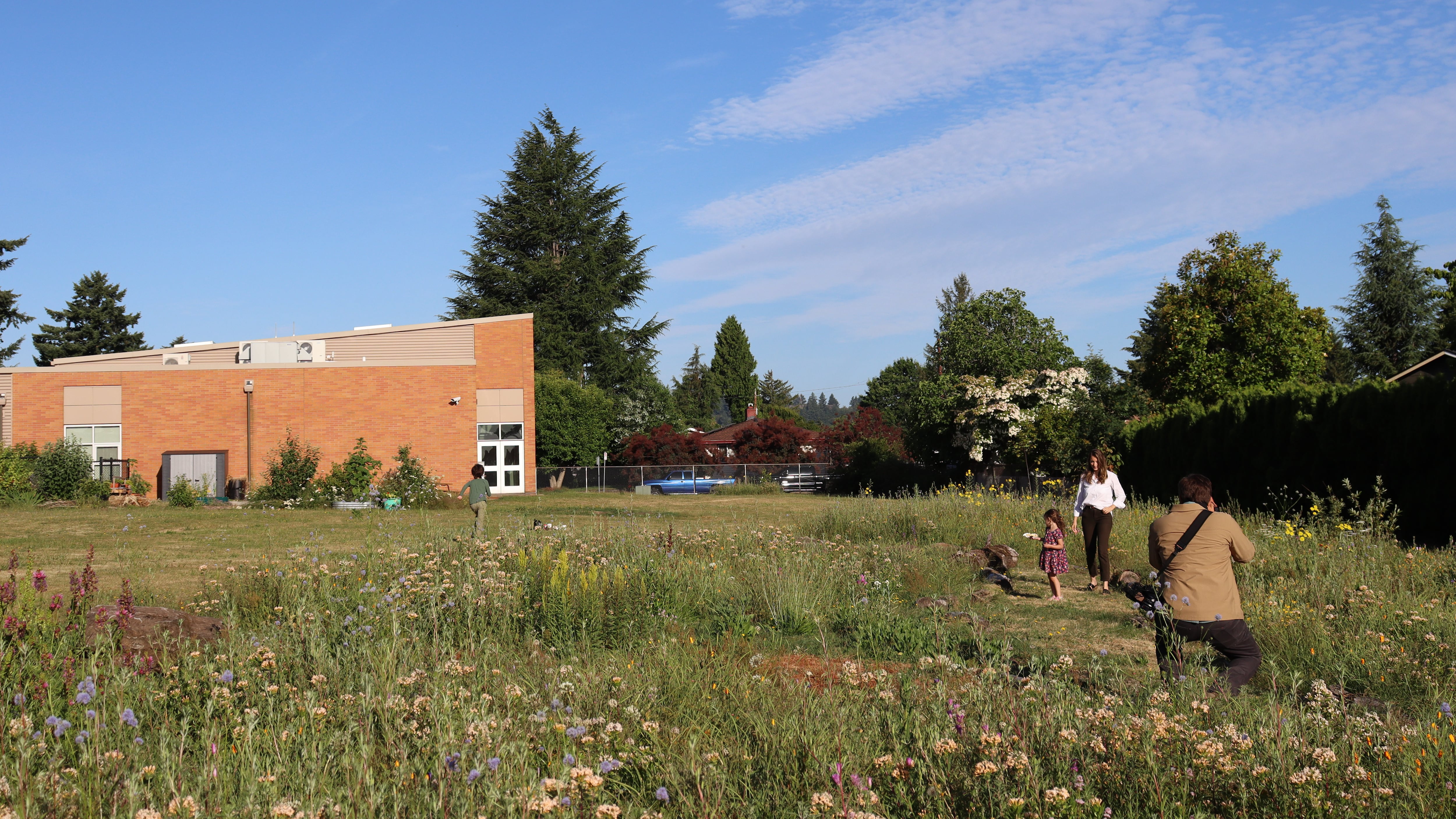
Bill Wessinger has lived in the Russell neighborhood of Northeast Portland for the past decade, well before he had two daughters, the older of whom attends the elementary school.
Yet since moving into his own fixer-upper, Wessinger says he’s often thought about the sprawling lawn at Russell Elementary. Until recently, about 6 acres of flat grass bordered the school’s blacktop, with a couple of trees scattered in between. According to parents, only about 2 acres were used for recreation, the rest being too expansive to supervise kids.
“I always kind of looked at it and thought, ‘Boy, it feels like there could be something more there,’” Wessinger says.
In recent years, Wessinger says he developed an increasing interest in native plants, specifically around how they supported entire community ecosystems. He’d always leaned toward planting natives, he says, because his grandparents had, and because he liked that his yard reminded him of being in Forest Park. But he’s learned more about their importance through books, which have taught him that native plants are crucial to sustaining local insect populations, which were in turn crucial to birds and larger wildlife.
“The more I thought about that, I was like, ‘Oh, God, this is a story that really should be embedded in the curriculum,” he says. “It was just so different than the way I grew up thinking about plants.”
As it turned out, an idea was already brewing.
Wessinger wasn’t alone in thinking the school’s lawn could be something else. Ian Hunter, whose son attends the school, had been talking about it with Russell’s now-retired principal. Hunter runs Phoenix Habitats, a firm that concentrates on habitat restoration and native plant landscaping. That passion for native plants inspired him to start talking about what the lawn could look like if parts of it were converted into a native pollinator garden.
But Russell Elementary is a school with limited means. About 40% of the student body is experiencing poverty, and the broader Parkrose School District in East Portland has had budget woes for years. It is one of several Oregon school districts that struggles to pass teachers levies, and narrowly passed a bond measure more than a decade ago.
So when Hunter heard about a new state program, the Community Green Infrastructure Grant, he worked with parents and school officials to try and tap it. The grant program is new; it first started accepting applications in 2024 to fund nature-based projects that would build community resilience, everything from stormwater management to landscape restoration. Hunter says the state awarded Russell about $170,000 for the project, which includes installation and maintenance for five years. The elementary school was one of 23 grant recipients in its inaugural year.
“This wouldn’t have happened without the grant program,” Hunter says. “Right now, there’s barely enough money to prune the trees, and they basically have a rotation with two or three people that are mowing and maintaining the lawn in all of the schools in the Parkrose district.”
Limited staff also meant it took some serious volunteer labor to piece the project together. Phoenix Habitats, which was awarded the work through a competitive contracting process, began digging up parts of the expansive lawn starting in August. Hunter and his wife, Abigail Leonard, who works as the firm’s planting designer, started hosting garden work parties once it was time to put in plants.
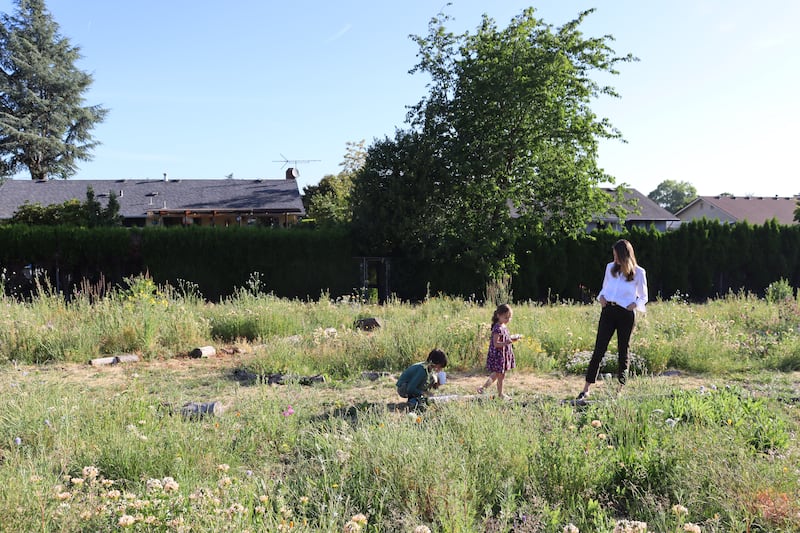
Wessinger joined in. He had already volunteered with Russell’s small vegetable garden, and says the garden work parties inspired a new sense of community. He says it’s been fun to watch once bare root stock blossom for the first time this spring, and he’s particularly excited that a large white oak tree on campus is now surrounded by native plants.
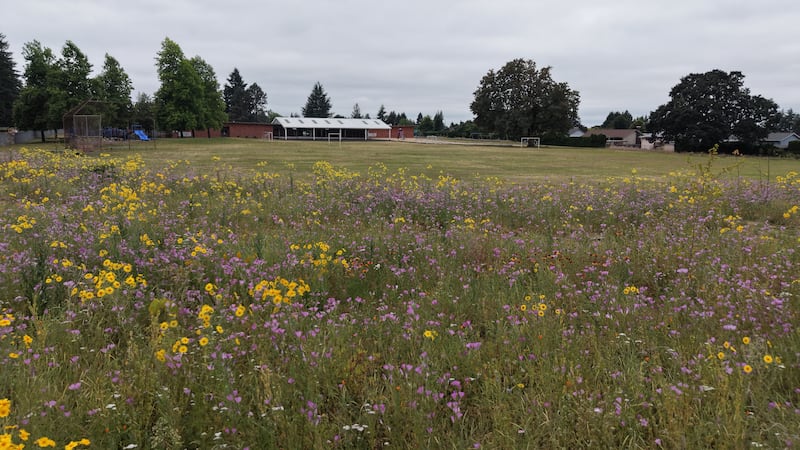
Now, an acre of the lawn has been converted into a wildflower meadow. On a spring morning in mid-June, Hunter walked WW through the garden. He gestured toward orange-red blanketflowers and freshly budding hot pink clarkias.
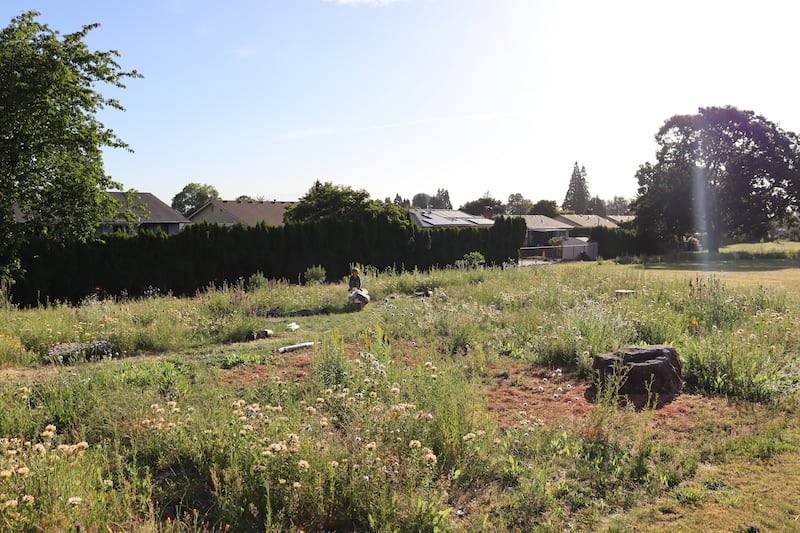
There are also now 73 more trees on campus, including eight additional Oregon white oak trees. That’s up dramatically from the 22 that were on Russell’s campus originally. And there are plenty of spaces for kids to roam, play and learn across the garden, which is scattered throughout the grassy field.
Hunter’s already seeing less visible changes, too, and he’s taken a lot of pleasure in showing them to Russell’s students. Kids can see the difference between soil dug up on grassy parts of the lawn and ones dug up in their new garden, and smell the natural sweetness of the latter. Hunter helps explain how healthy soil retains water better and sustains plants and worms, and he explains how fungi regulate soils. “I keep it pretty high level,” Hunter says.
“We have logs and boulders out here, and there’s a log that has a hole in it and the kids come and look in the hole and imagine what kinds of spiders and animals are living in there,” he says. “The teachers will talk with them about the relationship between flowers and pollinators, and then birds.”
The school even was home to a killdeer nest this past year, Hunter says. The killdeer is a ground nesting bird that is endangered in Oregon.
Amoreena Guerrero, a parent of an incoming fourth grader and an incoming kindergartner at the school, says she’s worked with Leonard to also develop more robust garden education programming. She’s excited to bring history programming to the school as well, and is thinking about how to help kids learn about native plant and food traditions through their own garden.
And she’s excited that the kids will have a respite at their school, a place to find calm and check in with their emotions. At the time of the plantings, Guerrero says her son was not attending Russell and faced some struggles. But her family attended the garden parties regardless. She recalls Russell’s principal welcoming her child and helping him use an auger (a big drill-like tool.) For her family, the garden became a place of connection and warmth.
“The kids having that experience of working on this project together with the principal, outside of the regular school hours, it created a different feel than seeing your principal in the hallway or in the office,” she says. “As a family with some struggles that were happening, it made it so much easier, and he was so much more excited to come back when we were able to come back.”