Skip to main content
In the waning weeks of August, Multnomah County commissioners are once again examining the tax on high earners that funds Preschool for All.
At a Thursday morning meeting, the Board of Commissioners appeared poised to approve another one-year delay of a scheduled 0.8% increase to the marginal income tax that funds the program. Its members unanimously approved a first reading of a proposal to do so. (Commissioners have already delayed the tax increase once before. It was originally scheduled to take effect in 2026.)
The proposal to delay the tax increase by one more year, until 2028, came from Commissioners Shannon Singleton and Meghan Moyer. It differs slightly from a recommendation by Preschool for All’s technical advisory group, which recommended commissioners delay the tax increase until at least 2029. The group of economists, demographers and policy experts had convened to assess the program’s economic outlook and sustainability.
The advisory group made some significant contributions to financial modeling for Preschool for All. County staff has in recent months produced updated projections for the program’s large fund balance, largely fed by new demographic forecasts that show the county will need just over 8,000 seats to reach universality—3,000 fewer than it forecast earlier.
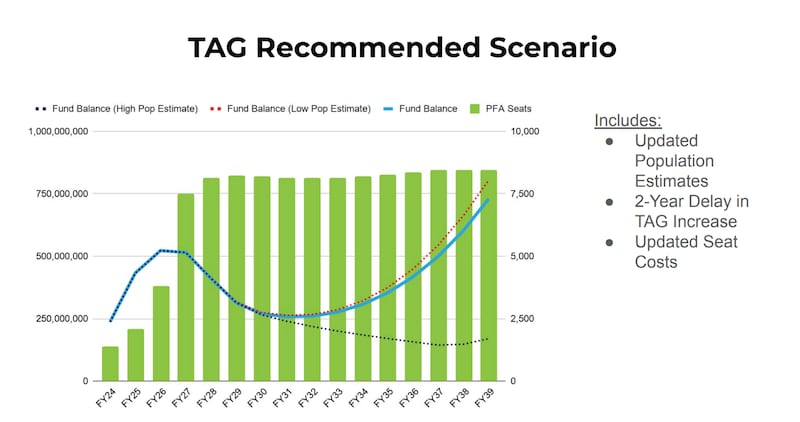
In a scenario where the county delayed its tax increase by two years, and incorporated new, higher reimbursement rates for preschool seats, modeling showed Preschool for All’s balance would, at its lowest, dip to about $250 million in fiscal year 2031. By fiscal 2039, it was expected to recover to just under $750 million.
Yet on Thursday several public commenters spoke out against approving a delay of any sort. Many voiced concerns that commissioners shouldn’t deprive the program of a potentially necessary income stream before the county understood the full cost of the program. (The county has been in the process of determining updated seat costs based on a true cost of care study, and providers have asked for better funding of inclusion supports for high-need students.)
Many also took issue with the county’s assumption that Preschool for All would have a 77.5% participation rate, citing other universal preschool programs that have participation rates up to 90%.
“[We’re asking] for a clear data-driven picture of the true cost of inclusive care, so decisions are made on real numbers based on actual child and provider needs,” said Candice Williams, executive director of For All Families Oregon. “Though at current population estimates the program won’t go into the red in the coming year with the reserves we have, that shouldn’t be mistaken for room to slow down progress toward this high-quality program.”
For now, financial forecasting shows Preschool for All can weather increased costs of its services. Moyer and County Chair Jessica Vega Pederson asked for county staff to model factors beyond demographic changes, like updated seat costs, greater investment in professional development, and better support for high-need students.
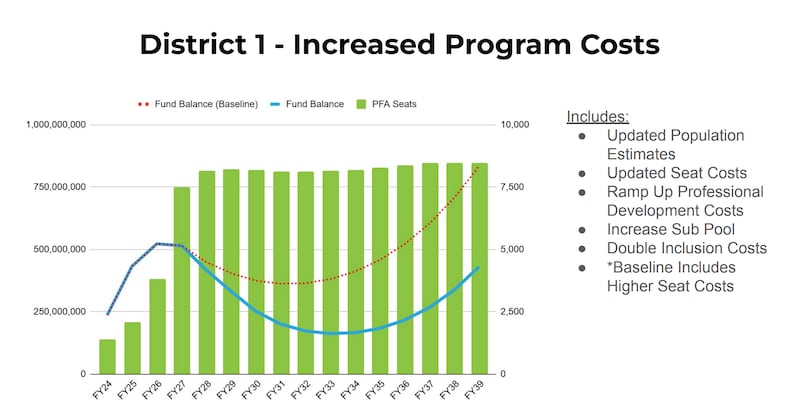
In scenarios where program costs increased, modeling indicated the program’s fund balance would stay well above zero. Projections indicate the program could also weather a recession or save a substantially larger reserve. (The full range of scenarios commissioners requested is viewable here.)
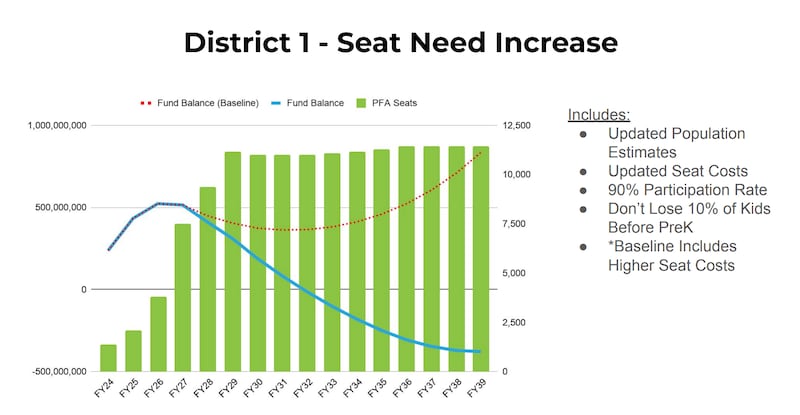
Forecasting does show public commenters have some reason for concern about the county’s assumptions around participation. In one scenario, the county assumed a 90% participation rate, and that 10% of kids didn’t leave before preschool. Jeff Renfro, the county economist, told commissioners that such a scenario would effectively mean the county would need about 11,000 seats once again.
Combined with higher seat costs, that scenario would put Preschool for All significantly in the red in later years, approaching a $400 million deficit by fiscal year 2039. Still, it should be noted that for the upcoming year, the county announced it has so far received more than 6,000 applications to fill 7,100 seats.
“The incorporation of those lower population estimates are doing significant work to make us think the program can be implemented as we currently plan,” Renfro said.
Vega Pederson, who had put forth a proposal to delay the tax increase for two years, said she considered Singleton and Moyer’s proposal for a one-year delay a “friendly” amendment and said it would make change more flexible. She said the projections made her confident the program could sustain itself without the increase in the upcoming year. Preschool for All reported a $610 million fund balance in the county’s latest Annual Comprehensive Financial Report.
The county chair also asked the county to model a number of scenarios that would directly change the tax’s structure, seemingly in an effort to respond to some of the Preschool for All tax’s harshest critics.
One scenario modeled never implementing the scheduled tax increase, one lowered the current tax rate, and another coupled no scheduled tax increase with eliminating the tax’s “marriage penalty.” (The program is funded by a tax of 1.5% on income over $125,000 for single filers or $200,000 for joint filers, and an additional 1.5% on income over $250,000 for single filers or $400,000 for joint filers.)
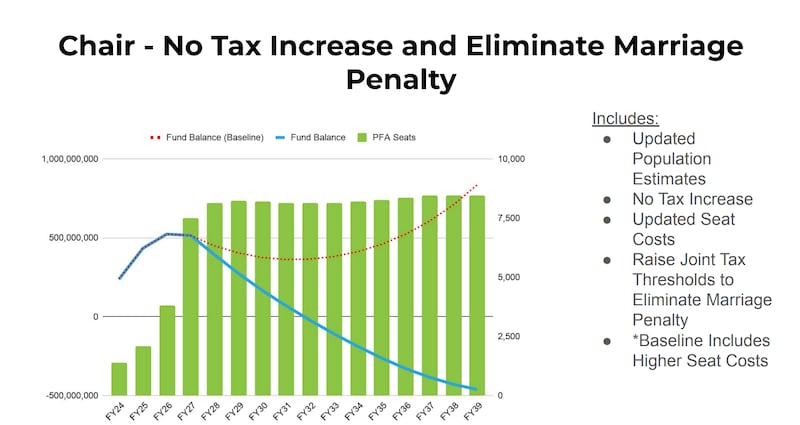
In all three scenarios, the program dipped into the red, to varying degrees. Vega Pederson said that those were important considerations as the county might weigh recommendations by Gov. Tina Kotek’s Prosperity Council, or other issues that might come up in the next legislative session. (Last summer, some top legislators made an eleventh-hour attempt to ax the universal program entirely.)
“We’ve heard from people that we should lower the tax rate, that we shouldn’t increase the tax ever, all of these things,” Vega Pederson said. “I thought it was really important to show that actually doing these things has a very definite detrimental effect on the program, as we’ve committed to doing to the voters who passed this measure.”