Skip to main content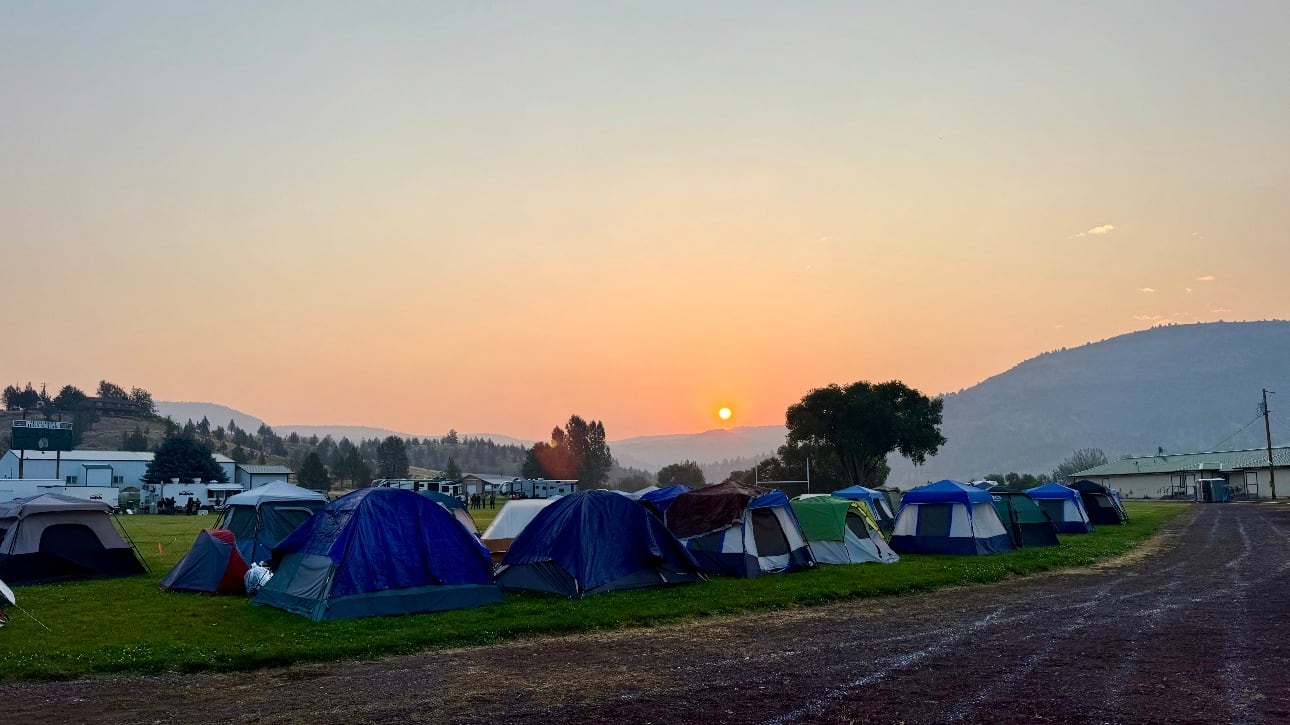
At the beginning of August, Shanna Northway, the principal of Grant Union Jr./Sr. High School in John Day, was busy facilitating all the typical back-to-school preparation. Then, at noon on a Sunday just weeks out from the start of school, she got a call from an incident commander.
Firefighters were hoping to set up a fire camp to monitor nearby blazes in Eastern Oregon. (Fire camps often serve as logistical coordination bases for wildland firefighting crews, though evacuation shelters can run in conjunction.) The obvious spot, the Grant County Fairgrounds in John Day, wouldn’t work because preparation for the county fair was in full swing. And in a small town like John Day, there weren’t many other places that could accommodate a large force.
So incident command zeroed in on one of the few viable alternatives: the school.
“The incident commander called me and said, ‘Hey, we’re kind of out of spots and locations. Is there any way that we could set up a command center at the school?’” Northway says. “In our rural community, our school tends to be the hub of our community, so it’s kind of open access to anything we can do or support.”
By 3 pm that day, Northway was giving a walk-through of the school’s classrooms and spaces, spelling out a couple of circumstances the crew would have to work around. There was summer school for some students, for example, and the Grant School District runs a summer lunch program for other districts in the area that runs out of the school’s kitchen.
After that, assembly for the fire camp began. “They pretty much said, ‘We need every space,’ and so they kind of moved in and took over the entire school for a couple weeks,” Northway says.
Grant Union is just one school in the state where incident command has pitched fire camps in recent years—a measure of how wildfire has become a grim summer ritual in a warming West, but also a demonstration of Oregonians’ resourcefulness. Schools offer a foundation of basic necessities in rural communities that fire camps otherwise would have to haul to town on their own—everything from functional showers to internet service. And hosting fire camps can be a mutually beneficial decision for districts facing financial struggles, as school officials have the opportunity to negotiate with the state or federal government for compensation.
At Monument School District, also in Eastern Oregon’s 4,500-square-mile Grant County, the district’s sole campus hosted a fire camp for a couple of weeks in mid-July. The district is small and rural, says Superintendent Laura Thomas. It enrolls 64 children total.
Monument’s closest grocery store is more than an hour away, Thomas says. So is the nearest hospital. The closest bigger cities are 2½ hours away. Thomas says that over the years, the school district has really become a hub of the community, also opting to offer early childhood programming.
“In communities like ours, you are either looking at setting up at a school or likely just in a field that belongs to a private landowner,” Thomas says.
And she adds that communities in Eastern Oregon are all too familiar with how devastating wildfires can be. Two years ago, Monument saw a fire that crept into the backyard of the community.
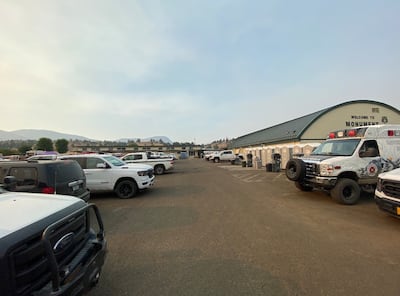
“This year, the fires were a little farther away and there wasn’t a direct threat to our town or anything like that,” she says. “But it’s still in our community and it’s still affecting landowners and people that are part of our community. By being able to host a fire camp, it allows us to continue to serve, and it provides a space.”
Thomas says Monument was able to swing its campus into a fire camp pretty smoothly, given that few people walk the building’s halls through the summer months. Most of the work for the district was initial setup, asking IT workers to help with connection. This year, the crew needed janitorial services, which meant some extra work for district staff.
At Grant, where the fire camp ran close to the start of the school year, there were some additional considerations, says Superintendent Beccy Nordtvedt. The district’s facilities crew had spent much of summer remodeling four classrooms, work that could only be done while students were out of the building. And when the large fire camp popped up weeks before the start of the school year, Nordvedt said there was still lots of deep cleaning work to be done.
The school district’s staff is used to the work. It’s also partnered in previous years with the Red Cross and other emergency services, and it’s been an evacuation center in the past. Still, Nordtvedt says a fire camp can be a big lift, and that staff had to work “extra hard” to get routine cleaning and maintenance done ahead of the school year.
Thomas says fire crews at Monument have been respectful about pulling out for the school year, and Northway, the principal, says this year’s crew at Grant was respectful of the district’s operations as the school year approached. Still, Nordtvedt certainly had to consider what might happen if the fire camp bled into the school year.
“If the timing of the fire camp had lasted a week longer, you know, we may not have been able to pull it off,” Nordtvedt says. “But those are choices that you make. And again, we do want to provide that service.”
Yet, at its best, Northway says a fire camp can bring a small community closer together. Fire camp crew members may be temporary members of the community, she says, but they become part of it for a while. In the early days of this year’s camp, before the catering crew moved in, she says hundreds of crew members ate out at local restaurants and helped boost the town’s economy. That means a lot in a town with a population of about 1,700, she says.
And as the camp in Grant demobilized ahead of the first day of school, Northway says many incident command crew members dropped by to ask if students needed school supplies for the upcoming year.
“We just assumed they meant leftover things from their operations,” Northway says. “But we had people going out and buying school supplies from the fire camp and dropping them off, which was awesome because we definitely live in a community where that is a challenge for some families to provide. We ended up with a nice stockpile of school supplies.”