Skip to main content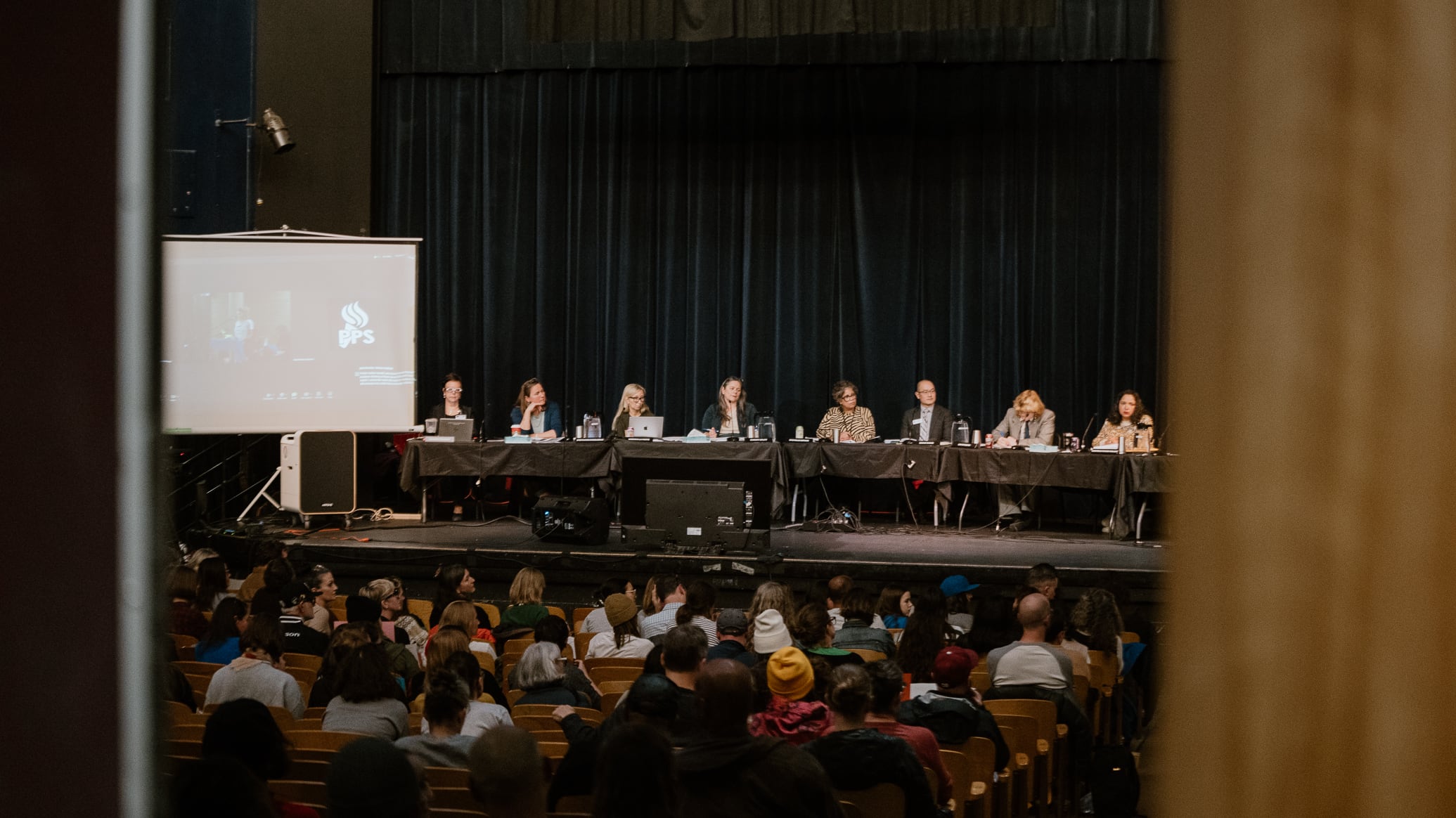
On Tuesday night, Portland Public Schools Superintendent Dr. Kimberlee Armstrong put a question to the district’s School Board: Did the seven-member body have an appetite to move forward with school consolidations?
Under guidance from the School Board, district administrative officials had taken spring and summer to better understand the scale of its task to rebalance enrollment across its elementary, middle and K-8 schools. In order to hit robust enrollment distribution for the next five years, Armstrong forecast last week that the district anticipated closing 10 to 20 schools, double the number she’d estimated in spring.
That number has been difficult for many parents and educators to process. And, as became apparent on Tuesday night, even a handful of members of the School Board were uneasy about proceeding with closures after hearing the scale at which they might need to occur.
PPS, like urban districts nationwide, is experiencing declining enrollment and continuing financial pressures. By the 2031–32 school year, the district’s own modeling shows that with no school closures, 37 of its 45 elementary schools would be under target enrollment thresholds. So would 13 of its 15 middle schools. Without dramatic change, district officials told the board it would be difficult to realize goals of stabilizing the school system.
“What we’ve arrived at in the data analysis is that in order to make change that’s sustainable for at least five years—this doesn’t even get us out 10 years…this is the magnitude of the impact that we would have to take,” Armstrong said.
Yet school closures are perhaps the most politically explosive challenge a school district can undertake. PPS faces heat from parents hungry for more information, and from its biggest labor union, the Portland Association of Teachers. That pressure seems to be weighing heavily on some School Board members.
Still, the majority of the board expressed an interest in PPS proceeding with the consolidation process. The board did not take a vote on the matter, but it’s possible, based on each member’s remarks, to gauge their enthusiasm for pushing forward.
Here’s where each of the board members stand:
Christy Splitt (Zone 1): Splitt was one of a handful of School Board members taken aback by the number of school closures it would take to stabilize the system. She worried that in the process, the district would prioritize preserving bigger schools that, in many cases, tend to be more affluent. And she said she was hearing from families and educators that the district should minimize the number of buildings it shutters.
Split said that if the broader community felt concerned that the district was going too far too fast, PPS should take a step back and compromise. While she signaled openness to moving forward with the conversation, she had concerns about the magnitude the district was considering.
“I think we probably do need to close some schools, but one quarter of the schools just really shook me and really changed my perspective,” Splitt said. “Sometimes you need a hammer and sometimes you need a scalpel. And I would much prefer a scalpel approach to this.”
Michelle DePass (Zone 2): Michelle DePass said she’d witnessed the district struggle to provide sustainable, well-resourced and equitable opportunities across its schools for a decade. DePass emphasized that the district is losing enrollment and struggling with another $65 million budget deficit. “If it takes a greater magnitude of rightsizing to get to the outcome that is the vision of a district that serves all of our schools equally, I’d say go big,” she said.
DePass also said she’d feel less comfortable with a piecemeal approach. She noted that the school system might have to see some intense disruptions to give the district the space to better support remaining schools. She worried that if the district were to drag the process out over the years, it would present frequent disruptions to school communities.
Patte Sullivan (Zone 3): Patte Sullivan said it was important that the district listen to lots of voices and consider many factors as it selects which buildings need closure. It will be important in the process, she said, to consider that different students have different needs. But she was committed to continuing the school closure process.
“If rightsizing means, as one person who sent me an email said, ‘increased stability and improved student earning and experience across the system and in every school,’ If that’s what it means, I’m for it,” she said.
Rashelle Chase-Miller (Zone 4): Rashelle Chase-Miller, the board’s vice chair, said she wanted the district to move forward because she wanted more information to base her decision-making on down the line. She clarified with Armstrong whether, if the board gave the green light for the district to continue its work exploring the consequences of closures, the board could still hit the brakes on the consolidation process. (Armstrong confirmed that the board was not locking itself in one way or another.)
Virginia La Forte (Zone 5): Virginia La Forte agreed that the data, particularly around student enrollment, was sobering, and joined the majority of School Board members in calling for some dramatic changes. “It does feel like we’re at a tipping point,” she said. “We may need to make some big swings.”
La Forte wants the district to pay careful attention to transition grades (between elementary and middle school) and to think about how to better retain families in those schools. She wants the district to better explore whether it wants to maintain both K–8 and middle school models.
Stephanie Engelsman (Zone 6): Stephanie Engelsman came to the board meeting with a long list of questions about school closure factors she hoped the district could provide clarity on. Her questions ranged from how the district determined thresholds for “well-resourced schools,” to testing data for smaller schools, to where in the city there are plans to construct family housing.
Like Splitt, Engelsman wondered if there were solutions outside of consolidations the district could explore to solve its enrollment and budgetary woes.
“If drawing boundaries and realigning boundaries is sufficient, then I think that’s a great place to start,” Engelsman said. “I don’t know that I share the same readiness to go forward without a lot of these questions answered.”
Eddie Wang (Zone 7): School Board Chair Eddie Wang was among those most open to dramatic change. Wang, who was actively involved in a recent district rebalancing effort through the Southeast Guiding Coalition, said he didn’t want the district to keep dragging its feet on reality. Like DePass, he reasoned that trying to slowly bring change about could mean more frequent disruptions and changes for students.
He said that as long as the district centered equity in the process and implementation of school closures, and that remaining schools ended up better resourced, he had no qualms exploring numbers bigger or smaller than the current range. “The bottom line is that if it means that we have a better system, I am for going for as much as needed,” he said.