Skip to main content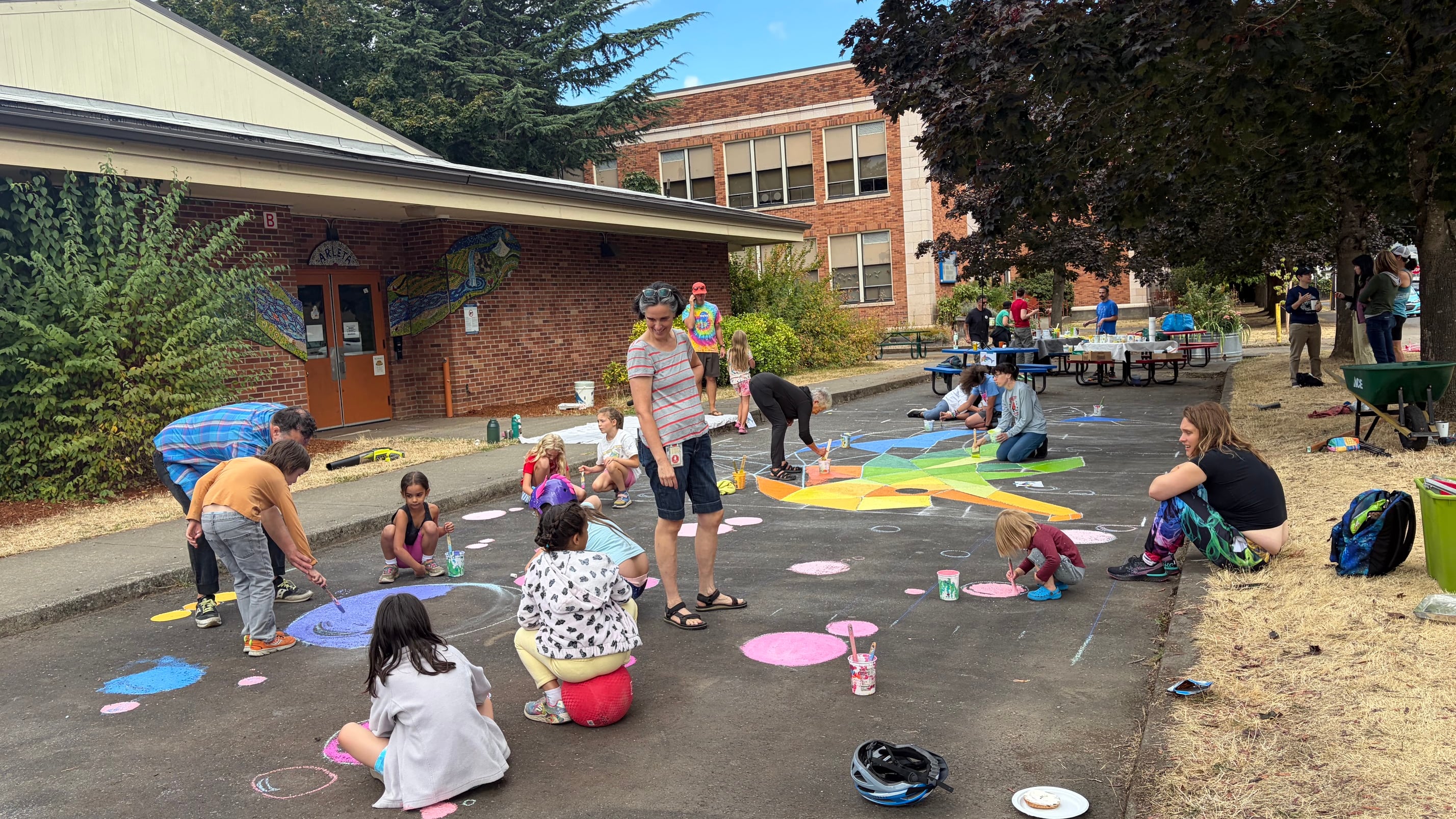
It was Sunday morning, but dozens of Arleta neighborhood residents were at school anyway, paint rollers in hand. A chalk outline of a dolphin, Arleta Elementary’s mascot, had been traced on the outside pavement, and buckets of rainbow paints to shade it in were scattered across a nearby table.
That dozens of people would choose to spend a weekend at this building speaks to the vital role that neighborhood schools play across the city.
Soon, Portland might lose 20 of them. On Aug. 26, Portland Public Schools Superintendent Dr. Kimberlee Armstrong shocked school communities across the city by announcing that the maximum number of elementary, K-8 and middle schools the district expects to shutter by the 2027–28 academic year had doubled from 10 to 20. The district currently operates about 70 of those buildings.
The school closure process has spawned an unending list of questions, everything from factors the district might consider as it selects which schools to shutter to how closures might affect academics, personnel and transportation.
But there’s also a practical problem worth considering as the process unfolds: what PPS might do with 20 vacant properties, currently vibrant buildings that define many of their neighborhoods.
At Arleta, the question whispered was what would happen if the school building, like that dolphin, became an empty silhouette.
“We bought our house knowing that the school was walking distance,” says Andy Chiller, a parent with two kids enrolled in first and fourth grade. “We wanted to invest in the public school system.”
School parents said they worried Arleta was in jeopardy because of its lower-than-average enrollment and low utilization rate, both the result of its conversion from a K-8 school to an elementary just a few years ago. Chiller, the advocacy committee chair of the school’s Parent Teacher Association, says PPS hasn’t put out much information and parents are hanging on to every scrap they can find.
Chiller hopes the district will soon produce a lot more information. To convince families that school closures are necessary, she says the district must transparently deliver data about how the process will result in cost savings and better experiences for students.
That includes information about what will happen to newly emptied buildings. Chiller has read research that indicates school closures don’t save much in the short term, in part due to the burden of maintaining facilities.
“What I, as a parent, want to know before they announce this decision is that they have a plan for how long it is that they’re going to have to pay for maintenance for these buildings that close down,” Chiller says.
As it turns out, the question of what to do with empty buildings has gone largely unanswered. School closures are by no means new; they have become increasingly common in recent years as districts nationwide continue to struggle with declining enrollment and rising costs.
Paul Beach and Carrie Hahnel, both education consultants with the firm Bellwether, have examined school closures closely. They’ve heard success stories from school districts here and there, like a school turned into an elder care center or one that became a community center with nonprofit office space. But neither could point to an example of a school district that underwent mass consolidations and managed to repurpose its buildings en masse as well.
“I think it’s a very tricky issue that not many school districts have solved,” Beach says. He adds there are substantial one-time costs districts might have to shoulder in order to downgrade their facilities, like paying to clear an entire building of chairs and desks.
It’s difficult to assess how much PPS spends on the average school building, given that each of the 81 in the district have different needs and face various maintenance challenges. The district itself acknowledges in a FAQ about school closures that savings realized depend in part on which properties are shuttered.
Still, physical operating costs take up a sizable portion of PPS’s general fund. In 2024–25, the district spent $74.6 million of its then $853 million general fund on the operation and maintenance of facilities. It budgeted $72.4 million to the effort this year.
When PPS has shuttered school properties in the past, it hasn’t taken a uniform approach to what happens next. There are all but abandoned properties like George Smith School in Southwest Portland, which closed more than two decades ago. Plans have been floated around what might replace the demolished Whitaker Middle School, including a homeless rest village, but its former site is still a grassy plain.
Then, there are famous repurposings. PPS shuttered Kennedy Elementary School in 1975 amid declining enrollment. About two decades later, the McMenamins brewpub chain transformed the building into a lively Northeast Portland hot spot: It’s now a hotel with multiple bars and a soaking pool. Revolution Hall, a live music venue that opened in 2015, repurposed Washington High School, a building PPS closed in 1981.
Halfway between these two fates is the former campus of Marshall High School next to the Eastport Plaza shopping center in the Southeast Portland neighborhood of Lents. Since PPS shuttered the building in 2010, Marshall has served as a temporary school for students awaiting completion of modernizations at other district high schools. Students at Franklin, Grant, McDaniel, Benson Polytechnic and, starting this school year, Cleveland have called Marshall’s campus home in the past decade or so. PPS has also used it as space for its clothing closet.
Hahnel says part of the challenge is that repurposing buildings is an entirely different conversation than school closures. “What’s likely to happen is that those decisions are going to be delayed, and the district is going to have to first figure out which schools to close and how to do that, and then start a process about what to do with the facilities,” she says.
PPS has vague ideas so far. Valerie Feder, a spokeswoman for the district, says officials have discussed the possibility of developing a long-range real estate plan “to determine what properties would be appropriate to try and sell and to keep.”
“But how buildings could be used is a conversation that is still TBD depending on the outcome of the rightsizing process,” Feder says.
Instead, Feder pointed WW to three School Board policies that currently dictate the maintenance and selling of empty properties. The most substantial of them is a policy that holds PPS to preserving buildings in “sufficient physical condition.” The policy urges caution in selling properties. It asks PPS, whenever possible, to opt for flexible long-term leases that would allow the district to reclaim a property if needed, and suggests signing leases over selling because they are a means to generate revenue.
In the rare case the district determines it needs to sell, the policy is picky about whom the district should sell to.
“Sale of a District property without replacing it with an equivalent or better property is usually disfavored,” the policy reads in part, adding that a sale must be in the district’s best interest and that a long-term lease that generates revenue is preferable. “Whenever possible, any District property sale should be to a public entity that intends to actively use the property for public purposes or that substantially advances the District’s racial equity and social justice goals for public schools.”
It might be hard to stick to that policy because two factors complicate the matter. First, PPS has lost about 10% of its student enrollment in the past decade and is projected to lose another 14% in the next. District officials have acknowledged that a big motivator for closing schools is that PPS manages too much space for its needs, so exchanging properties makes less sense than it once did.
Second, the larger Portland real estate market is overflowing with empty buildings. (One School Board member even toyed with using the U.S. Bancorp Tower, or Big Pink, for PPS’s new central office.) High office vacancy in downtown has already affected PPS in its own way—by tanking property values and consequently reducing how much money is raised by the district’s teachers levy. The larger story is that PPS might struggle to find takers for a school.
Yet some School Board members are starting to think big. Vice Chair Rashelle Chase-Miller says school closures could present an opportunity for PPS to generate some revenue. She points to the Austin Independent School District, which this spring made headlines for its plans to convert a shuttered elementary school building into affordable multifamily housing units, including homes for educators.
That strategy feels like something PPS should try replicating with the help of the city and county, Chase-Miller says, because it could generate revenue for the district through long-term leases and boost enrollment if families move in.
“We can also look at leasing those spaces to community partners that support our kids and families, and infusing resources into our community rather than allowing buildings to sit vacant,” she adds.
The loss of neighborhood schools goes beyond real estate for many Portlanders. PPS’s 81 buildings have become gathering spaces and social services hubs, places people have forged lasting relationships in and made life decisions around.
At Arleta, Chiller points out one neighbor who she says has lived in the community for more than four decades. He has no relationship to the school except that it’s in his backyard. With a shovel in hand, he passes by a couple of students painting a pink bubble by the dolphin’s head.
The neighbor does groundskeeping for the schools and is returning the shovel he used to clear leaves around the building, she says. His commitment speaks to something broader, she says—the idea that schools are, in many parts of Portland, an anchor to a neighborhood’s identity.
“What plans do they have to make sure that these buildings don’t just sit empty and change from an educational center, a heart of a community, to a blighted, empty building?” she says. “The worst-case scenario is that they close schools and our kids are in no better situation financially, educationally, fundingwise than they are now.”