Skip to main content
Data centers are creeping into the governor’s race as Democratic Gov. Tina Kotek and her opponent, state Sen. Christine Drazan (R-Canby), took turns this week attempting to tether the other to the issue.
On Wednesday, the challenger launched a 30-second online ad.
“Tina Kotek’s rolled out the red carpet for data centers,” says the narrator. “More than a billion in tax breaks. Ignoring the concerns of Oregon communities. But for the rest of us, Kotek’s raised our taxes by more than $6 billion. Tax hikes for us; tax breaks for them. Tina Kotek’s data centers get special treatment and we get the bill.”
Later that day, the Democratic Party of Oregon responded with a statement nicknaming the Klamath Falls-born lawmaker “Data Center Drazan.”
“Christine Drazan had opportunity after opportunity to stand up against data centers, and every time, she chose not to,” said Democratic Party of Oregon chair Nathan Soltz. “Pretending to oppose them now that she’s running for statewide office is a blatant attempt to mislead voters on her record. ‘Data Center Drazan’ will always side with data centers over Oregon families.”
Beneath the mudslinging lies one political truth: Data centers rank among the country’s least popular institutions. The backlash is grassroots, bipartisan and growing, with lines of argument ranging from the environmental (natural resource strain) to the fiscal (rising utility bills) to quality of life (noise and light pollution). The latest national polling shows opposition to data centers at rates north of 70%. And in Oregon, clear majorities of voters report negative feelings and support for policies that regulate data centers, like construction moratoriums.
And both candidates have plenty in their records to tie them to these loathed, buzzing monoliths.

Kotek has walked a fine line on the issue. In her first term, she has sought to appeal to the state’s business community, for whom data center construction has been a rare economic bright spot. According to Pew Research, the state now has 142 data centers—115 in operation and 27 in development—which ranks Oregon ninth in overall footprint in the U.S. Kotek has received large contributions from trade unions like the International Brotherhood of Electrical Workers, a prominent lobby in Oregon and outspoken supporters of data centers.
For years, the public was largely permissive of government subsidies meant to lure data centers, but grassroots groups like Tax Fairness Oregon—which says the state has given $457 million in data center tax breaks this year—have pushed the state to change the terms of that relationship.
Kotek has tried to get ahead of the issue. Last year, she signed the Power Act, which the Oregon Legislature passed to shift more costs to high-energy electric grid users. Earlier this year, she formed a data center work group to provide her policy recommendations ahead of the next legislative session. In June, after public outcry, Kotek terminated a land sale near Salem for a major data center project. And though as governor she may not to issue a statewide data center moratorium, she has supported local moratoriums.
On Thursday, Drazan’s campaign released information branding Kotek with a “yearslong history of giving special tax breaks to data centers while repeatedly raising taxes on Oregonians.” It notes a boom in data center development occurred while Kotek has been in office and highlights several legislative votes friendly to data centers in 2012 and 2015.
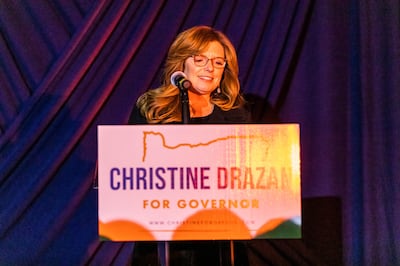
But Drazan is also vulnerable on the issue. As a member of the Oregon House of Representatives, she voted against the Power Act in 2025. Drazan rejects what she calls “arbitrary” local moratoriums on data centers yet says communities that don’t want data centers shouldn’t be subject to them.
The Republican Party is also walking a tightrope above data centers. Typically supportive of tax breaks, big construction projects and deregulation, GOP voters reflect increasing concern about rising utility bills and resource depletion. Nationally, the party isn’t expected to fare well in the midterm election. It holds all three branches of government, but voter polling reflects deep pessimism about the country’s economic direction. The anti-establishment dynamic is somewhat reversed here in Oregon, where Republicans are locked out of power in both legislative chambers and Kotek is in the governor’s residence.
“For both Republicans and Democrats, the politics of this are fuzzy,” says John Horvick of the Pacific Northwest polling firm DHM Research. “It’s typically Republicans who want to lower taxes to encourage development and business creation. And here’s the Drazan campaign saying that we shouldn’t have done that. And it’s typically the Democrats who are close to the trade unions and want to support them with construction projects.”
Horvick tells WW that Drazan’s ad appears to try to tie the hottest issue of the moment—data centers—with the issue voters care most about, which, despite all the noise, is not data centers.
“[Drazan’s] trying to both take the anti-data center position and tie it to Oregonians’ biggest concern, which is affordability.” Horvick says.
That’s certainly reflected in Drazan’s written campaign messaging. “For more than a decade, Tina Kotek has supported tax giveaways that helped fuel Oregon’s massive growth in data centers while continuously raising taxes on everyday Oregonians,” Drazan writes. “Oregon has done more than its fair share, and we cannot continue to be the Wild West for data center development.”
The state’s campaign finance website shows her campaign recently spent hundreds of thousands of dollars on ad buys and market analysis, which shows she could be working with fresh polling on the subject.
Nowadays, Horvick says, voters care most about issues related to affordability and quality of life. But four years ago, when Drazan and Kotek faced off for the first time, the race hinged more on broad societal issues like homelessness, crime, drug use and mental health. That race—coming at the tail end of the pandemic—had the added dynamic of an upstart third-party challenge from independent Betsy Johnson. Drazan led in the polls until about a month before the election.
In the end, voter concerns about Democrats were overwhelmed by their apprehensions of Republicans. Though they might flirt with the other party in the summer, by election day, they come home, Horvick says.