 Skip to main content
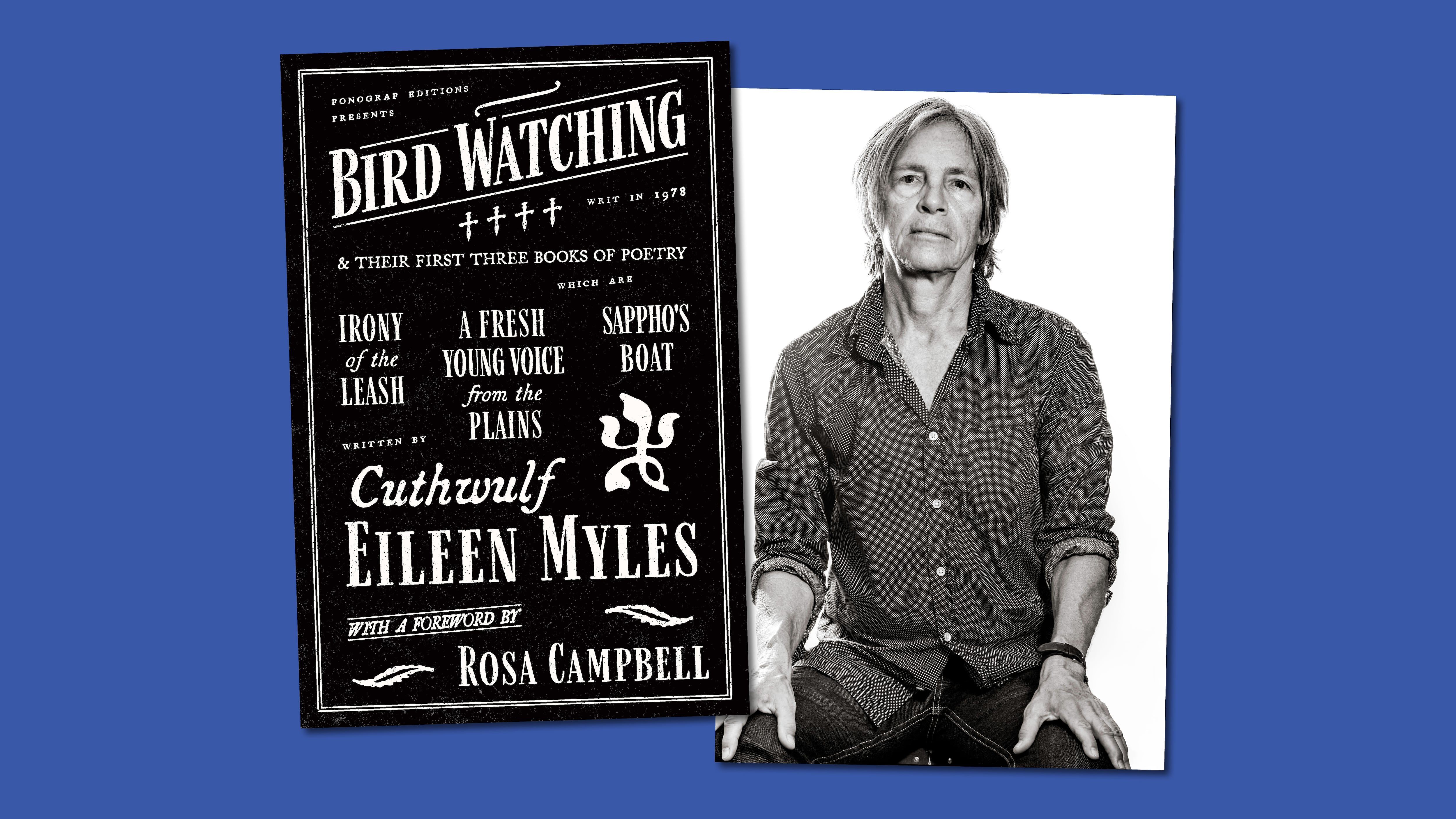
Eileen Myles is calling from a New York City cab. The Chelsea Girls author, a luminary and beloved poet who’s now 76, is headed toward the East Village apartment they’ve kept for nearly 50 years. That apartment is also the setting of Myles’ latest work, Bird Watching. After sitting unpublished for close to five decades, the movie script–length poem was published by the Portland small press and literary record label Fonograf Editions this spring.
“It’s like being in a conversation with an earlier version of myself,” Myles says.
In Bird Watching, a 28-year-old Myles writes over the summer of 1978, unfolding the days of their becoming. Scene by scene, Myles elaborates on personal manifestos, goings-on in ’70s New York, and the activity in a tree full of birds outside their window. Plus, being in love with three people at the same time, dogs barking, thinking with your heart, and looking for a job.
The book, which also anthologizes Myles’ first three poetry collections—The Irony of the Leash (1978), A Fresh Young Voice from the Plains (1981) and Sappho’s Boat (1982)—marks Myles’ second collaboration with Fonograf. Their first, a vinyl LP of Myles reading their collection Aloha/irish trees, was also the first thing Fonograf ever put out.
On Aloha/irish trees, we listen to Myles’ broad Boston As, our attention captured by the spirit of their performance. “Rather than having this pristine studio recording of poetry readings,” Myles says, “I thought it would be more interesting to have me in the studio going ‘fuck,’ having stumbled over a word or something and then beginning again.”
Myles will be in Portland at the end of October to read for Fonograf’s 10th Anniversary Fundraiser at Atrium Movement & Events. Expect two nights of live readings and music Oct. 23 and 24 (Myles reads on the 24th), with appearances by Rae Armantrout, Dao Strom, Mark Leidner, Golden Tiles, and more. Our conversation has been lightly edited for brevity and clarity.
WW: How did you initially get connected with Fonograf for your LP Aloha/irish trees? What was your understanding of Portland at the time?
Eileen Myles: It was just very out of the blue because who knew what Fonograf was? It was just coming into existence then. Jeff Alessandrelli wrote to me and told me he was planning to start doing a label of records by poets, and I thought that sounded really cool. I’ve been to Portland a bunch; it seems like one of the cities where people I know live, people live in ways that seem familiar to me. It was not a surprising place for a new idea to come out of.
I was first introduced to your work through YouTube; I was immediately drawn in by how you performed. Have your feelings around performance changed over time? What has influenced the way you’ve read your work?
When I came to New York in the ’70s, there were all these open mics. I didn’t know any writers, and I didn’t even know quite what a poet was, but I knew singers and songwriters.
I was very drawn to the idea of performing with my voice at the microphone. I started doing that before I ever published. [Myles’ first poetry reading was at CBGB’s in 1974.] The only thing I thought early on was that I didn’t want to sound like a poet. I wanted to sound like myself. Since I didn’t know what poets were, I felt like the way I could have permission to be a poet was to not go so far away from what I was just doing as a person talking. I just wanted to be as ordinary as possible.
There’s stops and starts in things that I write. I hear silence sometimes in what I write—and there’s timing and there’s rhythm and there’s pace. I wasn’t quite willing to acknowledge that when I read early on because I thought I’d sound pretentious and precious. Over time I’ve gotten more permission to stop and start and take my time and even walk away and say something in the middle of the poem and then go back to it—just be much more plastic. What’s on the page isn’t something I’m being obedient to, it’s something I’m being playful with.
In the introduction of Bird Watching, you write, “I remember how important it was to be not fake then.” What did truth feel like for you then? Who were your models?
All sorts of crazy things. There was a movie called King of Marvin Gardens that Jack Nicholson was in. He was like a contritional disc jockey. It’s kind of a great movie, but it was like a ’60s, ’70s thing of people on late-night radio who would start pouring their guts out. It was a documentary thing but also an intimacy thing, a kind of purging. I loved that. All kinds of speech that weren’t necessarily poetry were some of my models.
Why not publish Bird Watching earlier?
I don’t know. I have no answer to that. I knew that I loved that it existed, but I didn’t know what it was. This is the right time. I think this is absolutely the right time.
How do you feel rereading it?
It’s embarrassing, it’s moving.
At one point you write, “all sorts of shes & me / then me & her / then he / she, he / no she, then barely me.” It almost starts sounding like the chirps and the peeps of the birds, abstracted and songful, obscuring gender in this way. At that time, were you thinking about expanding the self by playing with pronouns?
I think I thought of it as comic. The collision of all these pronouns and the anonymity of it, so it was just kind of a chaos. I love the thought that it’s kind of like the birds.
What feels important in revisiting and republishing these early works?
A lot of my readers—it almost feels like most of my readers—are young, like a lot younger than me. If I do a reading and a lot of people my age are there, and a lot of young people aren’t, I’m like, “Where’s my people?” It’s certainly about Chelsea Girls, but it’s something about my body of work that is in conversation with people who are the age I was the summer of things that I’ve written about [in Bird Watching, 1978] were happening. What’s really exciting for me is to have a piece of that that’s authentically from that moment. It’s like finding old clothes. You’re like, “Oh my God, these jeans are from 1965.” It feels very like a vintage poem.
Any words for a young poet?
Don’t be afraid to be excessive, and don’t be afraid to be quiet. Have your own rhythm and don’t worry about what it looks like. It’s about getting comfortable with the idea of being a poet, whatever that means, and making up what that means, because every poet reinvents it.
GO: Fonograf Editions 10th Anniversary Fundraiser at Atrium Movement & Events, 2305 SE 50th Ave., fonografeditions.com. 7:30 pm Friday and Saturday, Oct. 23 and 24. $21+. All ages.