Skip to main content
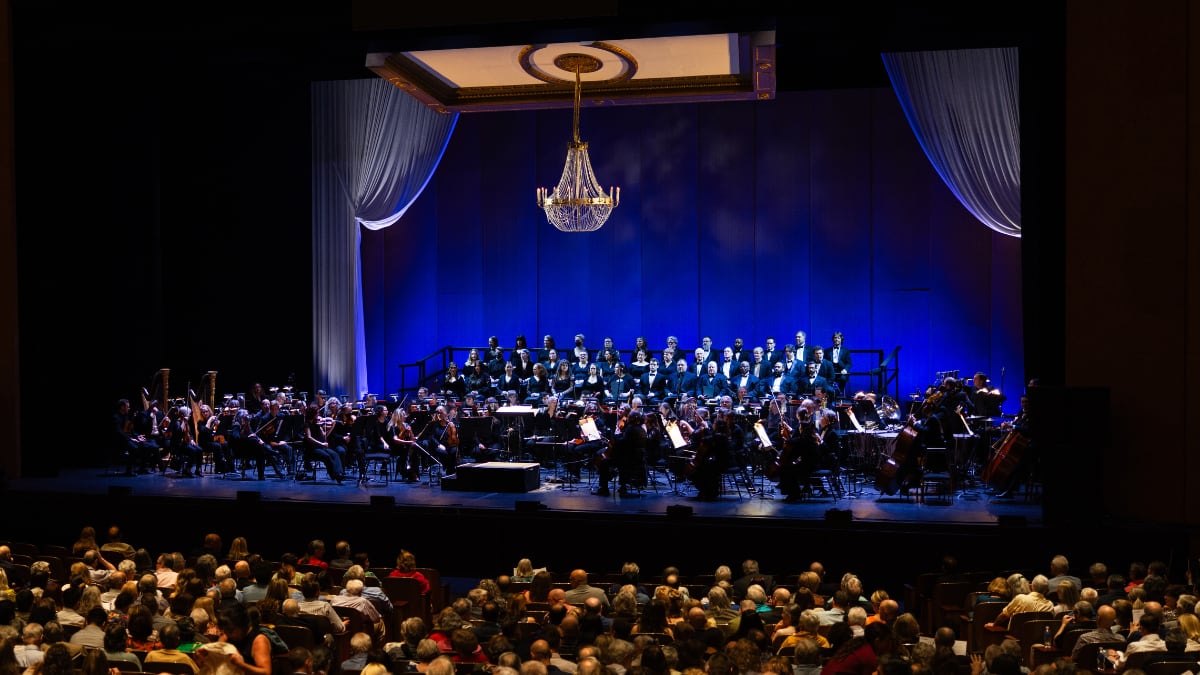
Verdi’s Requiem ended Portland Opera’s last season in May, its one-off performance drawing on age-old traditions of paying due to the dead. This season opens with another of the composer’s great masterworks, and once again centers on death, as dramatic opera frequently does.
But in contrast to Requiem, which is a Roman Catholic funeral mass without narrative, Verdi’s La Traviata is based on the 1848 novel La Dame aux Camélias by Alexandre Dumas fils, son of the Count of Monte Cristo author. Its young female protagonist, Violetta, is suffering from a great illness; her name gave the opera its working title before Verdi settled on the one we know, which translates as “The Wayward Woman.” As a Parisian courtesan slowly dying of consumption, Violetta meets Alfredo at a salon party, and the two fall in tragic love over three acts.
Violetta is “living her best life,” says Alfrelynn Roberts, Portland Opera’s artistic director. “Parisian courtesans were some of the wealthiest women,” Roberts adds, explaining that the narrative of La Traviata is not merely about death, but about “finding the power in going to the end of life.”
Portland Opera, like pretty much every performing arts company, is not exactly flush as of late. But neither is it going to the end of life. As the opener of this shortened and budget-conscious new season (a transitional phase before a projected return to full-scale programming in 2027–28), this production serves as an example of what the company will look like in this slightly compromised posture. This will be the eighth time Portland Opera has put on La Traviata, and this time, with simplified set design and choreography, the idea is to let the music and the singers tell the story.
The company is fundraising under the banner Keep Portland Operatic. “We’re just over $2.2 out of the $5 million,” director of development Beth Lewis says of the campaigns’s progress, adding that the company is “on track” to hit its full goal by the end of June 2027.
Lewis sees the show, and its central tragic romance, as a counterpoint to prevailing cultural narratives that decenter the human heart: “It’s about the power of simple stories in a moment where people are increasingly online—enjoying the opportunity to gather together. We’re craving opportunities to live outside ourselves for a moment, both for escape, but also to share that human experience.”
Associate music director Nicholas Fox worked on Portland Opera’s last La Traviata production, during the 2018–19 season. One shift for this show, he says, is that instead of working through choreography as they sing, the chorus will remain stationary. “From a purely musical point of view, it’s easier,” Fox says, explaining that it allows the singers to focus solely on the music.
Another inventive cost-saving measure comes from the costuming department. “Our chorus will be onstage, adorned in jeweled colors,” says Roberts, the artistic director. But those jewel tones will be the singers’ own. “Everyone will be in street clothes,” Roberts adds.
This progressive approach, pairing back the sets, choreography and costuming, is in line with Portland Opera’s recent history. The company has made distinct efforts of late to broaden its programming well beyond the old continental canon. Presenting one of the old classics with a stripped-back production might signify the company’s pride in the art form’s staying power.
“People think of [opera] as old traditional theater,” Roberts says. But “it really does have some themes that are relevant today: How we judge people, how we want people to be, and how we don’t let people live their truths—it’s still very current.”
This November, though the new approach is more minimalist, La Traviata is here to remind us all, reliably as ever, of the maximum impact of storytelling through these centuries of culture.
SEE IT: Portland Opera’s La Traviata at the Keller Auditorium, 222 SW Clay St., portlandopera.org. 7:30 pm Friday and 2 pm Sunday, Nov. 6 and 8. $19–$101.