Skip to main content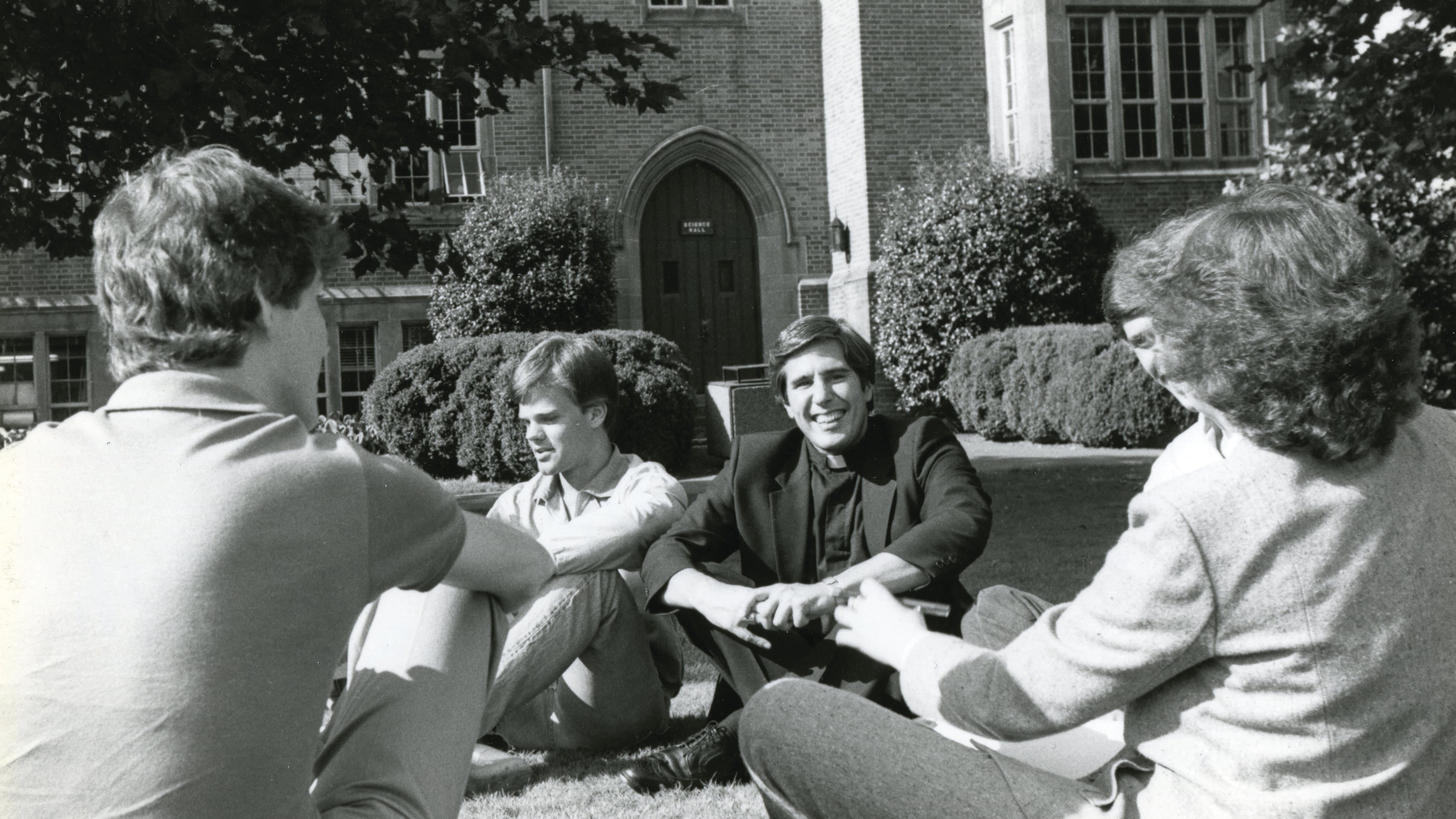
“We don’t wait for the institutional church to catch up in its theology to where the people are. We will assist the church by going ahead and doing it.” — Father Tom Oddo (Dayton, Ohio, Journal Herald; June 7, 1974)
Against the Current, a new biography by Tyler Bieber (Unencumbered Press, 304 pages, $26.99), opens with the car accident that took Father Tom Oddo’s life in 1989 at the age of 45. It’s an unsettling beginning, but that tragic foreknowledge doesn’t diminish the complex, surprising story of this queer man of faith, whose birth and death bookended a roller-coaster half-century that redefined what it meant to be an American Catholic.
Handsome, charismatic, popular everywhere he went, Tom (the book makes it impossible to think of him as “Father Oddo”) was born during World War II to first-generation Italian New Yorkers; spent the Kennedy years at Notre Dame; studied for the priesthood as the first wave of Vatican II changes were coming down; found love, for a little while, with a fellow gay Catholic activist; and ushered in a new decade at University of Portland that included computers, AIDS education, coed housing, and a bold willingness to question church teaching.
A Pacific Northwest native and a queer higher-ed professional, Bieber stumbled into this story a little sideways while researching another book on notable university presidents. Against the Current is a detailed look at the life of an administrator, juxtaposing nitty-gritty details of budgets and meetings with seismic shifts in the school’s identity. Tom’s tenure at UP from 1982 through 1989 takes place in an era of new reckonings—with race and gender in America, with the balance between sacred and secular in Catholic schooling—and many of the hot-button issues on his campus are still painfully relevant today. (A few particularly familiar ones: protesters scolded for their incivility to a visiting Ronald Reagan, parents complaining about inappropriate curricula, student pressure to financially divest from South Africa over apartheid.)
Against the Current is respectful but not deferential in its treatment of the Catholic Church. It’s clear-eyed about the reality of the sex abuse crisis (Tom got the UP gig following the resignation of a priest who later admitted to assaulting a boy in Pennsylvania), the frustrations of women and LGBTQ+ Catholics pushing for a seat at the table, and the excruciating pace of change in an institution where time is measured in centuries. But it also offers a model for what a more progressive church could look like. Tom wrote his Harvard dissertation comparing cloistered Trappist mystic Thomas Merton with Father Daniel Berrigan, an antiwar activist and the first priest to make the FBI’s “Most Wanted” list. Tom insisted that Catholics in an era of radical social shifts must embody both ideals: to go within and seek to understand the mystery of God, then take the fruits of that contemplation out into the streets. It’s a message that hits hard in 2026, as we watch American clergy at protests getting roughed up by ICE.
The most timely chapters document Tom’s history as a gay Catholic priest in the 1970s. He and his then-partner Paul Diederich co-founded the Boston chapter of DignityUSA, an organization for LGBTQ+ Catholics launched in 1969 (months before Stonewall) that’s still around today. Through preaching, organizing, and community education, they took on the U.S. bishops and the Vatican to advocate for the inclusion of queer Catholics. Tom’s writings from this period speak movingly of a God who already loves his queer children exactly as they are, using science and history to dispel antiquated cultural myths and fight back against the new Vatican decree that homosexuality was “intrinsically disordered.” He was a visible gay public figure in Boston, but in the era before social media, it seems it was still possible to slip at least partially back into the closet in order to take the job at UP. By the time he left Boston—and, with it, Paul—it seems his gay activist past went mostly unknown in Portland’s Catholic community.
Though maybe not entirely unknown. The book’s prologue includes an ice-cold “no comment” from Portland’s highly conservative former Archbishop William Levada on the news of Tom’s death. Also a bad look: UP’s soccer field, briefly dedicated to Tom’s memory, now bears the name of late timber baron Harry Merlo, long after the Catholic megadonor was forced out of Louisiana-Pacific amid a lawsuit alleging serial sexual harassment.
The shocking death of a young, handsome, charismatic American Catholic leader prompts all the obvious comparisons, and a fleeting Camelot-style mythos feels inevitable. One of Against the Current’s wildest anecdotes is the story of another book, written after Tom’s death, by two exceedingly weird women who claimed to be channeling his ghost. Neither seemed to know he was gay; one basically wrote fanfic about his spirit being in love with her. (It does not sit well in The Year of Our Heated Rivalry 2026.)
So much of Tom’s interior life is still unknown to us; there are no diaries, few personal letters, and little sense of his private self. Like so many figures from queer history, the real story is told between the lines of his public writings, invisible even in death. It took four years for one of the many, many memorials in Tom’s honor to mention he was gay: In 1993, a Western Orthodox church near Harvard offered a service to honor Tom on the anniversary of his death, finally publicly recognizing his work on behalf of LGBTQ+ Catholics.
The priest who organized it was Paul Diederich, Tom’s Dignity co-founder, former lover and lifelong friend. He left the Catholic Church and went on to live a long, happy life with his husband, but he never forgot about Tom.