Skip to main content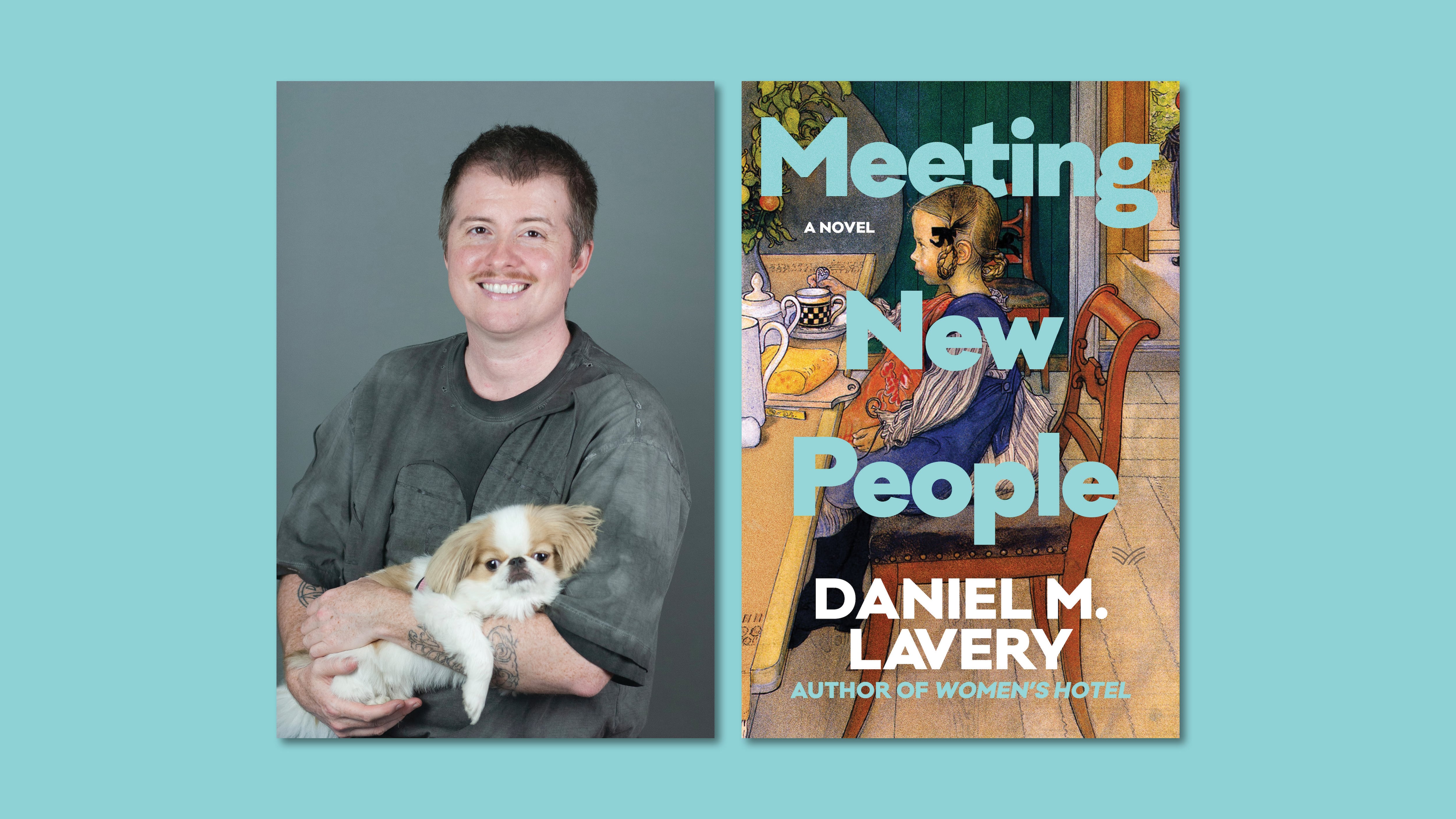
The first half of Meeting New People reads a bit like a string of posts in the AmItheAsshole subreddit. For the uninitiated: r/AmItheAsshole (often shortened to r/AITA) is a forum where people describe interpersonal conflicts and ask the internet: “Am I the asshole here?” During Twitter’s heyday, AITA posts often went viral, in part because posts often fell so cleanly into one of two categories. It wasn’t just that so many of the posters were obvious assholes, but that they were so lacking in self-awareness and so sure of the correctness of their position that they’d be stunned and furious when commenters called them out. The other, sadder, genre of r/AITA posts are by people who are not only not assholes, but being treated so badly you sometimes worry about them.
Meeting New People, Daniel Lavery’s newest novel (HarperCollins, 268 pages, $26), which comes out June 2, opens with its narrator, Barbara, getting dumped by her best friend, Susan. As Barbara describes the argument that leads to the end of a 14-year friendship, I was fully on her side. One of the reasons Susan offers is that Barbara never supported Susan’s desire to have a baby at 49, a desire she had never previously articulated. Barbara points out that Susan hadn’t been doing anything that another person could support: “You weren’t making appointments, you weren’t bringing around boyfriends, you weren’t doing IVF…Was I supposed to push you to do any of those things? Did you want me to find you somebody to get you pregnant?” Susan takes great offense, but doesn’t answer these questions, which I consider perfectly valid. Being a good friend does not mean being a mind reader, Susan! Barbara, you are Not the Asshole.
Meeting New People is modeled pretty clearly on Heartburn, Nora Ephron’s frothy but poignant roman à clef about her divorce from Carl Bernstein. Heartburn is brutally funny (some of its best lines ended up not in Mike Nichols’ oddly straight-faced film adaptation but instead in the script for When Harry Met Sally…); her character, a food writer, drops recipes right into the prose while describing her workday. Meeting New People (whose protagonist works at an upmarket deli and is an enthusiastic home chef) has a few recipes stitched into the prose, though not quite so many. And while Heartburn’s Rachel Samstat is entirely sympathetic (her husband is cheating on her with an acquaintance of hers!) and likable due to an acerbic wit, Barbara…well, I went back and forth on Barbara.
Lavery is perhaps best known as the co-founder of the late, lamented humor site The Toast; his other books include Something That May Shock and Discredit You, a memoir about his gender transition, and the novel Women’s Hotel. He’s written that he shares little with Barbara other than “her habit of believing I am acting with great dignity when I am in fact making a real spectacle of myself.” Here, too, the book differs from Heartburn; it’s safe to assume that if there’s any autobiographical inspiration, Lavery is keeping that to himself.
Like Rachel, Barbara is grieving the end of a relationship, albeit a platonic one (she’s been divorced twice, but the ends of those relationships didn’t hurt nearly so much). She’s also funny and full of strong, surprising takes—about food (“Phyllo dough and a pound of feta is, nine times out of ten, a recipe for a soggy mess”), about religion (“Crying in church is fine if you’re Pentecostal, but the strongest emotion you ordinarily encounter in an Episcopal church is mild wealth”), about her elderly downstairs neighbor (“I would have cheerfully cut off a toe, even an important toe, to get out of having to deal with Lorraine that morning”). Even learning that Susan is the ninth best friend she’s parted ways with in her life (Barbara is 58) didn’t turn me against her; I don’t have a precise count of the number of friend-breakups I’ve gone through, but the number is a bit higher than zero. There’s also the fact that she and her grown son are not on the best terms. This seems not to bother her much (“He’s a good conversationalist, which is somewhat rare in men of his age, and if you ask me, that’s a much more impressive accomplishment than loving your mother”). That seems like a fairly healthy attitude, but the crux of their most recent argument is that she’s uncomfortable hosting her toddler niece in her apartment because it’s furnished with expensive antique furniture. To her credit, she realizes that’s not the most sympathetic position. But…come on.
Somewhere in the latter half of the book, I began to realize who it was Barbara actually reminder me of: Cher Horowitz. (Yes, I mean Cher Horowitz and not Emma Woodhouse, on whom Cher is based.) Yes, the 15-year-old protagonist of Clueless is a fraction of Barbara’s age, lives in Los Angeles and not New York, and has entirely different priorities. Nonetheless, after attending a Wednesday-night prayer service at a nearby church, Barbara goes further than admitting that maybe she is, in fact, the Asshole: “Well, I have been desperate to change often enough before, and I have never changed. But I am desperate now to be changed.” Later, she expresses a desire to develop “a magnificent soul,” echoing Cher’s desire to “make over [her] soul” in the third act of the movie. Of course, the stakes are quite a bit different: Cher wants her crush to take her seriously as a person, whereas Barbara realizes she’s in real danger of dying alone.
Early in the book, Barbara outlines all the qualities she’d like to see in a new best friend, and even identifies a potential target in a work acquaintance. By the end of the book, she has yet to have a meaningful conversation with this person. Instead, just as Cher realizes all her friends have qualities worth emulating, Barbara starts opening up to people she had previously regarded with contempt or condescension. Including her awful neighbor. Including a co-worker she’s avoided becoming close to, simply because they have the same first name. Including a younger co-worker who suggested, early in the book, that the deli start keeping Narcan on hand (Barbara is incredulous that drug users would ever shop at up-market delis).
Has she actually changed? It’s hard to say, but watching her try is surprisingly satisfying, and still funny. (As a newly minted hospice volunteer, Barbara discovers the gig involves a surprising number of encounters with the work of Alan Watts: “I just never know quite how to feel about someone who comes out with two or three books about spiritual development a year, every year. It seems a little rushed to me.”) In the final chapter, she’s making plans for a dinner party. And while I suspect I’d find Barbara tiring if I actually knew her, I’m also pretty sure that if I knew her, I’d go to that party.
SEE IT: Daniel M. Lavery reads at Powell’s City of Books, 1001 W Burnside St., 800-878-7323, powells.com. 7 pm Tuesday, June 2.