Skip to main content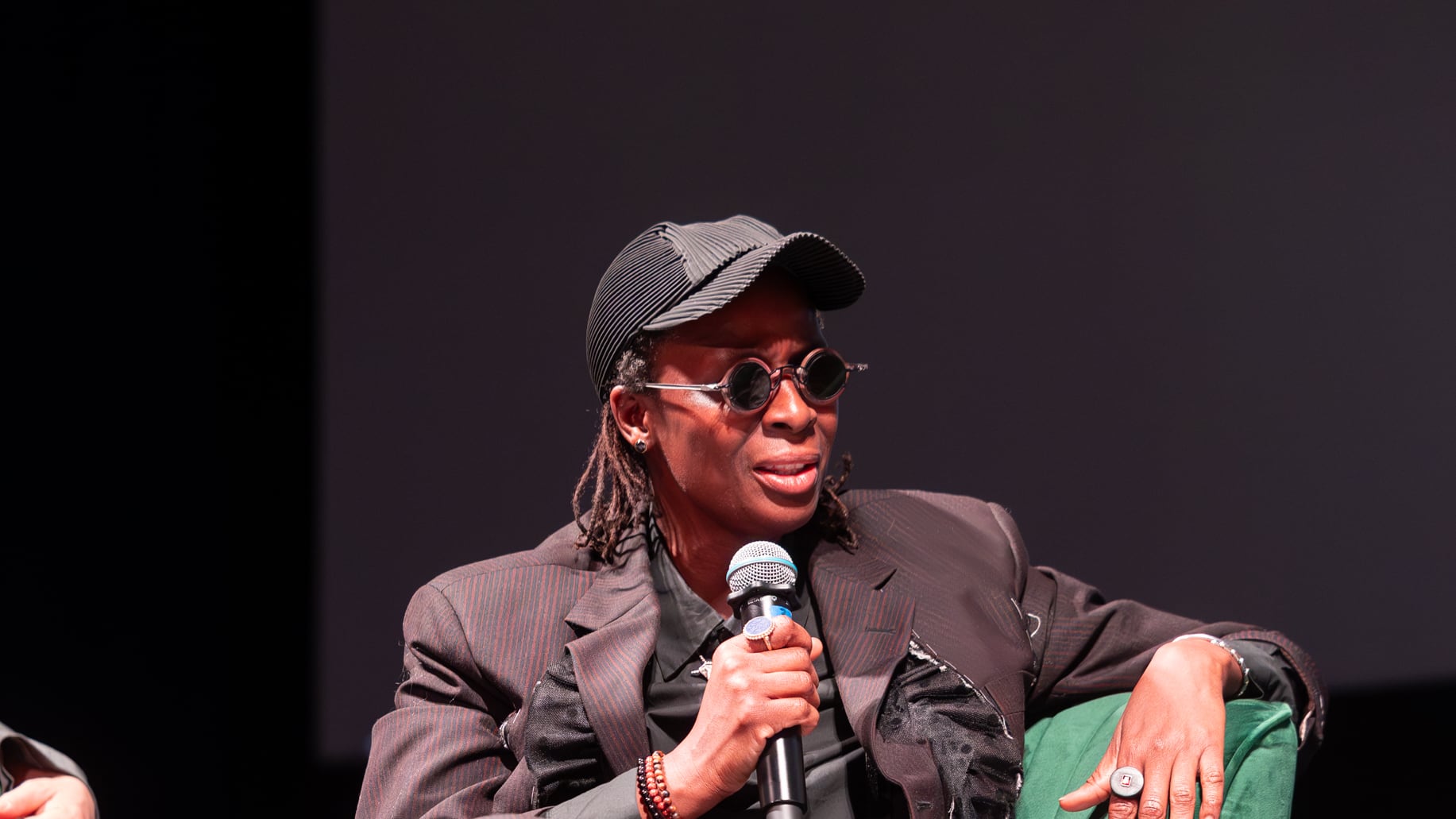
Mickalene Thomas’ late mother, Sandra Bush, is the tall, beautiful woman at the center of Thomas’ reflective short film Happy Birthday to a Beautiful Woman, which was released in September 2012, two months before Bush’s death that November. It screened Saturday, Jan. 10, at Portland Art Museum Center for an Untold Tomorrow’s Tomorrow Theater for a one-night-only Carte Blanche event.
PAM CUT’s Carte Blanche series famously attracts big names across cinema—from legendary directors like Francis Ford Coppola and Guillermo del Toro to rising comedians like Robby Hoffman and Julio Torres—and lets them put on any kind of program they want. Thomas chose to speak with Pink Martini bandleader Thomas Lauderdale, who scored the film, and Tanya Selvaratnam, the film’s producer.
Happy Birthday to a Beautiful Woman is a moving portrait that functions as both a love letter from daughter to mother and from artist to muse. Bush was Thomas’ model for many of her most acclaimed photo, collage and visual artworks. And as Thomas’ star rose in the contemporary art world, the image of her mother made Bush something of a recognizable face herself. The film unfurls how Bush’s aspirations as a model informed Thomas’ portraits of her—often in repose, with a sensual suggestion of vulnerability and comfort that makes the work so deeply moving.
The film plays out in lingering, tight close-ups of Bush’s face with archival footage, and images from Bush’s and Thomas’ upbringings, punctuated by Lauderdale’s pitch-perfect score. The stories rustle the surface of Bush’s life without clouding the atmosphere in dust, with Thomas behind the camera asking probing questions and Bush answering unflinchingly. The ease and beauty of their relationship emanates from the screen as clearly and resonantly as Thomas’ reverence for her mother emanates from her canvases.
Amy Dotson, PAM CUT’s director of film and new media, moderated a post-film conversation between the three creative luminaries that stayed in the orbit of interpersonal connections and the importance of creative commiseration, while a slide show of Thomas’ renowned portraits of Bush looped on the big screen behind them.
Selvaratnam and Thomas relayed the story of how in the late 2000s and early 2010s, Selvaratnam had sent a newsletter to her friends, family and contemporaries announcing a recent cancer diagnosis and her resulting hiatus. Thomas was struck by the vulnerability of Selvaratnam’s message and reached out to the producer and fellow Portland-rooted creative with the concept for Happy Birthday to a Beautiful Woman, feeling there was no one better in her orbit with which to discuss the material. Despite her health, Selvaratnam enthusiastically joined Thomas’ project.
“Her battle,” Thomas said of working with Selvaratnam, “encouraged me to go deeper. She told me to write 150 questions, and we ended up with over 40 hours of footage—for a 20-minute film.”
“It was so much heavier than the final edit,” Thomas continued. “So much gets edited out, respectfully. You have to be responsible sometimes. It’s not worth it to hurt through art. Art heals and inspires.”
The interplay between Lauderdale and Thomas had such a tone of intimate friendship that at times their onstage banter—reminiscing about their pre-fame young adulthood in Portland—transcended the stage. It occasionally felt as though we were simply spying on old friends catching up. Thomas praised Lauderdale’s contribution to the film: “How Thomas scored this film moved the narrative. It moved the vibe.”
Lauderdale responded by revealing a tiny, thoughtfully framed, postcard-sized pastel portrait Thomas made for him in their youth, when she had only just begun exploring her creative talents. “This still hangs in my house!” he said, laughing.
Heavier moments of introspection regarding Thomas’ pivot to film revealed an artist so consumed by the compulsion for storytelling as to not be bound to any single medium. Just as the visual portraits of her mother that line the walls of some of the most respected institutions of art, learning, and performance offer a singular lens into Black femininity, sensuality, and love, her video portrait peels back the layers of her mother’s womanhood to examine the framework of a life fully lived—dreams realized, hearts broken and self-discovered.
Thomas’ mother had been a runway model, but a twist of fate saw Iman swoop in on what could have been her breakout gig, effectively preempting her star turn. The story became a piece of Bush’s defining lore. As her illness intensified and Thomas ceased painting her, Bush wondered aloud to her daughter if she was no longer beautiful, since she was no longer her daughter’s primary subject. The conversation represented another thread in Thomas’ inspiration to create the film portrait: a new medium not only to capture her muse, but to give that muse the platform to tell her own story, comforted within the safety of Thomas’ lens.
When asked how she wanted to be remembered, Bush admitted, without a trace of reverie, that she wanted to be remembered as a “tall, beautiful woman.” Thomas has ensured we remember her as such.