Skip to main content
The 1988 killing of Mulugeta Seraw—an Ethiopian immigrant who moved to Portland to escape the country’s civil war and to attend college—shocked Portlanders. In the decades since, the murder has inspired a number of media retrospectives and at least three books: Morris Dees’ Hate on Trial, Elinor Langer’s A Hundred Little Hitlers and the multiauthored It Did Happen Here: An Antifascist People’s History, which came out of the KBOO podcast of the same name. (WW most recently examined the case in a 2018 cover package on the 30th anniversary of Seraw’s death.)
But the story still feels undertold.
Dan Evans, who co-produced Remember Mulugeta: Confronting Hate in Portland—a new one-hour OPB documentary that premiered on Oregon Experience in mid-February—says he remembered hearing about the story growing up in the Tri-Cities in the ’80s, but later moved to Portland and discovered a lot of his friends weren’t aware of the story. Co-producer Nora Colie, who grew up in Portland and was 17 at the time of the killing, had the same experience.
“You’d bring up his name, and I have so many friends that have moved here since [the 1980s], and they’re like, ‘Who?’” Colie says.
Seraw’s Nov. 13, 1988, death at Southeast 31st Avenue and Pine Street at the hands of three men associated with the skinhead gang East Side White Pride interweaves many stories. There are the stories of Seraw and his family and community, including his young son, the uncle who sought justice on his behalf, and the friends he spent the last day of his life with at a going-away party. There are the stories of the skinheads who ganged up on him and two friends outside his apartment. There are the stories of the white supremacists outside Portland who, lawyers eventually argued, incited East Side White Pride to attack Seraw and his friends. And then there are the stories of the community members who observed the event and rose up in the aftermath of the killing.
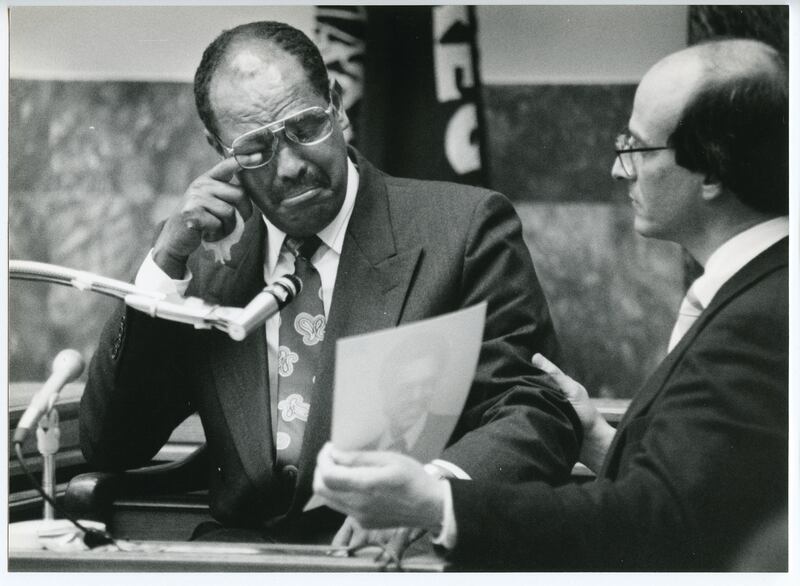
Remember Mulugeta pulls together several of these threads: It begins and ends with scenes of a 2024 visit by Seraw’s uncle, Engedaw Berhanu, to Portland, and includes interview footage of Berhanu explaining that in Ethiopian culture, it’s not just appropriate but necessary to seek vengeance after a family member is killed. (That’s why he decided to sue Tom Metzger, leader of the white nationalist group White Aryan Resistance, in 1989. The suit resulted in a $12.5 million judgment, the highest ever awarded in Oregon at the time.) Langer is interviewed, as is Jim Redden, who not only covered Seraw’s death for WW in 1988 but wrote a lengthy feature story earlier that year exposing Portland’s neo-Nazi underground. The film includes footage of the civil trial as well as interviews with Elden Rosenthal, one of the attorneys who represented Berhanu in the lawsuit.
Also featured on camera is Terry Currier, the longtime owner of Music Millennium. It feels like a surprising choice at first, but then it clicks into place that Currier has been a close observer of Portland’s music scene for decades, and it was in the music scene that most Portlanders started seeing skinheads.
In fact, the documentary notes, the skinhead aesthetic grew out of the racially integrated ska and reggae scenes of 1960s England. One interview subject, affiliated with Skinheads Against Racial Prejudice, says he still refuses to call Seraw’s killers and their ilk “skinheads” because they took that term from a scene created largely by Jamaican immigrants. “Nothing about ’em was skinheads. They were basically, like, heavy metal dudes that shaved their heads,” says the man, identified in the film as Tom.
“It was weird, because they were people that we all knew…one day you were all friends, and the next day you were like, what is happening?” says another subject, named Jason.
As sources in the film describe it, racist skinheads started showing up at punk shows—notably at the Pine Street Theatre—and picking fights. An activist identified in the film as China describes being harassed repeatedly by skinheads and called the N-word as a teenager in the Portland punk scene. One night, she says, they chased her out of the Pine Street and to her car. She was unhurt, but Seraw was killed a week later.
After that, anti-racist punks started organizing, forming groups like Skinheads Against Racial Prejudice, Anti-Racist Action, and the Coalition for Human Dignity. They asked club owners to start throwing skinheads out. They outed skinheads to their bosses and got them fired. And they fought, physically—dropping everything to deal blows if they got a call that someone in the scene was in danger.
“The level of violence that was happening was something that they had to meet it in some way,” Evans says. “It couldn’t just be violence meeting violence; they had to come up with tactics in order to stand up to the white supremacists.”
Still, some of the film’s subjects express unease and anxiety about both the lawsuit and the less formal tactics.
“It changed my life,” says Eric Ward, who remains an active anti-racist activist and speaker, of his involvement with the Coalition for Human Dignity, which mostly encompassed research. His somber tone does not suggest the change made his life easier, though; he adds, “I don’t sit with my back to the door.”
Redden tells the filmmakers he suspected one of the plaintiff’s witnesses in the Southern Poverty Law Center-led suit—Dave Mazzella, whose testimony was key to linking White Aryan Resistance to ESWP—lied on the stand. Langer, who has long been a vocal critic of the SPLC case against Metzger, reiterates her perspective in Remember Mulugeta, saying, “I don’t think stopping Metzger stopped anything.” Later, she unpacks that, describing the activist landscape of the 2020s: “It wasn’t stopped. It grew. And it is growing.”
Jason, one of the antiracist activists featured prominently in the film, strikes a similar, but slightly more hopeful note.
“I still don’t think that there’s a winning to this,” Jason tells the camera. “It’s ongoing.”
SEE IT: Remember Mulugeta: Confronting Hate in Portland streams at watch.opb.org.